Home Blog Page 73

Oil Prices Extend Losses As U.S.-Iran Talks Ease Supply Concerns

0

Oil prices fell for a third consecutive session on Thursday, dropping nearly 2% after talks between the United States and Iran in Qatar eased fears of supply disruptions through the strategically important Strait of Hormuz.

Brent crude futures fell $1.24, or 1.73%, to $70.33 per barrel by 1157 GMT, while U.S. West Texas Intermediate (WTI) crude declined $1.38, or 2.01%, to $67.20 per barrel. Both benchmarks slipped to their lowest levels since late February.

The decline followed the conclusion of U.S.-Iran negotiations in Doha, where discussions centred on maintaining stability in the Strait of Hormuz after the memorandum that ended last month’s conflict.

According to Qatar’s Foreign Ministry, the talks made “positive progress” on issues related to the June agreement, although officials acknowledged that no breakthrough had been reached toward a lasting peace settlement. The ministry also confirmed that another round of negotiations is expected after the July 9 funeral ceremonies for Iran’s late Supreme Leader, Ayatollah Ali Khamenei.

The easing geopolitical tensions have reassured traders that oil exports from the Middle East will continue without major disruptions. Shipping data showed that at least five supertankers carrying around 10 million barrels of Saudi crude have successfully passed through the Strait of Hormuz after loading at Ras Tanura. Saudi Aramco has also shifted to spot pricing to accelerate crude sales to Asian buyers.

Market analysts say improving supply conditions, combined with weak demand from China, continue to weigh on prices.

Bjarne Schieldrop, Chief Commodities Analyst at SEB, noted that oil continues to flow freely through the Strait of Hormuz while additional supplies are being released from strategic reserves. He added that China’s crude demand has yet to recover strongly, creating downward pressure on prices, although he believes the market could rebound after the current sell-off stabilises.

Despite Thursday’s decline, U.S. government data highlighted signs of strong domestic fuel demand. The Energy Information Administration reported that U.S. crude inventories fell to their lowest level since 2018 last week as refinery activity increased. Gasoline stockpiles also declined, pointing to stronger seasonal consumption.

Several financial institutions have adjusted their oil price outlooks in response to improving supply conditions.

UBS lowered its Brent crude forecast for the third quarter by $25 per barrel to $80, while maintaining an $80 forecast for the fourth quarter of 2026 after trimming its previous estimate by $10. The bank also reduced its 2027 Brent forecast by $10 to $75 per barrel, citing increased oil shipments through the Strait of Hormuz.

HSBC, however, expects the market to tighten later this year. The bank said additional Middle East production is likely to be absorbed through gradual inventory rebuilding, while the planned end of the International Energy Agency’s strategic oil stock releases in July could provide support for prices. Analysts believe Brent crude could recover toward $80 per barrel or higher once the current oversupply eases.

In another major development for the global energy sector, Nigeria became the first member of the Organization of the Petroleum Exporting Countries (OPEC) to join the International Energy Agency (IEA) as an associate member, strengthening cooperation between the world’s leading energy watchdog and Africa’s largest oil producer.

Meanwhile, geopolitical tensions remained elevated in Eastern Europe. Ukraine’s military said its forces carried out a strike on the Lukoil-Nizhegorodnefteorgsintez oil refinery in Russia’s Nizhny Novgorod region, targeting another piece of Russia’s energy infrastructure despite the recent decline in tensions in the Middle East.

U.S. Commits $1.3 Billion To Tanzania’s Health Sector Under New Five-Year Partnership

0

The United States has signed a five-year health partnership with Tanzania that will see more than $1.3 billion invested in the country’s healthcare sector, marking the latest agreement under Washington’s efforts to reshape its global health assistance strategy.

The memorandum of understanding, signed on Wednesday, forms part of U.S. President Donald Trump’s “America First Global Health Strategy,” an initiative aimed at helping developing nations build more self-sustaining healthcare systems as the United States scales back traditional foreign aid programmes.

Under the agreement, the United States will invest more than $1.3 billion in Tanzania’s health sector over the next five years, while the Tanzanian government has pledged to contribute $1.8 billion during the same period, according to the U.S. Embassy in Tanzania.

In a statement, the embassy said the joint investment demonstrates both countries’ commitment to strengthening healthcare systems, preventing the spread of infectious diseases, and improving Tanzania’s ability to finance and manage essential health services independently over the long term.

The deal follows similar agreements the United States has signed with several African countries, including Rwanda, Kenya and Uganda, as Washington shifts its approach from direct aid to long-term partnerships focused on local capacity building.

However, comparable agreements elsewhere on the continent have generated debate over provisions reportedly linked to access to strategic minerals, health data and biological samples.

In Zambia, authorities rejected proposals that would tie a health partnership to U.S. access to the country’s mineral resources. In Kenya, a court suspended part of a similar agreement in December while it considers a lawsuit filed by a consumer rights organisation over concerns about data privacy.

Tanzanian officials sought to address similar concerns during the signing ceremony, insisting the new agreement does not require the country to share biological or laboratory specimens with the United States.

Health Minister Mohamed Mchengerwa said Tanzania had not signed any specimen-sharing arrangement, adding that all laboratory samples—including those collected during disease outbreaks, epidemics or potential pandemics—would remain within the country.

He said Tanzania would continue to test, store and manage all such specimens under its own national systems, reaffirming the government’s commitment to maintaining full control over the country’s health data and biological materials.

The agreement represents one of the largest health investment commitments announced between the United States and Tanzania in recent years and underscores growing cooperation between the two countries in strengthening healthcare delivery and disease preparedness.

Morocco Advances As The Only African Team As Round Of 16 Race Continues

0

Africa’s hopes of a deep run at the 2026 FIFA World Cup now rest on Morocco, the only African nation to have officially secured a place in the Round of 16 as of Thursday, July 2, while five other teams are still battling for qualification in the newly expanded knockout format.

The 2026 tournament introduced a Round of 32 following the expansion from 32 to 48 teams, allowing a record nine African nations to progress from the group stage. However, the first wave of knockout matches has proved unforgiving, with several of the continent’s representatives falling agonisingly short.

Morocco became Africa’s first and, so far, only confirmed Round of 16 qualifier after edging the Netherlands in a dramatic penalty shootout. The Atlas Lions recovered from a late deficit before prevailing 3-2 on penalties to book a meeting with co-hosts Canada on July 4 in Houston.

Elsewhere, Africa has endured a series of painful exits.

South Africa’s historic campaign ended in heartbreak after conceding in stoppage time during a 1-0 defeat to Canada.

Côte d’Ivoire also bowed out despite a spirited performance, losing 2-1 to Norway after Erling Haaland’s decisive goal sent the Europeans into the last 16.

DR Congo’s dream run came to an end against England. The Central Africans took the lead but were undone by two late Harry Kane goals in a 2-1 defeat.

Senegal suffered perhaps the cruellest exit of all. The Lions of Teranga were leading Belgium 2-0 with just minutes remaining before the Red Devils mounted a stunning comeback, equalising in regulation time and sealing a dramatic 3-2 extra-time victory through a Youri Tielemans penalty after a VAR review.

With those eliminations confirmed, five African nations remain in contention for the remaining Round of 16 places:

  • Algeria vs Switzerland — July 2
  • Egypt vs Australia — July 3
  • Cabo Verde vs Argentina — July 3
  • Ghana vs Colombia — July 3

Victory in those matches would see the respective winners join Morocco in the last 16.

As things stand, Morocco is the only African team guaranteed to feature in the Round of 16. The final number of African representatives will not be known until the remaining Round of 32 fixtures conclude on Friday.

The continent has already made history by sending a record number of teams into the knockout stage, but whether Africa can match or surpass Morocco’s memorable semi-final run at the 2022 World Cup will depend on the outcome of the remaining Round of 32 ties over the next 24 hours.

Russian Missile And Drone Attack On Kyiv Kills 13

0

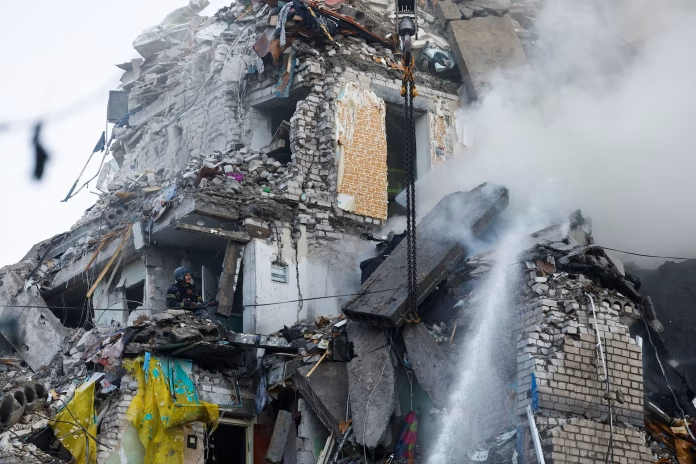
At least 13 people have been killed after Russia launched one of its largest missile and drone attacks on Ukraine’s capital, Kyiv, overnight, Ukrainian officials have said.

The large-scale assault forced evacuations across several neighbourhoods as explosions struck residential buildings and other parts of the city, just hours after Ukrainian President Volodymyr Zelensky warned that Russia was preparing a “massive” attack.

According to Tymur Tkachenko, head of Kyiv’s military administration, children were among the “significant number” of casualties recorded during the overnight bombardment.

“The enemy is once again deliberately targeting residential areas and killing civilians,” he said.

Russia’s Ministry of Defence, however, claimed the strikes were aimed at energy facilities in retaliation for recent Ukrainian attacks on Russian infrastructure.

Ukraine’s Air Force reported that Russia launched 74 missiles and 496 drones, with Kyiv identified as the primary target.

Although Ukrainian air defence systems intercepted the majority of the incoming weapons, authorities said 25 ballistic missiles and 12 drones still managed to strike 33 locations across the country.

BBC correspondents in Kyiv reported hearing repeated explosions throughout the night. By about 3:30 a.m. local time, at least ten major strikes had been recorded, with a large fire breaking out in the city centre alongside multiple blazes in surrounding districts.

Air defence systems illuminated the night sky with tracer fire as explosions echoed across the capital.

By daylight, the extent of the destruction became clearer, with images showing a massive crater believed to have been caused by one of the explosions.

Burnt-out vehicles, damaged buildings and destroyed infrastructure were visible around several impact sites.

Authorities also confirmed that multiple fires erupted across Kyiv, including at an ambulance station where at least one person was critically injured.

Firefighters spent hours battling flames that engulfed a hotel located on one of the city’s central boulevards.

Ukraine’s State Emergency Service said more than 30 people were injured, while emergency crews had rescued 34 people from damaged buildings.

Search and rescue operations were continuing at several affected locations, including residential high-rise apartments and homes in the south-eastern part of the city.

Ukraine’s Foreign Minister Andriy Sybiha urged international partners to provide additional air defence systems, insisting that the country needed “not only words of condemnation but concrete action to stop Russian terror.”

Writing on X, he said Russia had deliberately targeted civilian infrastructure and residential buildings while also calling for tougher sanctions against Moscow.

Ukraine’s ambassador to the United States, Olha Stefanishyna, described the night as another tragedy for Kyiv residents.

“Another horrific night for the residents of the city, who were forced to spend it in shelters.”

“Fires and the destruction of civilian infrastructure and residential buildings in several districts of the city.”

The attack represents the first major wave of Russian missile and drone strikes on Ukraine in more than two weeks.

Russia’s Defence Ministry also claimed its forces struck Ukrainian military bases in central and eastern parts of the country.

According to Russian officials, the operation targeted Ukraine’s defence and energy infrastructure in response to recent attacks on power facilities across Russia, stretching from Moscow to the Black Sea.

Those attacks prompted an uncommon admission from Russian President Vladimir Putin, who acknowledged that Russia was experiencing fuel shortages.

On Wednesday, President Zelensky cut short his visit to Dublin after receiving intelligence suggesting Moscow was preparing another large-scale assault.

“I urge our people to be especially careful, to protect themselves, their children, and, of course, their families,” he said.

He added that President Putin “has been preparing this massive strike against Ukraine for some time now”.

Meanwhile, Russian forces have recently advanced into Kostyantynivka, one of Ukraine’s last major defensive positions in the eastern region. Military analysts say capturing the city could open the way for Russia to gain broader control of the Donbas region.

Despite those advances, Ukrainian military commanders maintain that their forces have regained more territory this year than they have lost, disrupting key Russian supply routes between the Russian border and occupied Crimea.

The wider frontline has remained largely static for months, with both Russian and Ukrainian forces holding entrenched positions.

Russia currently controls roughly one-fifth of Ukraine’s territory, much of which was seized during the early stages of its full-scale invasion launched in February 2022.

DSS Arraigns Five Over Alleged Concealment Of Former Minister Timipre Sylva

0

The Department of State Services (DSS) on Wednesday arraigned five associates of former Minister of State for Petroleum, Timipre Sylva, before the Federal High Court in Abuja over allegations that they concealed his whereabouts after he was declared wanted by the Federal Government.

The defendants — Reuben Ayuba, Musa Mohammed, Friday Paul, Paganengigha Anagaha and Ayebaifie Suobite— were brought before Justice Peter Lifu on a two-count charge bordering on allegedly hiding the whereabouts of Sylva, whom the prosecution described as a fugitive.

According to the DSS, the five defendants became accessories after the fact by allegedly concealing Sylva’s whereabouts on April 28, 2026, an offence said to be contrary to Section 519 of the Criminal Code Act, Laws of the Federation of Nigeria, 2004.

The prosecution further alleged that the defendants conspired to commit a felony by assisting in concealing the former Bayelsa State governor’s whereabouts, contrary to Section 516 of the Criminal Code.

When the charges were read in court, all five defendants pleaded not guilty.

Following the plea, counsel to the DSS, Emmanuel Orubor, urged the court to fix a date for trial, while lawyers representing the defendants applied for bail.

Senior Advocate of Nigeria Sanusi Musa represented the first and fourth defendants, while Ibrahim Imadegbelo, I.G. Kelubia and E.C. Sogo appeared for the remaining accused persons.

The defence team informed the court that the defendants had remained in DSS custody since October 25, 2025, and appealed for their release on liberal bail conditions.

In his ruling, Justice Peter Lifu admitted each defendant to bail in the sum of ₦5 million, with two sureties in like sum.

The court directed that each surety must provide an affidavit of means, evidence of three years’ tax clearance, proof of a verifiable source of livelihood, and recent passport photographs. The court registrar was also ordered to verify the identities of the sureties.

Pending the fulfilment of the bail conditions, the defendants were remanded at the Kuje Correctional Centre.

Justice Lifu subsequently adjourned the matter until July 22 for the commencement of trial.

According to court documents, the defendants deliberately concealed Sylva’s whereabouts after the Federal Government declared him wanted.

The government had earlier accused the former minister and six others of involvement in an alleged coup plot against President Bola Tinubu. Following the allegations, separate charges were also filed against Sylva’s younger brother, Moses Sylva, and other associates, accusing them of obstructing efforts to arrest the former minister by concealing information about his location.

Sylva has denied all the allegations levelled against him.

Investigators alleged that the purported coup plot was planned for October 2025, leading to treason and terrorism charges against several military personnel and other suspects.

Authorities claimed the alleged conspiracy involved plans to assassinate the President, the Vice President and key leaders of the National Assembly before security agencies foiled the operation. The Defence Headquarters has since confirmed multiple arrests in connection with the case, while related trials continue before the Federal High Court.

Atiku Appoints Kenneth Okonkwo As 2027 Presidential Campaign Spokesman

0

Former Vice-President Atiku Abubakar has appointed Nollywood actor and politician Kenneth Okonkwo as the official spokesperson for his 2027 presidential campaign under the African Democratic Congress (ADC).

The appointment was confirmed in a letter shared by Okonkwo on his verified X account on Thursday, following Atiku’s emergence as the ADC’s presidential candidate for the 2027 general election.

In the appointment letter, Atiku said his decision was informed by his confidence in Okonkwo’s communication abilities, political insight, integrity and capacity to effectively project the campaign’s vision and positions to Nigerians.

The former vice-president expressed confidence that Okonkwo would play a significant role in advancing the campaign while promoting meaningful democratic engagement throughout the election period.

Responding to the appointment, Okonkwo expressed appreciation to Atiku for the confidence placed in him, describing the decision as a reflection of the former vice-president’s commitment to consultation, dialogue and inclusive leadership.

He revealed that discussions held with Atiku and other ADC leaders addressed several concerns affecting the South-East, noting that the issues were considered within the provisions of the Electoral Act 2026 and the prevailing political environment.

Okonkwo also acknowledged the efforts of former ADC National Chairman Ralph Nwosu and Atiku’s Senior Special Assistant on Special Duties, Ekene Onwuka, for their roles in the coalition-building process that culminated in his appointment.

He called on supporters and well-wishers to pray for wisdom, strength and divine protection as he undertakes what he described as a significant national responsibility.

The appointment represents another major political milestone for Okonkwo, who previously served as spokesperson for Peter Obi, the Labour Party’s presidential candidate in the 2023 general election.

However, his relationship with Obi later deteriorated, with both men becoming involved in a public disagreement that eventually extended to the courts over alleged defamatory remarks.

For Atiku, the 2027 election marks another attempt to become Nigeria’s president, as the former vice-president seeks to secure the country’s highest office after several unsuccessful bids in previous election cycles.

Tinubu Launches Akwanga-Jos Highway, Unveils Key Nasarawa Roads

0

President Bola Tinubu on Wednesday officially flagged off the construction of the 125-kilometre Akwanga-Jos section of the Akwanga-Kaduna-Jos-Bauchi-Gombe-Biu-Maiduguri Superhighway while also commissioning the newly dualised Akwanga Township Road and a modern underpass constructed by the Nasarawa State Government.

The President, represented by the National Chairman of the All Progressives Congress (APC), Professor Nentawe Yilwatda, performed the inauguration during a ceremony held in Akwanga, Nasarawa State.

Among the dignitaries in attendance were the Minister of Works, Senator David Umahi; Plateau State Governor Caleb Mutfwang; Gombe State Governor Muhammadu Inuwa Yahaya; members of the National Assembly, commissioners, government officials and traditional rulers.

Speaking at the event, Nasarawa State Governor Abdullahi Sule described the dualised Akwanga Township Road as one of the landmark achievements of his administration, noting that the project was completed without obtaining any bank loan.

According to him, the project was fully financed through improved revenue accruing to the state as a result of President Tinubu’s economic reforms.

Governor Sule also disclosed that individuals and business owners whose properties were affected by the road expansion received full compensation, a move he said ensured the successful execution of the project with minimal resistance.

He further appreciated the APC National Chairman for combining the commissioning of the state projects with the flag-off of the federal highway project.

President Tinubu, in his remarks, praised Governor Sule for delivering critical infrastructure beyond the state capital, describing the projects as evidence of purposeful leadership and responsible governance.

He noted that the road projects demonstrated strong collaboration between the Federal Government and the Nasarawa State Government and would significantly improve transportation links between Abuja and Akwanga, as well as Makurdi and Akwanga, through the newly constructed interchange.

The President also commended Governor Sule for recognising the positive impact of the Federal Government’s economic reforms on state finances.

Tinubu directed the Minister of Works and state governors to collaborate with the Surveyor General of the Federation in preparing setback plans to accommodate future road expansion. He also urged contractors handling the projects to prioritise the employment and training of local youths.

Minister of Works David Umahi said the Renewed Hope Legacy Road Projects were designed to improve connectivity across the country, stimulate economic activities and strengthen national unity.

He explained that the Akwanga-Jos highway represents Section One, Phase One of the larger Akwanga-Maiduguri Superhighway under President Tinubu’s Renewed Hope Agenda.

According to Umahi, the 125-kilometre stretch cuts across Nasarawa, Kaduna and Plateau states and forms part of the over 700-kilometre corridor linking Akwanga, Jos, Bauchi, Gombe, Biu and Maiduguri.

He revealed that construction had already commenced on the Gombe-Biu section, while the Jos-Bauchi, Bauchi-Gombe and Biu-Maiduguri sections were currently undergoing design processes ahead of procurement and contract awards.

The minister also gave updates on other legacy road projects nationwide, stating that Section One of the Lagos-Calabar Coastal Highway in Lagos had been substantially completed, while work continued on sections in Enugu, Cross River and Akwa Ibom states.

He added that construction was progressing on various sections of the Sokoto-Badagry Superhighway in Sokoto, Kebbi and Oyo states, while work was equally ongoing on the Trans-Saharan route connecting Calabar, Ebonyi, Benue, Kogi and the Federal Capital Territory.

Umahi further disclosed that North Central Nigeria currently hosts the highest number of federal road projects in the country, with 35 major projects, including five that have already been completed.

He also announced that President Tinubu had approved the immediate release of ₦111 billion for the construction of Section One of the Akwanga-Jos road, describing the funding as a significant boost to the administration’s infrastructure development programme.

Also speaking, APC governorship aspirant in Nasarawa State for the 2027 election, Senator Ahmed Aliyu Wadada, described Umahi as an exceptional performer and commended Governor Sule for his prudent and transparent management of public resources.

He appealed to Nigerians to support President Tinubu with another term in office to enable him consolidate on the achievements recorded by his administration.

Minister of Information and National Orientation Mohammed Idris also maintained that the Tinubu administration’s accomplishments over the last three years—including investments in road infrastructure, the establishment of the National Education Loan Fund and Nigeria’s removal from the Financial Action Task Force grey list—demonstrate that the President deserves a second term to continue his reform agenda.

Oyo Teachers Resume Work As NUT Suspends Strike After Government’s Security Assurances

0

The Nigeria Union of Teachers (NUT) has suspended the strike action embarked upon by public school teachers across Oyo State following renewed discussions with the state government and fresh assurances on measures to improve security after the abduction of teachers and pupils in Oriire Local Government Area.

The union announced that all teachers in public primary and secondary schools across the state are to resume work on Thursday, July 2, 2026, bringing the industrial action to an end. The decision followed consultations with the union’s national leadership, which reviewed the current security situation and considered appeals from the Oyo State Government and other stakeholders.

The strike was declared after more than 40 teachers and learners were abducted in Oriire Local Government Area early last month. More than a month later, the victims remain in captivity, although the state government has continued to assure residents that efforts are ongoing to secure their safe release.

In a statement jointly signed by the Oyo State NUT Chairman, Hassan Fatai, and Secretary, Olukayode Salami, the union explained that the suspension followed commitments made by the state government to improve school security and intensify efforts to rescue the abducted victims.

According to the union, the decision was taken in the best interest of teachers, students and the wider public after the government assured it that concrete steps were being implemented to address the security concerns that led to the strike.

The Oyo State Government reportedly pledged to:

  • Intensify efforts to secure the release of the abducted teachers and learners.
  • Establish a well-equipped Joint Security Task Force to patrol vulnerable schools and access routes.
  • Maintain continuous engagement with affected families.
  • Provide psychosocial support and rehabilitation for rescued victims.
  • Pay gratuities and other entitlements to the families of deceased teachers.
  • Strengthen the Safe School Initiative through public awareness campaigns and early warning systems.
  • Improve emergency response mechanisms.
  • Dismantle criminal hideouts across affected communities.
  • Upgrade security infrastructure around schools.
  • Tackle illegal mining and open grazing activities in forest reserves.
  • Strengthen community intelligence gathering.
  • Ensure the speedy prosecution of criminal suspects.
  • Improve the welfare of security personnel.
  • Deploy technology to enhance school security.

The union praised its members, alongside the All Nigeria Confederation of Principals of Secondary Schools (ANCOPSS) and the Association of Primary School Head Teachers of Nigeria (AOPSHON), for their discipline, unity and compliance throughout the strike period.

According to the union, their collective support played a significant role in drawing attention to the security challenges confronting teachers and learners across the state.

While directing members to resume academic activities, the NUT urged teachers to remain security conscious, obey all lawful directives and promptly report suspicious movements or security threats around schools and their communities to relevant authorities.

The union also reaffirmed its commitment to protecting the welfare and safety of teachers, stressing that it would continue engaging the government until all outstanding concerns relating to the protection of teachers and students are fully addressed.

Teachers across Oyo State withdrew their services after the abduction of over 40 teachers and pupils in Oriire Local Government Area. The incident sparked protests and widespread concern over the safety of schools across the state.

Although the abducted victims have yet to regain their freedom, the state government has repeatedly assured residents that efforts are ongoing to ensure their safe return.

CBN Revokes Licences Of 46 Microfinance Banks Over Regulatory Violations (Full List)

0

The Central Bank of Nigeria (CBN) has revoked the operating licences of 46 microfinance banks across Nigeria after determining that they failed to meet key regulatory and operational requirements.

The decision, which took effect on July 1, 2026, was approved by CBN Governor Olayemi Cardoso under the provisions of the Banks and Other Financial Institutions Act (BOFIA), 2020. According to the apex bank, the action forms part of its broader efforts to strengthen the financial sector, protect depositors, and ensure that only financially sound institutions continue to operate.

Why The CBN Revoked The Licences

In a statement signed by the Acting Director of Corporate Communications, Hakama Sidi-Ali, the CBN explained that the affected institutions failed to satisfy one or more regulatory conditions required for continued operation.

The bank stated:

“The Central Bank of Nigeria (CBN) has revoked the operating licences of forty-six (46) Microfinance Banks with effect from July 1, 2026, in accordance with its powers under Sections 12 and 13 of the Banks and Other Financial Institutions Act (BOFIA), 2020.”

According to the regulator, the revocation became necessary because some of the banks were found to have:

  • Insufficient assets to meet their financial obligations.
  • Closed operations without obtaining approval from the CBN.
  • Become inactive and stopped carrying out financial intermediation.
  • Failed to commence operations within 12 months after receiving their licences.
  • Failed to maintain the minimum capital requirements without impairment from accumulated losses.

CBN Reaffirms Commitment To Financial Stability

The apex bank said the move is part of its ongoing supervisory responsibility to maintain confidence in Nigeria’s banking sector and ensure compliance with regulatory standards.

The CBN stated:

“The Central Bank of Nigeria remains committed to promoting a safe, sound, and resilient financial system and will continue to take appropriate supervisory and regulatory actions, where necessary, to maintain public confidence in the Nigerian financial system.”

The regulator noted that ensuring only financially viable institutions remain in operation is critical to safeguarding depositors’ funds and strengthening the country’s financial ecosystem.

Full List Of Microfinance Banks Whose Licences Were Revoked

S/NMicrofinance BankCategoryState
1Minji-Se Churchill MFBTier 1Rivers
2Merchant MFBTier 2Abia
3Janmaa MFBTier 1Kwara
4Busu MFBTier 2Niger
5Gold MFBTier 1Lagos
6Zain MFB (formerly Dawakin Tofa MFB)Tier 2Kano
7Bompai MFBTier 1Kano
8Ajwa MFB (formerly Gezawa MFB)Tier 2Kano
9NOW NOW DIGITAL MFBTier 2Kano
10Crystabel Microfinance BankTier 1Bayelsa
11Chanelle MFBStateLagos
12Abia SME MFBTier 1Abia
13Kamba MFBTier 2Kebbi
14Iwade MFBTier 2Ogun
15Winview MFBTier 1Abuja
16Zuru MFBTier 2Kebbi
17Minjibir MFBTier 1Kano
18Shanono MFBTier 2Kano
19Sumaila MFBTier 2Kano
20Rimin Gado MFBTier 2Kano
21Mwaghavul MFBStatePlateau
22Sycamore MFBTier 2Kano
23TOFA MFBTier 2Kano
24Safegate MFBTier 1Lagos
25Creekline MFBTier 2Delta
26Bestar MFBTier 1Oyo
27Livingspring MFBTier 1Cross River
28Apple MFBTier 2Ogun
29Stanford MFBStateAkwa Ibom
30Frontline MFBTier 2Anambra
31Zafec MFBTier 2Kaduna
32Supreme MFBTier 1Lagos
33Bejin-Doko MFBTier 2Niger
34Kanopoly MFBTier 1Kano
35Bellbank MFB (formerly Tsanyawa MFB)Tier 2Kano
36Yeneng MFBTier 2Plateau
37Creditville MFBTier 1Lagos
38MBAG MFBTier 1Lagos
39Straight Sahara MFBTier 1Benue
40OurPass MFBTier 2Ondo
41Verdant MFBTier 1Lagos
42Basawa MFBTier 2Kaduna
43Casha MFBTier 2Abuja
44Esteem MFBTier 2Kano
45Enterpreneur MFBTier 1Lagos
46Avantus MFBTier 2Osun

What This Means

The latest action highlights the CBN’s intensified oversight of the microfinance banking sector as it seeks to improve financial stability and enforce stricter compliance with regulatory standards.

Customers of the affected institutions are expected to follow further directives from the CBN and relevant authorities regarding the resolution process and the protection of depositors’ interests.

Court Reserves Judgment In INEC 2027 Election Timetable Case

0

The Court of Appeal in Abuja has reserved judgment in two appeals challenging the legality of the Independent National Electoral Commission (INEC)’s timetable for the 2027 general elections.

A three-member panel of justices, led by Justice Adebukola Bankole, announced after hearing arguments that the date for delivering judgment would be communicated to all parties involved.

The appeals stem from separate lawsuits filed by the Youth Party of Nigeria (YPN) and the Social Democratic Party (SDP), both of which questioned the validity of INEC’s election timetable.

The YPN secured a favourable ruling from Justice Mohammed Umar of the Federal High Court in Abuja, who nullified the election timetable issued by INEC. In a separate judgment, Justice James Omotosho partly ruled in favour of the SDP while also granting some reliefs in favour of INEC.

Dissatisfied with both judgments, INEC approached the Court of Appeal, seeking to overturn Justice Umar’s ruling entirely and set aside the aspect of Justice Omotosho’s judgment that restricted the commission’s authority over election scheduling.

During the hearing, INEC’s legal team, led by Senior Advocate of Nigeria (SAN) Dr. Alex Izinyon alongside two other SANs, argued that the commission acted within the powers granted to it by the Constitution and the Electoral Act.

Izinyon maintained that the commission has the constitutional responsibility to organise, supervise and conduct elections, including issuing guidelines and timelines for the electoral process.

“The constitution, specifically, empowered INEC to organise, supervise and undertake elections and other political activities as provided and that the timetable provided is in consonance with the power donated by the 1999 Constitution and the enabling act for INEC to do what it did in issuing elections timetables.

“The trial court erred in law because it failed to interpret, using the Supreme Court authorities and Court of Appeal decisions on the power already donated by the 1999 Constitution to INEC to arrange for elections including pre-election matters.

“Supreme Court and Court of Appeal have held that INEC has the power to organise and supervise elections and this include timetable for elections to carry out political activities preceding the elections.

“The trial court failed to give effect to the phrase ‘not later than 120 days and not more than 90 days’, which was a subject of contention at the trial court.

“And that not less than 120 days means it should not be more than but it can be less than but for the court to say that it must be exactly 120 days, was too mathematical and not the intendment of the lawmakers as any of the activities can be done before the 120 days and not more than.

“For the trial court to say it must be exactly 120 days is a mechanical application of the statute which is contrary to the decisions of the apex court and the Court of Appeal.”

He further argued that the same interpretation should apply to the constitutional provision relating to the 90-day timeline.

Izinyon also submitted that the reliefs granted by the lower courts were declaratory in nature and should not have been awarded because the respondents failed to provide sufficient evidence that they had suffered any injury or had even commenced activities affected by the timetable.

“There was no evidence by way of affidavit to show that they have commenced any primary or taken steps or that they have suffered any injury.

“Therefore the court ought not to have granted any relief,” the senior lawyer said.

Speaking on the second appeal involving the SDP, Izinyon explained that while Justice Omotosho granted reliefs to both the political party and INEC, the commission was appealing the aspect of the judgment directing it to adjust the election timetable.

“INEC appealed part of the judgement in that case which limits their powers by saying that the days were short by a few number of days that INEC should go back and rectify this,” he added.

Before the substantive appeals were argued, Izinyon also presented three preliminary applications before the appellate court.

One of the applications urged the court to bar the Youth Party of Nigeria from responding to the appeal on the grounds that it failed to file its respondent’s brief within the time allowed after receiving INEC’s appeal documents.

According to him, Paragraph 13 of the Court of Appeal Practice Direction on pre-election matters does not permit an extension of time for filing such briefs.

When questioned by the panel, counsel to the YPN, Akinwale Irokosun, admitted that no response had been filed to the application.

The appellate court reserved its ruling on the preliminary application to be delivered alongside the final judgment in the appeal.

Izinyon also opposed a separate application by Irokosun seeking additional time to file the respondent’s brief, arguing that the rules governing pre-election appeals leave no room for such an extension after the prescribed deadline has expired.

He cited several Supreme Court and Court of Appeal decisions to support his position, insisting that the court lacked discretion to grant the request.

With arguments concluded, the Court of Appeal reserved judgment in both appeals, with the date for the ruling to be communicated to all parties.