
Home Blog Page 8

Arsenal Delivers Signature Win Over Bayern

0

Arsenal produced one of their most assured European performances in recent years, overpowering Bayern Munich to claim a crucial 3–1 win. Jurrien Timber opened the scoring midway through the first half, rising above the defence to nod home from a corner.

Bayern responded before the break through 17-year-old Lennart Karl, whose composed volley briefly silenced the home crowd. But Arsenal dominated the second half, with Noni Madueke restoring the lead in the 69th minute before Gabriel Martinelli punished a defensive lapse eight minutes later to seal the victory.

The win places Arsenal firmly at the top of their group and piles pressure on Bayern, who now face a complicated path toward qualification.

Real Madrid Survives Seven-Goal Thriller in Greece

Real Madrid produced the comeback of the night, edging Olympiacos 4–3 in Piraeus. The hosts pushed Los Blancos to the limit in a breathless contest, but Madrid’s relentless attacking firepower proved decisive as they overturned deficits twice to secure a dramatic win.

Liverpool Crumble at Anfield as PSV Run Riot

Liverpool’s Champions League campaign took a heavy blow after a shocking 4–1 defeat at home to PSV Eindhoven. The Dutch side capitalised on defensive errors, racing ahead and maintaining control throughout a disappointing evening for the Reds.

Atalanta Dominate Frankfurt with Second-Half Burst

Atalanta delivered one of the most dominant displays of the round, cruising to a 3–0 win over Eintracht Frankfurt. All three goals came within a destructive five-minute spell early in the second half, leaving the hosts stunned and keeping Atalanta firmly in the qualification race.

Sporting Cruise Past Club Brugge

Sporting CP secured a comfortable 3–0 victory over Club Brugge, asserting their authority from start to finish. The Portuguese side controlled possession, created the clearer chances, and sealed a win that strengthens their foothold in the group.

Atlético Madrid Edge Inter with Late Winner

In Madrid, Atlético claimed a hard-earned 2–1 win over Inter Milan, with the decisive goal arriving late. The tight contest swung both ways, but Atlético’s persistence paid off as they secured three vital points.

PSG Outlasts Tottenham in Eight-Goal Spectacle

One of the wildest games of the night unfolded in Paris, where PSG toppled Tottenham Hotspur 5–3. Both sides displayed attacking ambition and defensive vulnerabilities, but PSG’s superior finishing ensured they claimed a memorable victory in front of a roaring Parc des Princes crowd.

Pafos Hold Monaco in Spirited Draw

Elsewhere, Pafos FC held AS Monaco to a 2–2 draw in Cyprus. The hosts battled back after trailing and showed determination to earn a valuable point as the group stage tightens.

Copenhagen Edge Kairat in Five-Goal Encounter

FC Copenhagen also featured in a lively contest, squeezing past Kairat Almaty 3–2. The Danes took their chances when it mattered most, keeping their qualification hopes alive.

A Night of Goals, Drama, and Shifting Momentum

Matchday 5 delivered everything expected of Europe’s elite competition — from Arsenal’s authoritative display against Bayern to Real Madrid’s late-game resilience and PSG’s goal-laden triumph. With the league phase nearing its conclusion, the stakes have risen sharply, and Wednesday’s results have reshaped the qualification landscape dramatically.

The final round now promises even more tension as clubs fight to secure their place in the next stage of the Champions League.

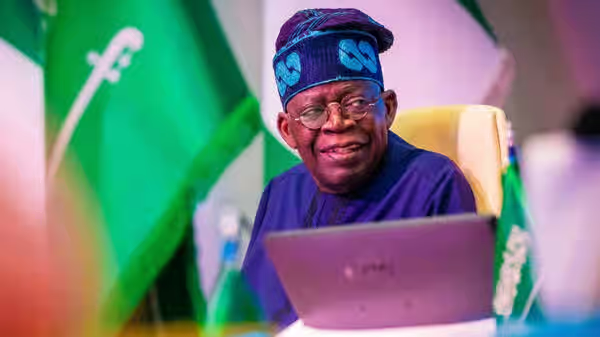
Tinubu Submits First Set Of Ambassadorial Nominees To The Senate

0

President Bola Tinubu has submitted a list of three ambassadorial nominees to the Senate for confirmation. The announcement was made by Senate President Godswill Akpabio during Wednesday’s plenary session, which was streamed on the NASS YouTube channel.

The nominees include Kayode Are from Ogun State, Aminu Dalhatu from Jigawa State, and Ayodele Oke. While reading Tinubu’s letter titled “Request for confirmation of appointments of non-career ambassador designates,” Akpabio quoted the President as saying, “In accordance with the provisions of Section 171 subsections 1 and 2, c and 4 of the Constitution of the Federal Republic of Nigeria, 1999, as amended, I am pleased to present for confirmation by the Senate the underlisted three nominees as non-career ambassador designates.”

After reading the letter, Akpabio added, “The list contains three names for now. I am sure others will follow.” He then directed the Senate Committee on Foreign Affairs to deliver its report within one week.

Since assuming office in 2023, Tinubu had not appointed any ambassadors, a delay that has faced widespread criticism. In September 2023, he recalled all ambassadors from Nigeria’s 109 foreign missions including 76 embassies, 22 high commissions, and 11 consulates as part of a “comprehensive diplomatic review.”

In the absence of confirmed envoys, many missions have been overseen by chargés d’affaires or senior consular officers with limited authority to conduct formal diplomatic negotiations.

On November 19, the President had received a new list of ambassador-designates and was considering when to forward it to the Senate. Senior officials close to the process confirmed that security and background checks had been completed, explaining that the list was “ready” and awaiting only the President’s final approval.

The prolonged diplomatic vacuum previously fueled tensions, including Nigeria’s designation as a Country of Particular Concern by former U.S. President Donald Trump, who cited alleged attacks on Christians and even threatened military intervention.

Tinubu has acknowledged the difficulty of managing political, regional, and professional considerations in making these appointments. Speaking to members of The Buhari Organisation on September 2, 2025, he said, “It’s not easy stitching those names.”

He added, “I couldn’t appoint everybody at once, and thank you for your patience. I still have some slots for ambassadorial positions that so many people are craving for.”

Relief Across Nigeria As 24 Kebbi Schoolgirls Regain Their Freedom

0

In a moment of national relief, all 24 schoolgirls abducted from a boarding school in Kebbi State last week have been safely released, President Bola Tinubu announced on Tuesday.

The students, kidnapped amid rising bandit attacks in the region, returned home unharmed. Yet uncertainty persists over what truly led to their freedom.

The abduction took place on November 17 at Government Girls Comprehensive Senior Secondary School in Maga, Danko/Wasagu Local Government Area.

Armed attackers stormed the school shortly after a military team withdrew, killing the vice principal and injuring a security guard before escaping with 25 students. One student fled during the chaos, leaving 24 in captivity for more than a week.

Government Celebrates Rescue, But Questions Linger

President Tinubu praised the release as the result of a swift and coordinated operation by security agencies, led by the Minister of State for Defence, Bello Matawalle.

Through his Special Adviser, Bayo Onanuga, the president expressed deep relief, saying, “I am relieved that all the 24 girls have been accounted for.” He ordered intensified efforts to rescue other captives across the country and promised to deploy more troops to rural communities vulnerable to attacks.

Matawalle, acting on Tinubu’s instructions, relocated to Kebbi to oversee the operation and later confirmed that a tactical team successfully secured the girls’ freedom.

The federal government also pointed to non-kinetic strategies, including coordination between the Office of the National Security Adviser and the Department of State Services, as part of the process, though specific details were withheld for operational reasons.

The situation sparked a series of similar incidents. In Eruku, Kwara State, gunmen kidnapped 38 worshippers from a church vigil on November 20; all were later freed after security pressure.

In Niger State, more than 300 pupils and teachers were taken from St. Mary’s Catholic School in Papiri, Agwara LGA, though 50 of the missing children were later found at home, indicating some may have fled during the attack rather than being captured.

As insecurity escalated, Tinubu ordered the Nigerian Air Force to begin continuous aerial surveillance over forested zones in Kebbi, Kwara, and Niger states, with ground troops receiving real-time intelligence.

Communities were urged to promptly report suspicious movements. Kebbi State Governor Nasir Idris demanded a full military investigation into why troops withdrew shortly before the attack, describing it as “clear sabotage.”

Bandit Video Sparks Public Outrage and Doubts Over Rescue Claims

Amid nationwide celebration, a disturbing propaganda video released by the kidnappers raised doubts about the official account. In the video, a gunman questions the girls about any overhead military jets which none were reported and boasts that authorities were unable to rescue them by force.

He claims their release came through negotiations with “leaders,” adding, “Your government has failed,” before permitting the girls to leave. The students said they were not mistreated, starved, or assaulted during captivity.

The footage supported local reports suggesting a negotiated release rather than a tactical rescue, intensifying public debate over the government’s approach to dealing with bandit groups. Critics argue that negotiations may empower criminal networks and encourage further abductions.

Human rights advocates and northern leaders renewed demands for better school security, warning that banditry in the North-West continues to uproot communities and weaken confidence in state protection.

Analysts note that while the girls’ safe return is a relief, the circumstances raise urgent questions about long-term solutions to insecurity.

As investigations continue, the Tinubu administration faces growing pressure to clarify what happened and to develop stronger strategies against the armed groups exploiting Nigeria’s remote regions.

Kenya To Challenge Regional Court Decision Suspending EU Trade Agreement

0

Kenya has announced plans to contest a regional court ruling that paused its trade agreement with the European Union, warning that the suspension threatens annual exports valued at $1.56 billion, Trade Minister Lee Kinyanjui said on Wednesday.

The East Africa Court of Justice, based in Tanzania, ordered the temporary halt on Monday while considering a case filed by an NGO contesting the agreement, Kinyanjui added.

The trade pact, formally called the Economic Partnership Agreement, was signed in 2023 to secure Kenyan access to the EU market while establishing a timetable for European goods entering Kenya.

Court documents show that the challenge was lodged by the Centre for Law Economics and Policy, which argues that the agreement violates certain provisions of the East African Community’s common market treaty, of which Kenya is a member.

In response, Kenya’s trade ministry has launched an appeal aimed at overturning the court’s injunction, though Kinyanjui did not provide a date for the hearing.

“The Kenya-EU EPA is the lifeline of our booming exports and a source of livelihood to a large majority of Kenyans,” Kinyanjui said in a statement.
“Kenya will continue to trade with the EU and steps are being taken to ensure continuity, predictability and protection of our existing commercial arrangements.”

Last year, Kenya exported $1.56 billion in goods to the EU while importing $2.09 billion from the bloc, the minister noted.

Amid rising global trade barriers, including higher tariffs recently imposed by the U.S., African countries are seeking to expand exports to major markets such as the EU and China.

The East African Community’s secretariat had not provided a comment at the time of reporting.

Italy Officially Makes Femicide A Crime With Life Imprisonment

0

Italy’s lawmakers on Tuesday passed new legislation that formally classifies femicide as a distinct crime within the nation’s penal code, making it punishable by life in prison.

The decision came on the same day as the International Day for the Elimination of Violence Against Women, an annual observance created by the UN General Assembly.

The bill passed comfortably in the Lower Chamber, earning cross-party backing from both the centre-right ruling bloc and the centre-left opposition, with 237 votes in support.

Promoted by Premier Giorgia Meloni’s conservative administration, the measure addresses a surge in murders and assaults targeting women across the country. It further introduces tougher penalties for related gender-based offences, including stalking and revenge porn.

Public outrage over cases such as the 2023 killing of university student Giulia Cecchettin has intensified national discussions surrounding the systemic roots of violence against women in Italy.

“We have doubled funding for anti-violence centres and shelters, promoted an emergency hotline and implemented innovative education and awareness-raising activities,” Meloni said Tuesday.

“These are concrete steps forward, but we won’t stop here. We must continue to do much more, every day.”

Although the centre-left parties endorsed the legislation, they argued that the administration’s focus remains narrowly concentrated on punishment and fails to confront the deeper economic and societal inequalities that contribute to violence.

Data from Istat, Italy’s national statistics agency, shows 106 femicides recorded in 2024, with 62 carried out by current or former partners.

Meanwhile, discussions around introducing sex and emotional-development education in schools as a preventive tool have sparked fierce debate.

A government-backed proposal seeks to prohibit such lessons for younger pupils and make them available to older students only if parents grant explicit permission.

Supporters within the ruling coalition claim the policy safeguards children from ideological influence, while critics in the opposition and activist community have denounced the idea as “medieval.”

“Italy is one of only seven countries in Europe where sex and relationship education is not yet compulsory in schools, and we are calling for it to be compulsory in all school cycles,” said the head of Italy’s Democratic Party, Elly Schlein. “Repression is not enough without prevention, which can only start in schools.”

Guinea-Bissau Military Announces Takeover After Reported Arrest Of President Embaló

0

A group of military officers in Guinea-Bissau has declared that they have taken control of the country following reports that President Umaro Sissoco Embaló was arrested after gunfire erupted in the capital, Bissau.

Government sources told the BBC that Embaló had been detained, and shortly afterward, uniformed officers appeared on state television announcing the suspension of the electoral process and stating they would govern “until further notice.”

Tension had been rising ahead of Sunday’s presidential election results, especially after the main opposition candidate was disqualified. Both Embaló and his closest challenger, Fernando Dias, had already claimed victory.

Witnesses reported hearing heavy gunfire around midday, prompting hundreds of residents to flee in fear. Later, General Denis N’Canha, head of the military household at the presidential palace, delivered a televised statement declaring the formation of “the High Military Command for the Restoration of Order”, the closure of national borders, and urging citizens to “remain calm.” 

Reports indicate that, along with Embaló, several ministers and senior military staff have also been detained. Guinea-Bissau, a nation of less than two million people, has long struggled with political instability, recording nine coups or attempted coups since 1980, including two attempts to unseat Embaló, the most recent in December 2023.

Tunisia Summons EU Ambassador To Protest Union Meeting

0

Tunisian President Kais Saied has demanded the presence of the EU ambassador after accusing him of breaching diplomatic norms by meeting the head of the country’s most influential trade union. The episode adds to a growing list of disputes between Tunisia’s authorities and foreign partners regarding the government’s dealings with civic and opposition groups.

Earlier in the week, EU envoy Giuseppe Perrone held talks with UGTT leader Noureddine Taboubi, where he highlighted the union’s Nobel Peace Prize recognition from 2015 and expressed support for stronger engagement with Tunisia’s civil society.

“Saied conveyed a strongly worded protest over the failure to adhere to diplomatic protocols and acting outside the official channels,” the presidency said in a statement on Wednesday.

In recent months, the Tunisian government has intensified pressure on civil-society organisations, leading to the shutdown of several groups such as Democratic Women, Nawaat Journalists, and the Economic and Social Forum.

Amnesty International has warned that the state’s actions have reached an alarming point, citing arbitrary arrests, detentions, frozen assets, banking obstacles, and formal suspensions affecting 14 organisations.

Although the UGTT — which counts around a million members — has not been directly targeted, the union has repeatedly complained about shrinking labour freedoms and about the government abandoning agreed-upon commitments without consultation.

The organisation announced earlier this month that it was ready to call a nationwide strike “in defence of trade union rights,” amid a severe economic and political downturn that has triggered demonstrations from opposition parties, journalists, unions, medical workers, and banking staff.

Ties between Tunisia and the EU, its biggest trading partner and long-time ally, have deteriorated significantly since Saied assumed sweeping powers in 2021 and began governing through decrees — a move opponents describe as a coup.

CCB Set To Introduce Digital Asset Declaration System

0

The Code of Conduct Bureau (CCB) is preparing to roll out a digital asset and liability declaration system aimed at enhancing transparency, reducing bureaucratic delays, and strengthening anti-corruption measures in Nigeria’s public service, according to the agency’s Chairman, Abdullahi Bello.

Speaking at a validation workshop in Abuja on Tuesday, Bello said the initiative is intended to replace the traditional paper-based system, which he described as “seldom analysed or used as tools against illicit enrichment.”

He added, “The old story must end. For too long, asset declaration has been seen as a bureaucratic ritual—forms hurriedly filled and forgotten, rarely analysed and rarely used as the powerful anti-corruption tool it was meant to be. This ends with the new ALDS.”

Bello explained that the platform will connect multiple national databases, including those of the Corporate Affairs Commission, land registries, and financial institutions, enabling real-time verification of public officers’ assets.

He added that the system will automatically flag undeclared companies, properties, and income streams, reducing dependence on manual reporting.

“By integrating with available databases, we will be able to discover assets in real time. You won’t need to tell us every property or company you own. The system will show it,” he said.

The chairman further noted that the Bureau plans to implement a graded service fee for political office holders and senior public servants to ensure sustainability, while junior staff or those unable to pay would receive waivers.

“We want an honest fee that is graded, with waivers for low-level public servants. We want to free ourselves from the burden of budget dependency,” he said.

Bello highlighted that the reform builds on the work of the CCB’s Forensic Accounting Unit, which currently analyses asset declarations submitted by former public officers.

He said the digital system will enhance the Bureau’s ability to monitor and enforce compliance with Nigeria’s anti-corruption framework.

Senator Neda Imasuen, Chairman of the Senate Committee on Ethics, Code of Conduct and Public Petitions, praised the Bureau’s progress, particularly the introduction of a sustainable funding model.

Imasuen noted that the agency has struggled for years to fund basic administrative processes, such as printing paper declaration forms.

“I have always wondered why CCB wakes up in the morning and looks for funds all over the place to print forms so you and I can fill them out for free. It’s time we depart from this. We can pay a nominal amount for the form you’re coming to fill so the Bureau does not keep begging for funds to do what it ought to be doing,” he said.

The CCB has historically relied on a paper-based system that has faced criticism for inefficiency, vulnerability to abuse, and limited capacity for data analysis. Bello confirmed that the digital platform will become fully operational after validation, review, and stakeholder harmonisation.

He emphasized that the initiative marks a significant step forward in Nigeria’s efforts to strengthen accountability in public office.

“Will Nigeria finally have a world-class, corruption-resistant asset declaration system that serves both public servants and the Nigerian people? My answer, and I believe yours, is a resounding YES,” he stated.

Tinubu Orders 24-Hour Aerial Surveillance On Northern Forests

0

President Bola Tinubu on Tuesday ordered comprehensive aerial security patrols across forests in Kwara State after a surge in kidnappings and terrorist attacks.

His Special Adviser on Media and Public Communication, Sunday Dare, disclosed this in a post on his verified X account, stating that the President has instructed the Nigerian Air Force (NAF) to scale up surveillance over the deepest sections of the forests where criminal groups are believed to be hiding.

He said the deployment will run continuously, with air assets maintaining real-time communication and coordination with ground forces.

Dare added that the same directive extends to the Kebbi and Niger corridors, where joint operations are expected to aid the rescue of abducted persons.

Communities in the affected areas, he noted, have also been encouraged to quickly share intelligence on unusual activities to support security operations.

A recent surge of violent abductions and raids across Kwara, Kebbi and Niger States has highlighted the expanding reach of criminal networks exploiting remote forests and poorly governed spaces.

Tinubu’s instruction for uninterrupted air surveillance paired with coordinated ground action is described as an urgent and necessary step to dismantle these groups, free captives and restore public confidence.

Dare wrote in part:

“President Tinubu has ordered total security cordon over the forests in Kwara State following recent kidnappings and terrorist activities.

“President Tinubu directed the airforce to expand its air surveillance across the innermost parts of the forests in Kwara State where it is believed the terrorists are hiding.

“They are to maintain a 24-hour surveillance and link up with the booths on the ground. This order equally applies to the Kebbi and Niger States axis where many are expected to be rescued.

“Communities are also urged to provide timely information about strange movements and activities to aide the work of the security forces.”

The Presidency further revealed that intensified pressure from both the military and the Department of State Services (DSS) over the weekend led to the release of the 38 church members kidnapped in Eruku, Kwara State.

Presidential spokesman Bayo Onanuga said a non-kinetic strategy was used to secure the freedom of the 38 abducted worshippers.

In a statement appreciating the military and the DSS, Onanuga noted that the gunmen understood that failing to cooperate would have resulted in them being “pummelled”.

He explained:

“After the incident, the DSS and the military were involved in the rescue effort. They got in contact with the bandits to release the captives unharmed.

“On Sunday, they were able to get them out unharmed. They do have a way of tracking these people.

“The security agencies have a way of contacting these people. They (bandits) know the consequences of not acquiescing to government demands. They know they could be pummelled.”

Onanuga stressed that using force would have been dangerous because terrorists tend to hide behind abductees as “human shields”, increasing the risk of “collateral damage”.

He added that striking the criminals’ hideout could have endangered the hostages.

The presidential aide also stated that the military will determine “the next line of action” regarding the kidnappers.

The freed victims were seized from the Christ Apostolic Church (CAC) in Eruku, Kwara State on November 18, 2025, and the Director-General of DSS, Adeola Ajayi, briefed President Tinubu on November 21 about the worsening national security situation.

Tinubu had announced on Sunday that all abductees had been released after receiving detailed security updates from top military and intelligence chiefs at the State House in Abuja.

Tanzania Halts Independence Day Festivities Amid Election Turmoil

0

Tanzania will not hold its independence day events next month, with the resources instead redirected toward repairing infrastructure damaged during recent election-related unrest, Prime Minister Mwigulu Nchemba announced.

His statement comes amid calls from opposition groups and others urging citizens to gather on 9 December to protest the killings that followed last month’s contested vote.

The opposition asserts that the crackdown claimed hundreds of lives. The authorities have not released official figures but have established a commission to investigate.

President Samia Suluhu Hassan secured the election with 98% of the votes, which the opposition labelled a “mockery of democracy”.

Leading challengers were prevented from participating: Tundu Lissu has been detained on treason accusations he denies, while Luhaga Mpina was disqualified due to procedural issues.

Observers monitoring the election noted irregularities and concluded the process did not meet democratic benchmarks.

Authorities cut off internet access for five days starting on 29 October and warned against sharing protest images online.

Graphic footage showing deceased Tanzanians has circulated widely, with some videos independently verified as genuine.

Yet the government has condemned the coverage, arguing it misrepresents the country’s safety and reputation.

On Sunday, government spokesperson Gerson Msigwa stated that the commission would clarify the events, although doubts persist about its impartiality.

Following the demonstrations, at least 240 individuals faced treason charges, but the president later called for reduced tension and asked prosecutors to “show leniency”. Many of those accused are reportedly already free.

On Monday, while declaring the festivities canceled, Nchemba urged citizens to refrain from violence and stressed the necessity of political discussion.

“I urge my fellow Tanzanians to come together and discuss the issues affecting us. Let us not return to what we went through, because the consequences are irreparable,” he said.

President Samia assumed office in 2021 as Tanzania’s first female president after the passing of President John Magufuli.

Initially lauded for softening political repression, her administration has since faced a shrinking space for dissent.
