Home Blog Page 89

Why IPOB Dissolved Key Leadership Offices And What It Means For Nnamdi Kanu

0

The Indigenous People of Biafra (IPOB) has announced a major restructuring of its leadership framework, triggering fresh debate about the future direction of the separatist movement and the role of its detained leader, Nnamdi Kanu.

In a significant move, IPOB’s Directorate of State (DOS) declared the indefinite suspension of two of the movement’s most prominent positions; the Office of the Leader of IPOB and the Office of the Director of Radio Biafra. Both positions had historically been associated with Kanu, who remains the central figure of the organisation despite being in detention.

The decision marks one of the most notable internal administrative changes within IPOB in recent years and has raised questions about the group’s leadership structure, operational strategy, and future plans.

Why Did IPOB Restructure Its Leadership?

Although the organisation has not released a comprehensive explanation, analysts and observers believe the decision is linked to the practical realities of managing a movement whose leader has remained in detention for several years.

Since Nnamdi Kanu’s arrest and ongoing legal battles, much of IPOB’s day-to-day administration has been handled by the Directorate of State, which functions as the movement’s highest decision-making body in his absence.

Why Was Radio Biafra Included?

Radio Biafra has long served as a key communication platform for IPOB and was closely associated with Nnamdi Kanu’s leadership.

The suspension of the Director of Radio Biafra position may reflect efforts to reorganise the movement’s communication channels and place media operations under a different administrative arrangement.

What’s Next For Nnamdi Kanu?

Looking ahead, Nnamdi Kanu’s future remains a defining factor for IPOB’s direction and internal stability. Any changes in his legal proceedings or detention status could directly influence the movement’s structure and strategy.

In the meantime, IPOB is expected to maintain its campaign for his release while adapting its leadership model to ensure continuity in his absence. Further restructuring decisions from the Directorate of State may also clarify how Kanu’s legacy and influence will be positioned within the organisation moving forward.

US Lifts Naval Blockade As Iran Says Trump Acted ‘Out Of Desperation’

0

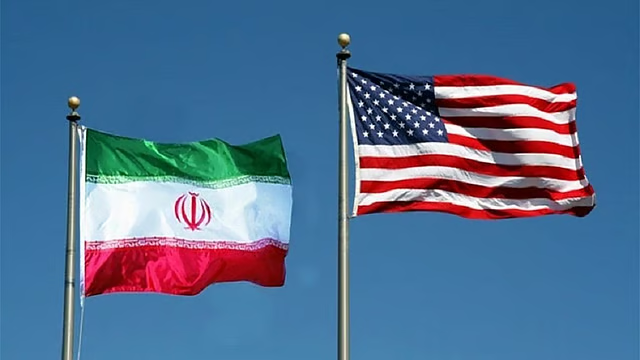
The United States has ended its naval blockade of Iran after both countries signed an agreement aimed at bringing the Middle East conflict to an end.

US Central Command announced on X that the blockade had been lifted in line with President Donald Trump’s directive, adding that some American naval vessels would remain in the region.

Shortly after the announcement, Iran’s Supreme Leader, Mojtaba Khamenei, said he approved the agreement despite personally holding a “different view.” He explained that he accepted the deal after receiving assurances from President Masoud Pezeshkian that Iran’s national rights would be protected.

Khamenei accused President Trump of using “all kinds of leverage” out of desperation to secure the agreement. He also stressed that while Tehran and Washington would hold face-to-face negotiations in the future, such talks should not be interpreted as Iran accepting the position of the United States.

The statement marked Khamenei’s first public reaction to the agreement. He has not appeared in public since assuming office in March after his father and predecessor, Ayatollah Ali Khamenei, was killed during the US-Israeli strikes on Iran on February 28, an event that triggered the regional conflict.

President Trump did not directly respond to Khamenei’s remarks. Instead, he wrote on Truth Social that he expected a ceasefire to take effect “on all fronts,” including between Israel and the Iran-backed Hezbollah group in Lebanon. He also expressed hope that countries across the Middle East would uphold their commitments to allow negotiations to continue.

The agreement between Washington and Tehran contains 14 major provisions, including reopening the Strait of Hormuz, ensuring Iran never acquires a nuclear weapon, and establishing a $300 billion (£227 billion) reconstruction and economic development fund for Iran, although the United States is not obligated to finance it.

The deal also commits both countries to reaching a final agreement within a maximum of 60 days, with the option of extending the deadline if both sides agree.

An official signing ceremony had been scheduled to take place in Switzerland on Friday, but Pakistani mediators later confirmed it had been cancelled because the agreement had already been signed remotely. However, US and Iranian officials are still expected to meet in Switzerland for further discussions.

A White House spokesperson said on Thursday evening that Vice President JD Vance would not travel as originally planned. Earlier, Vance confirmed that the agreement had officially taken effect, beginning the 60-day negotiation period, and said he expected to travel to Switzerland for technical talks. However, he declined to specify when, noting that Iran was “not an easy country to get out of.”

The White House added that it was eager to begin technical negotiations as soon as possible.

Trump’s decision to reach an agreement with Iran has faced criticism from some American lawmakers, including members of his own Republican Party. Critics have questioned several aspects of the deal, particularly the creation of a reconstruction fund for Iran.

Republican Senator Bill Cassidy described the agreement as the “worst foreign policy blunder in decades,” arguing that Iran’s nuclear ambitions had not been sufficiently addressed and that Tehran had demonstrated the effectiveness of threatening the Strait of Hormuz.

Vance defended the agreement, insisting that Iran would receive no funding or sanctions relief unless it fulfilled all of its commitments under the Memorandum of Understanding (MoU). He said Iran must eliminate its stockpile of enriched uranium and prove it will no longer support proxy groups operating across the region.

The vice president also criticised members of Israeli Prime Minister Benjamin Netanyahu’s cabinet who opposed the agreement, saying they needed to “wake up and smell the reality.”

Speaking to reporters, Vance argued that Israel should avoid attacking its strongest ally, the United States. In an interview with The New York Times, he specifically identified Israel’s National Security Minister Itamar Ben Gvir and Finance Minister Bezalel Smotrich as opponents of the agreement. He questioned what alternative they proposed, saying military action alone could not resolve every national security challenge.

Meanwhile, Netanyahu reaffirmed the importance of Israel’s alliance with the United States, saying Washington had stood “shoulder to shoulder” with Israel throughout the conflict with Iran.

Despite the agreement, hostilities have continued between Israel and Hezbollah. Both sides have carried out fresh strikes since the deal was announced, including Israeli attacks in Lebanon on Thursday that reportedly killed three people.

Israel has maintained that its conflict with Hezbollah is separate from its war with Iran, while Hezbollah has rejected the terms of the US-Iran agreement.

Vance said Israel must respect the ongoing peace process with Iran, adding that attacks on civilians in Lebanon’s capital, Beirut, were “not acceptable.”

Top 10 Talking Points As 2026/27 Premier League Fixtures Are Released

0

The Premier League has unveiled the fixture list for the 2026/27 season, with several standout matches and storylines set to shape the campaign from the opening weekend through to the final day.

Here are the biggest talking points from the newly released fixtures.

Liverpool’s new era begins with blockbuster trip to Newcastle

One of the headline fixtures of the opening weekend sees Liverpool travel to St James’ Park to face Newcastle United.

The clash revives memories of the iconic 4-3 encounters between the clubs in the 1990s, while new Liverpool manager Andoni Iraola is expected to bring an aggressive, high-pressing style similar to Jurgen Klopp’s. Combined with Eddie Howe’s attack-minded Newcastle side, the match promises to be one of the most entertaining of the opening round.

Coventry return to the Premier League with Arsenal test

Premier League champions Arsenal will kick off the new season at home against newly promoted Coventry City on Friday night.

The match marks Coventry’s return to the top flight after 25 years, following a journey that included relegation to the fourth tier, financial struggles and stadium issues. Frank Lampard’s side will face a difficult opening fixture, while Arsenal supporters return to the Emirates Stadium for the first time since celebrating last season’s league title.

Xabi Alonso could make Chelsea debut in familiar rivalry

Chelsea’s opening fixture could see new manager Xabi Alonso face former Liverpool, Real Madrid and Spain teammate Alvaro Arbeloa if Fulham appoint him as their new head coach.

The west London derby would reunite the two former teammates, this time as opposing managers, adding another layer of intrigue to Alonso’s first Premier League match in charge of Chelsea.

Promoted clubs handed difficult opening schedules

The three promoted teams—Coventry City, Ipswich Town and Hull City—have all been given challenging starts to life in the Premier League.

Each club will face two members of the traditional “Big Six” within their opening five fixtures, alongside another opponent who finished in last season’s top eight, making survival hopes even tougher from the outset.

Manchester City and Bournemouth begin new eras

Manchester City welcome Bournemouth to the Etihad Stadium in a fixture that symbolizes the changing landscape of the Premier League.

With Pep Guardiola no longer in charge, City enter a new chapter, while Bournemouth begin life under Marco Rose. The match is one of several opening-weekend fixtures featuring clubs led by newly appointed managers.

De Zerbi faces tactical battle against Brentford

Roberto De Zerbi starts his first full season as Tottenham Hotspur manager with a trip to Brentford.

Having secured Spurs’ survival last season, the Italian is now expected to fully implement his attacking philosophy. However, Brentford’s disciplined defensive style under Keith Andrews is likely to provide an immediate tactical challenge.

Newcastle handed demanding festive fixture list

Newcastle face one of the toughest schedules over the Christmas and New Year period.

Eddie Howe’s side will play Brentford, Manchester City, Nottingham Forest, Chelsea and Manchester United within 19 days, a run that could significantly shape their season.

Chelsea face difficult title run-in

If Chelsea remain in the title race, Xabi Alonso will have a difficult end to the campaign.

The Blues are scheduled to face Manchester City, Liverpool and Tottenham Hotspur in successive weeks between late April and early May, a stretch that could determine their title ambitions.

Manchester City vs Liverpool could decide the title

One of the biggest fixtures of the season comes on May 8, when Manchester City host Liverpool at the Etihad Stadium.

Scheduled for Matchweek 35, the clash could prove decisive in the Premier League title race depending on how both teams perform throughout the season.

Aston Villa and Tottenham headline final day

The final day features several intriguing fixtures, with Aston Villa hosting Tottenham Hotspur standing out as one of the biggest.

Both clubs are expected to compete for European qualification, meaning the match could have UEFA Champions League qualification on the line. Elsewhere, Liverpool finish the season against Bournemouth, Manchester City travel to Sunderland, while Arsenal host Brighton.

What’s In The US–Iran Agreement? Key Points Of The Ceasefire Deal Explained

0

A US–Iran agreement extending the ceasefire between both nations has officially been signed and is now in effect, according to confirmation from a White House official to the BBC.

President Donald Trump signed the deal during the G7 summit in Evian-les-Bains, France. The agreement—described as a 14-point Memorandum of Understanding—aims to reopen the strategic Strait of Hormuz and set the foundation for broader negotiations between Washington and Tehran.

The document states that Iran must never develop a nuclear weapon and outlines a $300bn reconstruction and economic development plan for the country, although the United States is not required to contribute financially. The deal comes months after tensions escalated between Iran, the US, and Israel.

The Trump administration has described the agreement as “performance-based,” meaning Iran will only benefit if it complies with the outlined commitments.

Although several issues remain unresolved, here are the major highlights of the agreement:

An end to conflict ‘on all fronts’

The agreement calls for an “immediate and permanent” end to military operations involving the US, Iran, and allied forces across all regions, including Lebanon.

From Washington’s perspective, concerns remain that Israeli operations against Hezbollah could disrupt the ceasefire framework. Iran, meanwhile, insists Lebanon should be included under the truce.

A spokesperson for Iran’s Ministry of Foreign Affairs said any continued Israeli action in Lebanon would violate the understanding and trigger “necessary measures”.

The agreement also states that neither side will initiate attacks or threats moving forward and will respect Lebanon’s sovereignty.

The final settlement aims at a permanent end to hostilities, though Israel’s response remains uncertain.

Respect for ‘internal affairs’

The document states that both countries will “respect each other’s sovereignty and territorial integrity” and avoid interference in internal political matters.

This clause is expected to be controversial among Iranian opposition groups.

Earlier this year, Trump told Iranian protesters that “help is on the way” during nationwide demonstrations.

60-day negotiation timeline

Both countries have agreed to reach a final deal within 60 days, though this deadline may be extended if mutually agreed.

The countdown begins immediately following the signing of the MoU.

The White House confirmed Trump signed the document in France, alongside Iranian President Masoud Pezeshkian.

A planned signing ceremony in Geneva remains uncertain.

End of US naval blockade

The US will begin lifting its naval blockade on Iranian ports, removing restrictions and “disturbances or impediments,” according to the agreement.

The process is expected to take up to 30 days, during which vessel movement will be gradually restored.

Within 30 days of a final agreement, US forces are expected to withdraw from proximity to Iran, returning to pre-conflict positioning.

Strait of Hormuz reopening

Iran has agreed to ensure safe and uninterrupted passage of commercial vessels through the Strait of Hormuz.

The agreement states that movement will resume “immediately,” while technical and security obstacles are addressed.

Officials also emphasized that no transit fees will be imposed.

Long-term plans include cooperation between Iran, Oman, and Gulf states to manage the waterway.

$300bn reconstruction plan

The agreement includes a proposed $300bn reconstruction and economic development package for Iran, to be finalized within 60 days.

However, the US will not directly contribute funds.

Officials clarified that Washington will not pay “a cent of money” but may support third-party investments under approved conditions.

Lifting of sanctions

The US will remove all economic sanctions on Iran, including UN and unilateral restrictions.

However, the timeline is still under negotiation.

Iran remains heavily affected by sanctions, and easing them is tied to compliance with the agreement.

No nuclear weapons

Iran has committed not to develop or acquire nuclear weapons.

Enriched uranium stockpiles will be managed later through mechanisms agreed in future talks, likely under International Atomic Energy Agency (IAEA) supervision.

A US official described this as a “major win” and a minimum compliance standard.

Maintaining the status quo

Both sides agree to maintain the current status of Iran’s nuclear programme until further arrangements are finalized.

No new sanctions will be imposed during this period, while limited waivers may allow exports and financial transactions to continue.

Frozen funds release

The agreement includes provisions for releasing frozen Iranian assets once the MoU takes effect.

Further details will be negotiated, but some funds may be gradually unblocked based on compliance milestone

Monitoring and final deal structure

A monitoring mechanism will be created to oversee compliance and implementation of the agreement.

Both countries will then begin negotiations for a final settlement.

The agreement is expected to be endorsed by a binding UN Security Council resolution once finalized.

Zimbabwe MPs Approve Bill Extending Presidential Term To 2030

0

The Zimbabwe lower house of parliament has passed a controversial constitutional amendment that could allow President Emmerson Mnangagwa to remain in office until 2030.

More than 200 lawmakers voted in favour of the bill on Thursday, easily clearing the two-thirds majority required to amend the constitution. The legislation extends presidential terms from five to seven years and removes direct presidential elections, with future leaders instead to be chosen by parliament.

If fully enacted, the changes would mean Mnangagwa, 83, who is currently serving his second term and was due to leave office in 2028, could remain in power for an additional two years.

The bill now moves to the senate, where it is widely expected to pass before being signed into law by the president.

Mnangagwa came to power in 2017 after the military-backed removal of longtime leader Robert Mugabe. He later won disputed elections in both 2018 and 2023.

The constitutional changes are part of a wider push by the ruling Zanu-PF party, which has governed Zimbabwe since independence in 1980, to revise term limits and extend presidential tenure. The cabinet had already endorsed the proposal earlier this year.

During the parliamentary vote, Speaker Jacob Mudenda announced that 216 MPs supported the amendment, while 42 opposed it—well above the 187 votes needed for constitutional change.

Key provisions of the amendment include scrapping direct presidential elections, extending both parliamentary and presidential terms to seven years, and delaying the next general elections from 2028 to 2030.

Opposition parties, civil society organisations and legal experts have criticised the move, arguing that such major constitutional reforms should be decided through a national referendum rather than parliamentary approval alone.

Critics also warn the changes could weaken democratic accountability, while supporters argue they will provide political stability and continuity.

Zimbabwe’s 2013 constitution limits presidents to two terms and states that any extension of term limits must be approved by voters in a referendum, with additional safeguards preventing a sitting president from benefiting without further public approval.

However, on Wednesday, the Constitutional Court dismissed a legal challenge seeking to block the legislation, clearing the way for Thursday’s vote.

How Airports Can Manage Bird Strike Hazards During Peak Flight Operations And Seasonal Bird Movements

0

An Air Peace aircraft operating a scheduled flight from Abuja to Kano has been grounded after experiencing a bird strike upon arrival at the Mallam Aminu Kano International Airport, once again highlighting growing concerns over wildlife hazards in Nigerian aviation operations.

The airline disclosed the incident on Wednesday, saying the aircraft was withdrawn from service in line with aviation safety procedures.

According to Air Peace, the bird strike occurred shortly after the aircraft landed in Kano.
The airline said the aircraft is undergoing technical assessments to determine the extent of any damage before it can return to service.

“In strict compliance with aviation safety protocols, the affected aircraft has been grounded for comprehensive technical assessments,” the airline said.

Air Peace said it immediately deployed another aircraft to continue operations on the route and reduce inconvenience to affected passengers.

The airline noted that the decision was taken to ensure passengers reach their destinations safely in accordance with operational standards.

The carrier expressed regret over the disruption and appealed for understanding from affected passengers.

The growing dispute between domestic airlines and airport authorities over the rising incidence of bird strikes at Nigerian airports has once again drawn attention to the challenge of wildlife hazard management within the aviation sector.

As concerns grow, aviation experts and stakeholders have outlined practical measures airports can adopt to reduce the risk of bird strikes and improve safety during peak flight operations and periods of increased bird activity.

How Airports Can Manage Bird Strike Hazards During Peak Flight Operations and Seasonal Bird Movements

Revive Dedicated Ornithology And Bird Control Programmes

Aviation security expert and former military commandant of Lagos Airport, Group Captain John Ojikutu (rtd), believes airports should return to some of the wildlife management strategies that were previously successful.

According to him, bird strike incidents at the Murtala Muhammed Airport were significantly reduced in the past through dedicated ornithology units and specialised bird-abatement programmes.

Ojikutu recalled that airport authorities once maintained ornithological services and bird control teams that monitored bird activity and addressed environmental conditions that attracted birds to airport environments.

He argued that reviving such programmes would provide airports with scientific data on bird behaviour and migration patterns, enabling more effective hazard management.

Strengthen Wildlife Control Departments

The Secretary-General of the Association of Nigerian Aviation Professionals (ANAP), Comrade Abdulrazaq Saidu, stressed that airport authorities already have structures in place to address wildlife hazards.

According to him, the Federal Airports Authority of Nigeria (FAAN) operates a dedicated Wildlife Control Department, which should be fully functional and adequately equipped to manage bird strike risks.

Saidu maintained that wildlife control should remain a core responsibility of airport management, with officers conducting regular surveillance, risk assessments, and preventive measures around airport facilities.
He noted that strengthening these units would improve monitoring and ensure faster responses to emerging bird strike threats.

Eliminate Environmental Conditions That Attract Birds

For Dr. Femi Aiyegbajeje, Senior Lecturer in the Department of Geography, Faculty of Social Sciences, University of Lagos, effective bird strike management must focus heavily on environmental control.

He explained that most bird strikes occur during takeoff and landing, making the airport environment and surrounding communities critical areas of concern.

According to Aiyegbajeje, airports should prioritise:

  • The elimination of open refuse dumps around airport corridors.
  • Proper waste management and disposal systems.
  • Control of illegal dumping activities.
  • Reduction of food sources that attract birds.
  • Improved environmental sanitation around airport boundaries.

He specifically highlighted Lagos as an example where uncontrolled waste disposal around airport environments can significantly increase bird activity and elevate the risk of strikes.

Improve Coordination Between Airport Authorities And Host Communities

Experts also believe airports cannot tackle bird strike hazards alone.
Many bird-attracting activities occur outside airport fences, including waste dumping, livestock activities, open markets, and unmanaged wetlands.

Airport operators, local governments, environmental agencies, and community leaders must therefore collaborate to identify and eliminate environmental conditions that encourage bird congregation near flight paths.
Such partnerships would help create safer airspace around airports while reducing long-term wildlife risks.

Invest in Continuous Monitoring and Data Collection

The collection and analysis of bird strike data, regular monitoring allows airport authorities to identify patterns, understand bird behaviour, and develop targeted mitigation strategies.

Maintaining accurate records of bird strike incidents can also help authorities determine high-risk periods, seasonal migration trends, and specific airport locations requiring additional intervention.

Deploy Modern Bird Detection Technology

Globally, many airports are adopting advanced technologies to reduce bird strike incidents.
These include:

  • Bird detection radar systems.
  • Thermal imaging equipment.
  • Acoustic deterrent devices.
  • Laser bird dispersal systems.
  • Automated wildlife monitoring tools.

Such technologies enable airport authorities to detect bird activity early and take preventive action before aircraft movements are affected.

The increasing number of bird strike incidents reported by airlines highlights the need for a more proactive approach to wildlife hazard management.

Who Was Tay Keith? Grammy-Nominated Producer

0

The music industry is mourning the loss of Grammy-nominated producer Tay Keith, the acclaimed beatmaker whose signature sound helped shape some of the biggest hip-hop records of the last decade.

Keith, whose real name was Brytavious Chambers, was found dead in his apartment in Nashville, Tennessee, at the age of 29.

Authorities confirmed that officers responded to a welfare check request and discovered the producer deceased inside his residence. According to Nashville police, “no foul play is suspected” in his death.

Officials have not yet released the cause of death, although an autopsy is currently being conducted.

The news has sent shockwaves through the music world, with artists, collaborators, and fans paying tribute to one of hip-hop’s most influential young producers.

Who Was Tay Keith?

Born and raised in Memphis, Tennessee, Tay Keith emerged as one of the most successful music producers of his generation.

Despite achieving success at a young age, Keith remained committed to his education.
While building his music career, he attended Middle Tennessee State University, where he earned a degree in Integrated Studies and Media Management.

Reflecting on his decision to complete his studies, he once said:
“There wouldn’t be any point for me to come to college if I didn’t want to finish it — I could have just focused 100% on music.”
He added:
“By my last week of college, I had my first No. 1 single, so it didn’t make any sense to drop out.”
His story became an example of balancing academic achievement with professional success.

Known for his hard-hitting drums, Memphis-inspired production style, and instantly recognizable tag, Keith became one of the driving forces behind modern hip-hop’s commercial success.

His breakthrough came through collaborations with fellow Memphis rapper BlocBoy JB, helping him gain industry recognition before eventually becoming a sought-after producer for some of the biggest names in music.

Over the years, Keith built an impressive catalogue that spanned rap, hip-hop, R&B, and pop music.

Working With Music’s Biggest Stars

Tay Keith’s production credits read like a who’s who of contemporary music.
He worked with major artists including:

  • Drake
  • Travis Scott
  • Beyoncé
  • Eminem
  • Lil Baby
  • 21 Savage
  • Sexyy Red
  • J Cole
  • Cardi B
  • Moneybagg Yo
  • Lil Nas X
  • DJ Khaled
    One of his most celebrated achievements came in 2018 when he co-produced Travis Scott’s chart-topping hit Sicko Mode.

The song became a global success and earned Keith his first Grammy nomination in 2019.
He later received another Grammy nomination in 2024 in the Best Rap Song category for Drake and 21 Savage’s Rich Flex.

His influence also extended beyond the United States.

Keith produced Rain, the 2020 hit collaboration between British rappers AJ Tracey and Aitch, which reached number three on the UK Singles Chart and further cemented his international reputation.

Recognition And Industry Impact

Tay Keith’s influence on modern hip-hop continued to grow throughout his career.
In 2025, he was recognised on Forbes’ prestigious 30 Under 30 Music list, highlighting his contributions to the music industry and his growing legacy as one of the most impactful producers of his generation.

His production style helped define an era of rap music, with his beats becoming staples on radio, streaming platforms, and major charts worldwide.

Tributes Pour In

Following the announcement of his death, tributes quickly emerged across social media.
Memphis rapper BlocBoy JB, who had known Keith since they were teenagers, expressed his grief in an emotional Instagram post.

“We talked everyday yeen tell me you was leaving.”
The rapper also shared phone records showing how frequently they communicated.

British rapper AJ Tracey also paid tribute, describing Keith as:
“a legend of the game”
He added:
“I don’t think it’s an overstatement to say he had a big impact on my career.”

Beyond Xenophobia: The Political Strategy Behind Afrophobia in Africa

0

Afrophobia in Africa is increasingly shaping global perceptions of the continent at a time when African economies, culture, and innovation are experiencing unprecedented global recognition. While international headlines continue to frame the crisis as “xenophobia,” the violence and hostility directed primarily at Black African migrants reveal a far more targeted problem.

What Africa is witnessing is not simply fear of foreigners. It is Afrophobia in Africa — a growing pattern of anti-African hostility fueled by political manipulation, economic frustration, historical amnesia, and deepening social divisions.

Across social media platforms and global news coverage, disturbing scenes from Johannesburg, Durban, and Cape Town continue to overshadow stories of Africa’s economic transformation, industrial expansion, and cultural influence. The result is a dangerous contradiction: while Africa rises globally, Afrophobia in Africa continues to weaken continental unity from within.

Africa’s Economic Rise and Internal Contradictions

Africa’s industrial and cultural influence has expanded significantly over the past decade. Major investments in infrastructure, manufacturing, technology, energy, and entertainment are reshaping the continent’s future.

The Dangote Group’s multi-billion-dollar investments across Africa reflect a broader continental ambition for food security, industrialization, and economic independence. At the same time, African music, film, fashion, and digital innovation have become major global exports generating influence and revenue across international markets.

Yet despite this progress, Afrophobia in Africa continues to dominate international discourse.

Recurring anti-immigrant violence in South Africa has become symbolic of a wider continental challenge — one where Africans increasingly view fellow Africans as economic threats instead of strategic partners.

Afrophobia in Africa Is a Continental Problem

Although South Africa remains the most visible center of anti-immigrant violence, Afrophobia in Africa is not limited to one country.

Across different periods in African history, hostility toward African migrants has surfaced in Ghana, Tunisia, Libya, Morocco, Angola, and Uganda. Political rhetoric, economic pressure, and social frustrations have repeatedly been redirected toward vulnerable migrant communities.

This reveals an uncomfortable truth: Afrophobia in Africa is part of a larger continental identity crisis driven by unemployment, inequality, political opportunism, and unresolved colonial-era divisions.

The Forgotten History of African Migration

One of the greatest drivers of Afrophobia in Africa is historical ignorance.

South Africa’s industrial economy was built through regional African migration. During the mining expansions of the 1950s through the 1970s, migrant workers from Malawi, Mozambique, Zimbabwe, Lesotho, and Zambia formed a major part of the labor force that powered economic growth.

Migration was not an invasion. It was foundational to South Africa’s industrial history.

Entire communities were built around this interconnected African labor system. However, many younger Africans today have little understanding of this shared history, making them vulnerable to manipulation and extremist narratives.

Political Manipulation and the “Third Force”

The persistence of Afrophobia in Africa cannot be understood without examining political influence.

Economic hardship, unemployment, corruption, and inequality have created frustration among millions of young Africans. Rather than addressing governance failures directly, some political actors redirect public anger toward migrants and foreign Africans.

This strategy creates convenient scapegoats while protecting failed political systems from accountability.

A divided Africa benefits those who profit from instability. A united Africa represents economic leverage, political influence, and continental strength.

Echoes of Apartheid-Era Destabilization

The current rise of Afrophobia in Africa mirrors tactics used during the final years of apartheid.

Between 1985 and 1993, apartheid intelligence structures allegedly exploited ethnic divisions and funded proxy violence to weaken Black liberation movements. Internal conflict became a political weapon used to prevent unity among oppressed communities.

Today, similar patterns can be seen in modern populist movements that weaponize tribalism, regional identity, and anti-immigrant sentiment for political gain.

The strategy remains familiar:

  • exploit economic desperation;
  • redirect public frustration;
  • create internal enemies;
  • sustain division among Africans.

Why Afrophobia in Africa Threatens Continental Unity

The geopolitical consequences are already visible.

Countries such as Ghana, Malawi, and Mozambique have periodically responded to anti-immigrant tensions involving their citizens abroad. Nigeria has also signaled concerns over the treatment of Nigerians in South Africa during previous outbreaks of violence.

Beyond diplomacy, Afrophobia in Africa threatens the long-term vision of continental integration under initiatives such as the African Continental Free Trade Area (AfCFTA).

No continent can successfully pursue economic unity while normalizing hostility against fellow Africans.

Africa Needs Critical Thinking, Not Retaliation

Emotional outrage alone will not solve Afrophobia in Africa.

Social media anger, retaliatory rhetoric, and nationalist hostility only deepen the divisions already weakening the continent. Africa requires deeper political awareness, historical education, and collective responsibility.

Africans must begin asking difficult questions:

  • Who benefits when Africans distrust each other?
  • Why are migrants blamed for governance failures?
  • Who gains politically from division and instability?

These questions are central to understanding the deeper forces sustaining Afrophobia in Africa.

Ubuntu and the Future of African Unity

Africa’s future depends on whether Africans can resist systems designed to divide them.

The philosophy of Ubuntu — “I am because we are” — remains one of the continent’s most powerful survival principles. In an era of rising nationalism, economic competition, and political manipulation, solidarity among Africans is no longer optional.

If Africa is to achieve true economic and geopolitical strength, Afrophobia in Africa must be confronted not only as a social problem, but as a strategic threat to continental unity itself.

Thirty-Five Killed As Gunmen Attack Niger’s Main Airport

0

At least 35 people have been killed after armed gunmen launched an attack on Niger’s largest airport in the capital Niamey on Thursday, officials have confirmed.

The violence erupted at Diori Hamani International Airport shortly after residents had completed morning prayers, with witnesses reporting explosions and heavy gunfire near the facility, which also serves as a military base.

According to Niger’s defence ministry, the death toll includes 22 attackers, 11 soldiers, and two civilians. Authorities also said four of the attackers were wounded, while 20 suspects have been arrested following a subsequent manhunt.

On Thursday evening, Jama’at Nusrat al-Islam wal-Muslimin (JNIM), an al-Qaeda-linked group, claimed responsibility for the assault. The airport had previously been targeted in January in an attack attributed to an Islamic State-linked organisation.

Security forces regained control of the area by mid-morning and launched operations to track down any remaining suspects. Officials reported the seizure of a large weapons cache, including RPG-7 launchers, AK-47 rifles, explosives, grenades, communications equipment, and thousands of rounds of ammunition.

Residents living near the airport described scenes of panic and confusion. One witness told the BBC that the explosions were initially mistaken for unrelated sounds before it became clear an attack was underway. Another resident said some civilians attempted to join the response, armed with machetes and sticks, after attackers reportedly blended into the local population.

Authorities later restricted access to the airport area, stopping and searching vehicles as security operations continued.

The defence ministry blamed “armed mercenaries” allegedly backed by France, although no evidence was provided to support the claim. France has not responded.

Relations between Niger’s military government and France have deteriorated since the 2023 coup, with French troops expelled and replaced in part by Russian military contractors. The junta has repeatedly accused Western and regional actors of destabilisation efforts.

The African Union condemned the attack, praising Nigerien forces for repelling the assault and securing the airport.

Diori Hamani International Airport is one of the country’s most sensitive security sites, combining civilian aviation with military infrastructure and facilities linked to the Alliance of Sahel States, which includes Niger, Mali, and Burkina Faso—all governed by military juntas.

In January, a similar attack on the airport injured four soldiers and left 20 attackers dead, according to officials. The government later claimed foreign assistance helped prevent further damage, while also making unverified accusations against several foreign governments.

In recent weeks, authorities have demolished nearby neighbourhoods and expanded security measures around the airport, including extending perimeter fencing and installing hundreds of surveillance cameras amid ongoing concerns about militant activity.

Mexico Becomes First Team To Reach 2026 World Cup Knockout Stage

0

Co-hosts Mexico became the first nation to secure a place in the knockout stage of the 2026 FIFA World Cup after edging South Korea 1-0 in Guadalajara.

Midfielder Luis Romo scored the game’s only goal five minutes into the second half, tapping into an empty net after South Korea goalkeeper Kim Seung-gyu spilled the ball following a collision with defender Lee Gi-hyuk.

South Korea came close to equalising late in the match when Cho Gue-sung’s close-range header was brilliantly saved by Mexico goalkeeper Raul Rangel, who also denied Yang Hyun-jun on the rebound.

Earlier, captain Son Heung-min thought he had put South Korea ahead after chipping Rangel, but Edson Alvarez cleared the effort off the line before the offside flag was raised.

Mexico, who were booed by sections of their home fans after a lacklustre first-half display, nearly doubled their advantage in the 75th minute, but Raul Jimenez was denied from a tight angle by Kim Seung-gyu.

Substitute Obed Vargas also tested the South Korean goalkeeper late on with a powerful strike, forcing another impressive save.

The victory maintained Mexico’s perfect start to the tournament and confirmed Javier Aguirre’s side as Group A winners.

As group winners, Mexico will play both their Round of 32 match and a potential Round of 16 tie in Mexico City. They could face England in the last 16 if Thomas Tuchel’s side top their group and win their opening knockout fixture.

Despite the defeat, South Korea remain well placed to qualify for the knockout stage after their opening victory over the Czech Republic.

South Korea will face South Africa in Monterrey on Thursday, while Mexico take on the Czech Republic in their final Group A match at the same time in Mexico City.