

Both sides escalated on Thursday while signalling willingness to negotiate — and the dispute over Starlink shows how thinly US-Ukraine trust is stretched.
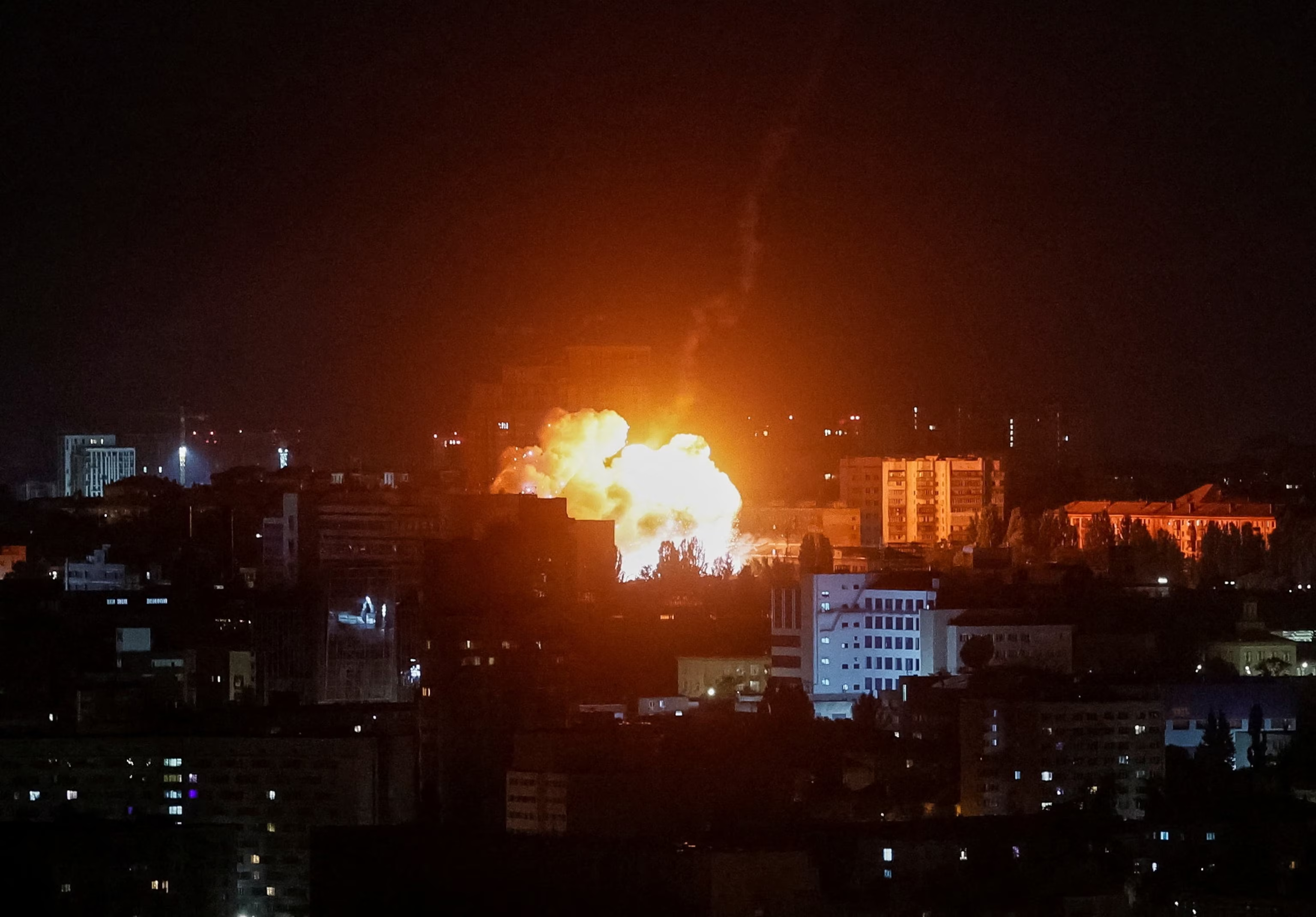
Kyiv / Moscow, October 23, 2026 — Russia pounded Kyiv with ballistic missiles and Ukraine sent hundreds of drones toward Moscow on Thursday, as both sides pressed their campaigns despite the latest US push to end the war.
The night’s attacks
Ukraine said Russia fired at least 21 ballistic missiles in three waves. President Volodymyr Zelensky said three carried cluster munitions — bomblets that disperse across a wide area and are banned by many states because of the danger they pose to civilians. Russia’s defence ministry did not immediately respond to a request for comment.
Zelensky said two people were killed and 34 injured, including five children, across a dozen Ukrainian regions. Regional officials separately reported that a strike on a market in Lozova, near Kharkiv, killed two people and injured 36, while three were killed in Zaporizhzhia and one more in neighbouring Dnipropetrovsk region. Figures from different authorities had not been reconciled as of publication.
Russia said it carried out a “massive strike” overnight on port infrastructure in Ukraine’s Odesa region, and on vessels used by Ukraine’s military. Moscow’s mayor, Sergei Sobyanin, said two people were wounded near Moscow, with most drones downed at long range. Russia’s defence ministry said Ukraine launched 630 drones toward the capital overnight.
Moscow and Kyiv also exchanged war dead, with Russia handing over 252 bodies and Ukraine 25, according to Belarus’s state news agency Belta. Such exchanges have historically accompanied moves toward talks.
The diplomacy, and its contradictions
President Vladimir Putin, in a television interview the day after meeting US envoy Steve Witkoff, confirmed Russia was ready to resume US-mediated talks next month, saying the aim was to secure the safety of Russia, Ukraine and Europe. He said Witkoff had stressed that discussions must extend to “the architecture of European security” — a framing long central to Moscow’s demand for a reordering of continental alliances.
Zelensky said he hoped the first negotiations since February would take place early in November.
But Russian signalling was guarded. Kremlin aide Yuri Ushakov said the Americans had sensed “some new nuances” in Oslo but that “these nuances, so to speak, do not entirely satisfy us.”

A senior Russian official, briefed on the Putin–Witkoff meeting, described it as relatively short and not substantive, with Witkoff handing over proposals drafted in Oslo for Putin’s review. A source close to the Kremlin said US proposals included a scenario in which Ukraine cedes its Donbas region in return for a NATO security guarantee for its future.
Moscow has repeatedly said it will not end fighting unless Ukraine gives up more land, caps the size of its forces and is permanently barred from alliances — terms Kyiv rejects as capitulation that would leave it defenceless.
The Starlink standoff
President Donald Trump said SpaceX chief Elon Musk had restored Ukraine’s Starlink access, one of the issues behind a rift between Washington and Kyiv that has cast doubt on US support. Declining to confirm whether he called Musk personally — as the Wall Street Journal had reported — Trump said: “I don’t want to comment on it, whether I called or whether somebody else called… The bottom line — he put it back.”
That account is contested. A person familiar with the matter said the problem was continuing, with the same curbs largely remaining, adding: “The main problem is that we have no official explanation what’s going on.” Zelensky, speaking alongside Finland’s prime minister, said speed on Starlink systems had not been restored, and that he hoped to raise it with US Secretary of State Marco Rubio.
Ukraine relies on Starlink for battlefield communications and drone operations; restricting it hampered attack and air-defence drone missions. Some drone units reported reaching 200kph, but the wider picture was unchanged.
The Washington–Kyiv rift
Over more than a week of friction, Trump has repeatedly rebuked Ukraine for striking Russian oil refineries while saying little about far deadlier Russian attacks, called for Zelensky to be replaced, and described Russia’s actions as “fine.” Zelensky — who long avoided criticising Washington — has pushed back harder against what he calls a shift toward sympathy for Moscow.
On Thursday he answered Witkoff directly, after the envoy saluted Putin as a “humanitarian” for securing the release of a 74-year-old American captured by Russian forces.
Zelensky posted on X: “Three waves of ballistic missiles have been launched at Kyiv by Russian ‘humanitarians’ since yesterday evening. They used 21 missiles.”
Kyiv also says Washington has withheld early-warning data on Russian missile launches, throttled the SpaceX system guiding Ukrainian drones, and held up European-purchased missile defence systems.
Washington denies shifting policy to hamper Ukrainian forces. Zelensky’s Oslo meeting with Witkoff, European and NATO officials aimed partly to repair relations after Trump announced a deal to buy Russian diesel and lifted sanctions on Moscow; Witkoff spoke of “some degree of momentum,” but the Kremlin’s response suggests little of it has landed.
What it means
The pattern is the story. Body exchanges, envoy shuttles and a November date on the table signal movement; 21 ballistic missiles, 630 drones and contested satellite bandwidth signal that neither side has stopped fighting to improve its position. And the unresolved Starlink question is the sharpest indicator for Kyiv — a war whose air defence and drone corps depend on a private company’s willingness, and a US government whose explanations its own president will not confirm.
Discover more from LN247
Subscribe to get the latest posts sent to your email.

