Home Blog Page 106

Eritrean President Warns Ethiopia Against Renewed Conflict

1

Eritrean President Isaias Afwerki has issued a stern warning to neighboring Ethiopia, cautioning against actions or rhetoric that could trigger a renewed conflict in the Horn of Africa. His comments follow recent public statements by Ethiopian Prime Minister Abiy Ahmed asserting Ethiopia’s need for direct access to the Red Sea, remarks that have raised alarms across the region and drawn international attention.

Afwerki’s statement comes at a particularly delicate time in the region’s history. Although Eritrea and Ethiopia were on opposing sides for much of the early 2000s, the two nations realigned during the 2020–2022 Tigray War, briefly partnering militarily against the Tigray People’s Liberation Front (TPLF). However, the alliance was largely tactical, and underlying disputes between the two countries, particularly concerning port access, historical grievances, and regional dominance, remain unresolved.

Prime Minister Abiy’s recent remarks about Ethiopia’s geopolitical imperative to gain access to the Red Sea have revived tensions, with observers noting that such aspirations could be interpreted as veiled territorial ambitions. Eritrea, which controls a significant portion of the Red Sea coastline, views these overtures as a direct threat to its sovereignty and regional stability.

President Afwerki warned that any attempt to alter existing borders or impose unilateral solutions would risk plunging the region into further turmoil. “History has shown that coercion and unilateralism in this region yield nothing but suffering,” Afwerki reportedly said. He called on Ethiopian leaders to engage in dialogue and respect international norms while acknowledging the complex economic and security realities facing landlocked Ethiopia.

The situation is further complicated by the slow and partial implementation of the 2018 peace agreement between the two nations. While the deal formally ended a two-decade-long war, key issues such as border demarcation and economic cooperation remain unresolved. The fragile peace has often been characterized by mistrust and political posturing rather than meaningful reconciliation.

Analysts warn that the Horn of Africa, a region already plagued by instability, humanitarian crises, and competing foreign interests, cannot afford another round of conflict. Any military escalation between Eritrea and Ethiopia could have ripple effects across the Red Sea corridor, potentially drawing in neighboring states and disrupting international trade routes.

President Afwerki’s comments have been interpreted as both a warning and an appeal for diplomatic caution. He emphasized Eritrea’s commitment to peace but reaffirmed that the country would defend its territorial integrity if provoked.
International observers, including the African Union and the United Nations, have yet to comment formally on the escalating rhetoric, but sources indicate growing concern about the deteriorating tone of regional diplomacy.

As tensions simmer, the path forward appears uncertain. Much will depend on whether Ethiopia pursues its Red Sea aspirations through negotiation or confrontation, and how Eritrea and other regional actors respond in the weeks and months ahead.

Kenyan Activist Boniface Mwangi Charged with Unlawful Possession of Ammunition

1

Boniface Mwangi, one of Kenya’s most prominent human rights activists, has been formally charged with unlawful possession of ammunition following his arrest over the weekend. The charges, detailed in court papers seen by Reuters, come in the wake of renewed anti-government protests and growing concerns about the suppression of dissent in the country.

Mwangi, 42, was arrested on Saturday after authorities raided his residence. According to the police, items recovered during the search included three unused teargas canisters, a 7.62mm blank round, two mobile phones, a laptop, and several notebooks. The charge sheet states that Mwangi was “found in possession of noxious substances to wit three teargas canisters without lawful authority,” as well as a single round of blank ammunition, both considered offences under Kenyan law.

On Monday, Mwangi appeared in court in Nairobi, where the courtroom was packed with supporters, fellow activists, and members of civil society — many donning Kenyan flags and chanting in solidarity. His appearance marks the latest development in a series of confrontations between the Kenyan government and civil society actors who have been vocal about rising cases of police brutality, corruption, and shrinking civic space.

Boniface Mwangi, who has built a reputation over the years for fearless activism and speaking out against government excesses, once ran for parliament on an anti-corruption platform. His arrest has drawn sharp criticism from local and international rights groups who view the charges as politically motivated and aimed at intimidating dissenting voices.

The broader context of Mwangi’s arrest lies in the resurgence of nationwide protests in Kenya, particularly following the controversial death of political blogger Albert Ojwang in police custody last month. While initial police reports suggested Ojwang had taken his own life, an independent autopsy revealed injuries consistent with physical assault, prompting public outrage and further protests. Police later issued an apology, but activists have continued to demand accountability and reform.

Mwangi has also faced challenges outside Kenya. In May, he was arrested and deported from Tanzania, where he had travelled to observe the trial of opposition leader Tundu Lissu. Following the incident, he alleged that both he and Ugandan journalist Agather Atuhaire were subjected to sexual assault and harassment by Tanzanian security personnel during their detention.

With Kenya’s political temperature rising and civic tensions running high, Mwangi’s prosecution is being closely watched. Observers warn that it may further inflame an already volatile atmosphere, particularly among Kenya’s youth and activist community.

Human rights organisations have called on the Kenyan judiciary to ensure that due process is followed and that Mwangi’s rights are respected throughout the legal proceedings. As the case unfolds, many see it as a litmus test for Kenya’s democratic values and its commitment to upholding civil liberties amid increasing state pressure on dissent.

China Breaks Ground On Massive Hydropower Project

2

Construction has commenced on a colossal hydroelectric facility in Tibet by China, set to become the most powerful dam globally, a development that has triggered unease in India and Bangladesh over water security and ecological impact.

Premier Li Qiang officially launched the project on Saturday during a visit to the Yarlung Tsangpo river, which winds through the Tibetan Plateau before crossing into South Asia.

The initiative, situated in a geopolitically sensitive region, has drawn backlash due to fears that it may affect the livelihoods of millions living downstream and potentially harm the local ecosystem and Tibetan communities.

Chinese officials maintain that the dam’s construction will emphasize environmental preservation while also fostering economic growth in the surrounding area.

Once completed, the Motuo Hydropower Station—carrying a price tag of roughly $1.67 billion—is expected to eclipse the Three Gorges Dam in scale, generating energy output three times higher than its predecessor.

Analysts warn that the structure could allow Beijing greater control over the transboundary Yarlung Tsangpo, which feeds key river systems in India’s Arunachal Pradesh and Assam states, eventually flowing into Bangladesh.

A past report from 2020 stated that “control over these rivers [in the Tibetan Plateau] effectively gives China a chokehold on India’s economy.”

Concerns have also emerged from local leaders. In a recent interview, Arunachal Pradesh’s chief minister Pema Khandu warned that “the Siang and Brahmaputra could ‘dry up considerably’ once the dam was completed.”

He went on to say the project “is going to cause an existential threat to our tribes and our livelihoods. It is quite serious because China could even use this as a sort of ‘water bomb’.”

“Suppose the dam is built and they suddenly release water, our entire Siang belt would be destroyed,” he said. “In particular, the Adi tribe and similar groups… would see all their property, land, and especially human life, suffer devastating effects.”

India’s external affairs ministry had earlier relayed its disapproval to China regarding large-scale dam projects, urging them to “ensure the interests of downstream states” and stressing the “need for transparency and consultation with downstream countries.”

As a countermeasure, India is working on its own dam along the Siang River to mitigate any potential flooding from China’s side.

Beijing’s foreign ministry had responded in 2020, insisting that China had a “legitimate right” to pursue hydropower development and had taken downstream consequences into account.

Bangladesh has also sought clarity on the implications of the project, with officials reportedly reaching out to Beijing for further details earlier this year.

The selected dam site, located in Tibet’s remote terrain, lies within a vast gorge known for being both the deepest and longest land canyon. Here, the river curves sharply around the Namcha Barwa mountain, a geological feature referred to as “the Great Bend.” At this point, the river’s elevation plunges significantly.

Earlier plans outlined the excavation of multiple 20-kilometre tunnels through the Namcha Barwa range to divert water for the facility.

Over the weekend, a report mentioned that engineers would implement “straightening” work and ‘divert water through tunnels’ to build five cascading power stations.”

The electricity generated is expected to be exported to other regions of China, although some supply will remain to support local demand in Tibet.

China’s pursuit of energy in the country’s less-developed western regions is part of a national agenda to harness resources from Tibet to meet the needs of energy-intensive cities in the east—a policy known as “xidiandongsong”, or “sending western electricity eastwards.”

Chinese authorities describe the initiative as an eco-friendly way to reduce carbon emissions and provide economic benefits to Tibetans.

However, critics argue that the project represents a broader pattern of resource exploitation in the region. Past demonstrations by Tibetan residents against similar projects have often met with harsh crackdowns.

Last year, authorities detained numerous Tibetan protesters opposing another dam. Reports confirmed that arrests and beatings occurred, leaving several injured.

Environmentalists also warn that flooding in Tibet’s biologically rich valleys and the risks associated with constructing dams in earthquake-prone zones remain major causes for concern.

France Ends Permanent Troop Presence in Senegal

1

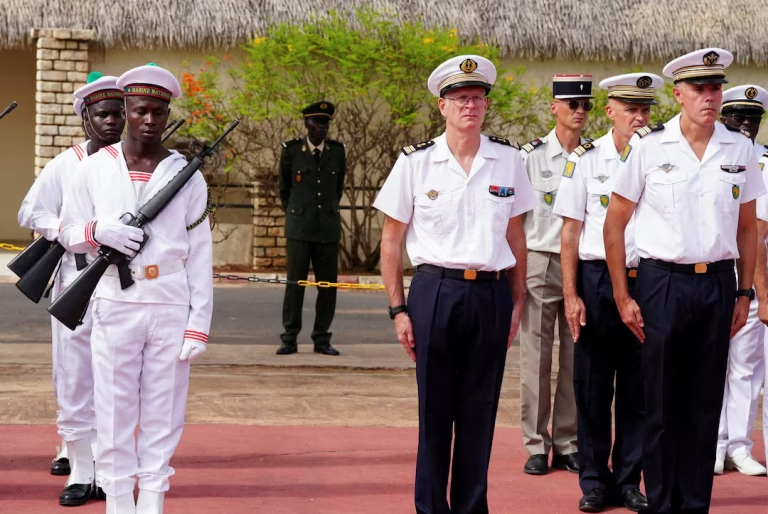
France has officially ended its permanent military presence in Senegal, a symbolic move that marks the closing of a significant chapter in the long and complex relationship between the two countries. On Thursday, France handed over control of its last major military base in Senegal, Camp Geille in Ouakam, Dakar, bringing an end to more than two centuries of French armed presence in the West African nation.

During a ceremonial handover, General Pascal Ianni, commander of French forces in Africa, handed over a ceremonial key to Senegalese officials. As Senegalese troops raised their national flag and the anthem echoed through the base, the moment underscored a peaceful yet powerful assertion of national sovereignty.

“Today’s transfer of Camp Geille marks a new stage in the evolution of the partnership between our two armed forces,” General Ianni said. “It is a response to the Senegalese authorities’ wish to no longer have permanent foreign forces present on their territory.”

The withdrawal comes after Senegalese President Bassirou Diomaye Faye, elected on a platform of reform and sovereignty, declared last year that the continued presence of French military bases was incompatible with Senegal’s full independence. The two governments agreed to a gradual and orderly process, which began in March with the handover of two other French military installations in Dakar.

Unlike the strained exits of French forces from other former colonies—such as Mali, Burkina Faso, and Niger, where new military governments expelled French troops and welcomed Russian security assistance—Senegal’s transition has been relatively smooth and diplomatic. France and Senegal have opted to maintain their military partnership in a revised form that focuses on cooperation rather than control.

General Mbaye Cissé, head of the Senegalese armed forces, affirmed that the end of France’s permanent base would not mean the end of collaboration. “The new agreement will allow Senegal to continue benefiting from training and the exchange of information,” he said. He also wished the departing French troops and their families a safe journey home and acknowledged the historical ties that bind the two nations.

France’s presence in Senegal traces back more than 200 years, beginning during colonial times when Dakar became a central hub for French West Africa. While France officially granted Senegal independence in 1960, its military footprint in the country persisted through strategic bases and bilateral defence agreements—something that has drawn increasing scrutiny from Senegalese citizens and civil society groups over the years.

There are also lingering demands for France to fully acknowledge and investigate historical injustices, including the massacre of African soldiers in 1944. These soldiers, known as “Tirailleurs Sénégalais,” fought for France during World War II but were executed by French forces in Thiaroye after protesting unfair treatment.

As France continues a broader military retreat from the Sahel and West Africa amid growing regional skepticism of foreign influence, the handover of Camp Geille represents more than a logistical shift—it is a statement of changing geopolitical priorities in Francophone Africa. Yet, both sides hope their long and complex history can form the basis of a modern, mutual partnership built on respect, rather than residual colonial dynamics.

Why Japan’s PM Ishiba Refuses To Resign After Election Loss

Japan’s Prime Minister, Shigeru Ishiba, has announced that he will remain in office even after his ruling coalition suffered a major setback in the recent upper house election.

The Liberal Democratic Party (LDP), along with its partner Komeito, won a total of 47 seats: three short of the 50 needed to keep control of the 248-member House of Councillors. Although they still hold 122 seats, the loss has led to internal debates about Ishiba’s leadership.

Why Ishiba Says He’s Not Stepping Down

At a press briefing, Ishiba acknowledged the poor election results but emphasized the importance of stability during challenging times. He mentioned that issues like rising prices, trade talks with the United States, and the global political climate cannot wait for internal political changes.

“Although I’m aware of our responsibility for the results, I believe it’s my duty to keep moving forward and listen to the voices of the people,” Ishiba said.

Far-Right Sanseito Party Gains Traction

A surprising twist in the election was the rise of the Sanseito Party, a far-right group that moved from the political fringe to winning 14 seats, in addition to their only existing seat.

Led by Sohei Kamiya, a former teacher and supermarket manager, Sanseito gained support by tapping into public frustration over Japan’s inflation, immigration concerns, and promises of tax cuts and better social welfare.

Kamiya has made controversial statements in the past, including conspiracy theories and strong nationalist rhetoric. However, he defended his “Japanese First” slogan, stating it was about protecting Japanese citizens, not attacking foreigners.

What the People Are Really Worried About

Although Sanseito stirred fears about immigration, polls show that only 7% of Japanese voters see immigration as a top issue. Most citizens are more concerned about the soaring cost of food, especially rice, and Japan’s declining birthrate.

What’s Next for Ishiba and Japanese Politics?

Political experts believe Ishiba may remain in power for now due to a lack of strong alternatives within his party. However, internal party battles and increasing public pressure could challenge his leadership in the coming months.

The election outcome has also opened the door for new voices and ideas in Japan’s political space, with Sanseito’s success marking a shift in how some voters feel about the country’s future.

Japan’s political scene is changing. While Prime Minister Ishiba stays in power for now, growing voter dissatisfaction and the rise of far-right parties like Sanseito suggest that big shifts may be ahead, both for leadership and national policies

Universities That Accept NECO, GCE As Entry Criteria In 2025

For many Nigerian students, securing admission into a university is a major milestone. The Senior Secondary Certificate Examination (SSCE), such as the National Examinations Council (NECO) and the General Certificate of Education (GCE), plays a critical role in this journey.

These exams serve as key qualifications for gaining entry into higher institutions in Nigeria and, in some cases, abroad.

In 2025, the good news is that many universities continue to accept NECO and GCE results, either individually or as combined results, to meet their admission requirements. This flexibility is a lifeline for students who may have faced challenges in one exam but excelled in another.

In this article, we’ll explore the latest updates on universities in Nigeria and beyond that accept NECO and GCE as part of their entry criteria for the 2025 academic year, helping you make informed decisions about your educational future.

The National Examinations Council (NECO) conducts the SSCE for both internal (school-based) and external (private) candidates, with the NECO GCE being the external version offered in November/December. Similarly, the GCE, often associated with the West African Senior School Certificate Examination (WASSCE), is another option for private candidates. Both qualifications are widely recognized in Nigeria, and many universities allow students to use them individually or combine them to meet the required five O’level credits, including core subjects like English Language and Mathematics.

Nigerian Universities Accepting NECO And GCE In 2025

Based on the latest information, most Nigerian universities: federal, state, and private, accept NECO and GCE results for admission into various programs. Below are some prominent institutions that have consistently accepted these qualifications, with updates relevant to 2025:

University Of Nigeria, Nsukka (UNN)

UNN, a leading federal university in southeastern Nigeria, accepts NECO, GCE, or a combination of NECO and WASSCE results. With its four campuses in Nsukka, Enugu, Aba, and Ituku-Ozalla, UNN offers a wide range of programs, from Medicine to Arts, and remains a top choice for students with these qualifications.

University Of Ibadan (UI)

As Nigeria’s oldest university, UI continues to accept NECO and GCE results for admission in 2025. Located in Ibadan, Oyo State, UI is known for its prestigious faculties, including Law, Medicine, and Engineering. However, students applying for competitive courses like Medicine may need to confirm if combined results are accepted, as some programs have stricter requirements.

Obafemi Awolowo University (OAU)

OAU, located in Ile-Ife, Osun State, is another federal university that accepts NECO and GCE results. Students can apply with either a single sitting of NECO or GCE or a combination of both to meet the O’level requirements for programs like Dentistry, Engineering, and Social Sciences.

University Of Benin (UNIBEN)

UNIBEN, based in Benin City, Edo State, accepts NECO and GCE results for its undergraduate and diploma programs. The university, known for producing notable alumni, offers flexibility for students combining results to meet admission criteria.

Nnamdi Azikiwe University (UNIZIK)

Located in Anambra State, UNIZIK accepts NECO and GCE results for its diverse academic programs. With campuses in Awka, Nnewi, and Agulu, the university is a popular choice for students in southeastern Nigeria.

University Of Abuja (UNIABUJA)

UNIABUJA, situated in the Federal Capital Territory, accepts NECO and GCE results across its 12 faculties, including Health Sciences and Law. This makes it an accessible option for students in northern Nigeria and beyond.

Other Notable Institutions

Other universities that accept NECO and GCE in 2025 include Ahmadu Bello University (ABU), University of Jos (UNIJOS), Kwara State University (KWASU), Covenant University, and Babcock University. Private universities like Covenant and Babcock are particularly open to NECO and GCE results, provided candidates meet their specific admission criteria.

However, acceptance varies by institution and program. Students are advised to visit the official websites of their chosen universities to confirm specific entry requirements and whether combined results are allowed.

Key Considerations For 2025

Combining Results: Many Nigerian universities allow students to combine NECO and GCE results to meet the minimum requirement of five O’level credits. However, for competitive courses like Medicine or Law, some institutions may prefer a single sitting or have higher grade expectations. Always check the JAMB brochure or the university’s admission portal for clarity.

Verification: International universities often require official transcripts from NECO to verify results. Ensure your results are authentic and accessible through the NECO portal.

Registration Updates: For NECO GCE 2025, registration began on July 7, 2025, and will end on November 18, 2025, with late registration incurring an additional fee of ₦5,000. The exams will run from November 26 to December 13, 2025, and will be computer-based for 16 selected subjects. Candidates should complete their registration via the official NECO portal (www.neco.gov.ng) (www.neco.gov.ng) and ensure biometric capture is done accurately.

Preparatory Programs: For students whose NECO or GCE results fall short, some universities offer foundation or pre-degree programs that may not require O’level results initially but will require them before advancing to degree programs.

In 2025, NECO and GCE remain vital pathways for Nigerian students seeking admission into universities both at home and abroad. Prestigious institutions like UNN, UI, OAU, UNIBEN, and UNIABUJA, among others, continue to accept these qualifications, offering flexibility for students to combine results where necessary.

To make the most of these opportunities, students should research specific university requirements, verify their results, and complete registrations on time.

By staying informed and prepared, you can confidently take the next step toward your academic dreams with your NECO or GCE results in hand. For the latest updates, always check the official websites of NECO, JAMB, or your chosen university.

10-Month-Old Yelewata Massacre Survivor Discharged After Recovery

2

Aondosoo Targule Aya, the 10-month-old baby who miraculously survived the Yelewata massacre in Guma LGA, Benue State, has been discharged from the Benue State University Teaching Hospital (BSUTH), Makurdi. Aondosoo, who suffered a machete wound on his left buttock during the deadly attack by suspected Fulani herdsmen, was the only surviving member of his immediate family.

The brutal attack claimed the lives of over 200 people, including women, children, and the elderly. According to a statement from Tsenzughul Moses F., Ag. Head of Public Relations & Protocol, BSUTH, the child was officially discharged on Thursday, July 17, 2025, after months of treatment and recovery.

Expressing his gratitude, Aondosoo’s father, Aya Targule, thanked the hospital management, doctors, nurses, and the Benue State Emergency Management Agency (SEMA) for their unwavering care and support throughout his son’s recovery.

Despite the loss of his wife and three other children in the attack, Targule expressed appreciation for the compassion shown by the medical team and prayed for God’s blessings upon them. With no home left, he said his sister would take Aondosoo to stay with their aunty in North Bank, while he would return to the IDP camp at International Market, George Akume Way, Makurdi.

Germany, EU Partners Move Toward Stricter Asylum Policies

Germany’s Interior Minister, Alexander Dobrindt, has joined forces with five fellow European officials to push forward a proposal aimed at reinforcing the European Union’s asylum framework—highlighting a future where deportations to countries like Syria and Afghanistan would be normalized.

The talks took place atop Zugspitze, Germany’s tallest mountain, shortly after Germany implemented a controversial measure in May to deny entry to certain asylum seekers at the border. That move, which authorities claimed was coordinated with neighboring nations, nonetheless sparked heated public debate.

During the gathering, Dobrindt sat down with officials from Austria, France, Poland, Denmark, and the Czech Republic, along with EU Home Affairs Commissioner Magnus Brunner.

Together, they outlined a unified plan for reform, including a push to dismantle legal barriers that currently block rejected asylum seekers from being relocated to safe, non-EU nations for processing. The proposals also support allowing asylum requests to be handled in designated third countries.

“We share the conviction that Europe must act with determination and unity to reduce illegal migration effectively,” stated a joint declaration circulated by the German interior ministry.

According to the same document, deportation to high-risk countries like Syria and Afghanistan should become routine once more. It also suggests applying visa penalties to nations that refuse to cooperate with the EU’s deportation efforts.

This renewed migration stance aligns with recent actions by the German government, which just carried out the deportation of 81 Afghan nationals—its latest move in a more aggressive migration strategy launched in May.

African Music: From Awards Stage To Industry Transformation

The African music industry remains a vibrant and influential force, deeply rooted in the continent’s rich traditions, languages, and cultures. AFRIMA (All Africa Music Awards), established in 2014 in partnership with the African Union Commission (AUC), continues to play a crucial role in promoting African music across borders through its focus on talent development, market access, and policy collaboration. AFRIMA provides a unifying platform that empowers African voices and showcases the continent’s diverse musical talents to the world.

President Bola Tinubu has endorsed the 2025 edition of AFRIMA, scheduled for November 25 to 30 in Lagos, under the theme “Unstoppable Africa.” The Ministry of Arts, Culture, Tourism, and Creative Economy, led by Hannatu Musawa, has inaugurated an inter-ministerial committee to work with Lagos State, AFRIMA, and the AU to deliver a world-class event. Musawa says AFRIMA aligns with Tinubu’s vision of leveraging the creative industry for economic growth, tourism, and job creation, describing it as “more than just an awards show” but a platform to tell Africa’s story through music.

Libyan ICC War Crimes Suspect Apprehended In Germany

Authorities in Germany have detained a Libyan national wanted by the International Criminal Court (ICC) over his alleged leadership role in a prison infamous for systematic torture and sexual abuse.

Khaled Mohamed Ali Al Hishri, believed to have served in a commanding position within the Special Deterrence Force during Libya’s civil conflict, was taken into custody on Wednesday, according to officials in Germany.

The ICC confirmed that Al Hishri will remain detained in Germany as domestic legal processes continue.

Prosecutors at the Court allege that Al Hishri is responsible for a range of serious offenses, including murder, sexual violence, and inhumane treatment, between February 2015 and early 2020, when he is said to have held a high-ranking post at Mitiga prison.

The facility, located in western Libya, was one of the country’s largest detention centers. Prosecutors describe it as a site where detainees were crammed into unsanitary conditions, repeatedly subjected to coercive interrogations and acts of torture.

According to the ICC’s account, both male and female prisoners were also victims of sexual abuse, including instances of rape.

The arrest occurs at a particularly sensitive moment for the Court, which is under pressure following political backlash over a recent arrest warrant for Israeli Prime Minister Benjamin Netanyahu concerning alleged offenses related to the conflict in Gaza. The move led to sanctions by the United States and criticism from several of the Court’s European member countries.

Amid these tensions, the ICC is also dealing with internal leadership changes. Chief Prosecutor Karim Khan has temporarily stepped aside due to an ongoing UN-led inquiry into claims of sexual misconduct, which he denies. The prosecution office is currently being led by his two deputies.

In its statement issued Friday, the ICC prosecution office confirmed plans for Al Hishri’s transfer to The Hague and stated that preparations for trial proceedings are underway.

“This development is so needed at a time of unprecedented turmoil in the field of accountability generally and at the ICC specifically,” said Kip Hale, a lawyer involved in documenting Libya-related atrocities.

“Yet, it is most important for the victims of the many atrocity crimes committed at Mitiga prison,” he added.

Earlier this year, another Libyan ICC suspect, Osama Elmasry Njeem, was detained in Italy. However, authorities there later released him back to Libya, citing errors and inconsistencies in the arrest warrant. He too was suspected of involvement in abuses committed at the same prison facility.