In a striking crossover between rap and football, Swansea City have confirmed that legendary American rapper Snoop Dogg has become a co-owner of the Championship club.
The 53-year-old artist, whose real name is Calvin Broadus, joins an increasingly high-profile ownership group that already includes Croatian football icon and former Real Madrid midfielder Luka Modrić, who was announced as an investor in April after signing with AC Milan at age 39.
Snoop Dogg’s involvement had been hinted at last week when he made a surprise appearance on Swansea’s social media platforms, modelling the club’s new home kit for the 2025–26 season. The Welsh side formally announced his investment on Thursday.
His stake comes as part of a wider transformation at the club under American businessmen Brett Cravatt and Jason Cohen, who took over ownership in November 2024. The owners hope that Snoop Dogg’s massive global following—over 100 million across social media—will elevate the club’s visibility and brand appeal as they push for a return to the Premier League, following their relegation in 2018.
“Our aim is to boost revenue and reinvest that into building a competitive squad, within the framework of football’s profit and sustainability regulations,” the ownership group said in a statement. “To borrow a line from Snoop’s catalogue, this is ‘the next episode’ for Swansea City.”
Snoop Dogg expressed pride in joining the club, saying on Swansea’s official website:
“Everyone knows about my love for football, but making this move into club ownership with Swansea City feels truly special. The story of the club and the city resonated with me—it’s a proud, working-class community with an underdog spirit that matches my own. I’m honoured to be part of the journey.”
The club believes that Snoop’s star power and passion for football will play a key role in growing Swansea’s global reach while helping them build a stronger, more competitive team on the pitch.
This move echoes the successful rise of Swansea’s Welsh rivals, Wrexham AFC, whose fortunes have soared since Hollywood actors Ryan Reynolds and Rob McElhenney took over the club in 2020, helping guide them to the Championship.
The Independent National Electoral Commission (INEC) has extended the Continuous Voter Registration (CVR) exercise in Anambra State by three days, shifting the deadline from July 17 to July 20, 2025, in response to strong public demand and stakeholder appeals. The announcement, made after INEC’s weekly meeting in Abuja, aims to ensure more eligible voters can participate in the upcoming off-cycle governorship election scheduled for November 8, 2025. INEC’s National Commissioner and Chairman of the Information and Voter Education Committee, Sam Olumekun, disclosed that 96,085 new voters were registered across 326 registration centers in Anambra within nine days, averaging over 10,600 registrations daily. Additionally, 12,595 voters applied for registration transfers within or outside the state, while 7,061 requested updates or replacements for lost or damaged Permanent Voter Cards (PVCs). “The Commission is pleased with the impressive turnout and peaceful conduct of the CVR,” Olumekun said, noting that 58% of new registrants (56,017) are female and 52.48% (50,429) are youths aged 18–34. The extension follows appeals from citizens and groups, including the Ohaneze Ndigbo Youth, who criticized initial logistical challenges, such as inadequate machines and personnel. Former National Human Rights Commission Chairman Chidi Odinkalu also called for an extension, describing the initial process as “an intentional disaster” due to under-resourced registration units. INEC responded by pledging to improve operational efficiency during the extended period. Post-extension, INEC will display the voter register for claims and objections, followed by a data cleanup using the Automated Biometric Identification System (ABIS). A detailed breakdown of registrants by age, gender, occupation, and disability will be published for transparency. The Commission also noted receiving five new applications for political party registration, bringing the total to 134, signaling heightened political activity ahead of 2027. The extension has been widely welcomed, though some residents expressed concerns about accessibility in rural areas. INEC urged eligible voters to seize the opportunity to register, emphasizing its commitment to a credible electoral process.
Behind the troubling statistics on malnutrition in Nigeria are real children, real families, and futures being lost to hunger. Despite Nigeria’s vast agricultural potential, over 2 million children suffer from severe acute malnutrition, more than 12 million under-five children are stunted, according to UNICEF.
This crisis persists even as Nigeria holds the title of Africa’s largest economy, leaving many to wonder why children continue to starve in a nation full of food. With food inflation at 40.66% as of June 2025, the rising costs of essentials like beans, maize, and eggs only deepen the problem. Yet, beyond inflation, poor distribution, limited access, and weak policy frameworks continue to fuel this silent epidemic.
Malnutrition’s impact goes far beyond hunger, it stunts growth, causes cognitive delays, and contributes to Nigeria’s high child mortality rate. The World Bank warns that stunting can reduce future earnings by up to 10%, with Nigeria potentially losing over $5 billion annually due to productivity gaps caused by child malnutrition. A recent report from the Cadre Harmonisé, supported by the United Nations World Food Programme, forecasts that 33.1 million Nigerians could face severe food insecurity between June and August, highlighting the urgent need for sustainable action.
Finance leaders from the world’s largest economies were on the verge of reaching a shared position on global trade and other pressing matters during their summit on Friday, marking what could be their first unified stance since the election of U.S. President Donald Trump and the onset of tariff tensions.
This meeting comes after a failed attempt to produce a joint statement earlier this year, during a February gathering, which had disappointed the host nation, South Africa.
If a consensus is finalized at the current discussions taking place in Durban, it would mark a significant step forward even though G20 declarations are symbolic and not legally enforceable, and the final language remains to be seen.
“I don’t think it’s a secret. It hasn’t been issued yet, but there’s going to be a communique,” said Raymond Gilpin on Friday.
Another participating official noted cautious hope, saying the group was edging closer to producing a formal communique. That sense of optimism was echoed by multiple delegates.
“We have to see the final text, but I think it’s important that we reached a communique and common language. That’s an improvement from the last G20,” said Dutch Finance Minister Eelco Heinen.
This year, South Africa has focused on advancing a continent-wide agenda under the theme Solidarity, Equality, Sustainability. Key topics have included tackling the high cost of borrowing and mobilizing resources to combat climate-related risks.
Participants worked toward developing unified statements addressing global economic uncertainty and climate financing, while also navigating sensitive discussions surrounding trade policies.
Some officials indicated that the final draft might highlight the value of open markets while avoiding direct criticism of tariff practices, and could refer to “extreme weather events” rather than explicitly using the term “climate change.”
Negotiators reportedly faced difficulty identifying terms acceptable to Washington, particularly given the absence of U.S. Treasury Secretary Scott Bessent, who skipped the two-day gathering.
This was not the first time Bessent was absent he had also missed the February meeting, which saw limited attendance from several other key nations including China, Japan, and Canada, despite the U.S. preparing to take over the rotating G20 presidency later this year.
Though Bessent’s nonattendance posed challenges, insiders noted that the U.S. had still been participating in background conversations on global trade, economic matters, and environmental policy wording.
Tarrif Threats
Finance heads from several major economies, including Brazil, India, China, France, and Russia, did not attend the Durban summit. However, the South African Reserve Bank Governor, Lesetja Kganyago, emphasized that every member country had a presence at the table.
Despite full representation, the weight of U.S. trade policies under Trump loomed large, disrupting international trade norms and affecting global market confidence.
German Finance Minister Lars Klingbeil, speaking during side talks with G7 counterparts, pressed for swift resolution to the global trade standoff.
“What I take home from this is that I hear a lot of countries advocating for free trade and the importance of free trade. It’s under pressure right now. It’s not good for the world,” the Dutch finance minister added.
In response to a new directive from President Donald Trump, truck drivers in Ciudad Juarez, Mexico, have started learning English to align with updated U.S. language regulations for commercial drivers.
Roughly 50 drivers making routine deliveries between Ciudad Juarez and El Paso, Texas, are now participating in weekly English training sessions ranging from four to eight hours. Their employer, Fletes Sotelo, initiated the program to help them meet the language expectations for operating within the U.S.
According to the company’s owner, Manuel Sotelo, the language lessons were launched about a month and a half ago with the intention of helping every driver grasp fundamental English skills. Sotelo also leads the Ciudad Juarez transportation union.
One driver, Jose Murguia, said the language course is a timely initiative in light of recent developments. “It’s important to know the language, at least in the ways that are necessary for our work, which is to transport goods into El Paso,” he explained.
Although the U.S. had already required drivers to speak English, a previous policy from 2016 advised inspectors not to penalize drivers solely for lacking proficiency. That guidance was revoked by Trump’s executive order in April.
This order followed another declaration made in March, officially designating English as the national language of the United States.
Critics have called the executive mandate unfair, pointing out that the U.S. is home to millions of people who communicate in languages other than English.
Reigning Nigeria Women’s Football League (NWFL) champions, Bayelsa Queens, have announced a 25-player squad ahead of the upcoming West Africa Football Union (WAFU) Zone B CAF Women’s Champions League Qualifiers, scheduled to take place in Ivory Coast from August 9 to 24.
Fresh off their triumphant 2024/25 NWFL campaign—capped by a commanding 4-1 victory over Naija Ratels in the final round of the Super Six playoffs—the Prosperity Girls are setting their sights on regional glory. Victory in the WAFU B tournament will guarantee the team a place in the 2025 CAF Women’s Champions League.
Head coach Whyte Ogbonda will be counting on his captain, Blessing Ilivieda, to marshal the defence. She will be joined by defenders Florence Alexander, Jennifer Oliver, Otega Okoko, Semilore Bumi, Amblessed Ogbonnaya, Sefiat Idris, and Chinyere Iheoma.
Between the posts, Bayelsa Queens will rely on the quartet of Monle Omini, Linda Jiwuaku, Agatha Thompson, and Sylvia Echefu.
The midfield will feature Mary Aderemi, Vera Samuel, Dooshima Tarnum, Bankole Sofiat, Chiamaka Ezekwugo, and Kafayat Mafisere.
Tasked with leading the attack are forwards Janet Akekoromowei, Shakirat Moshood, Emem Essien, Lucky Mary, Alaba Olabiyi, Ifeanyi Kindness, and Delight Issac.
In addition to chasing a spot in the CAF Women’s Champions League, Bayelsa Queens will also be aiming for their second regional title, having previously lifted the WAFU B trophy in 2022. The current titleholders are Edo Queens, who defeated Ainonvi FC of Benin Republic 3-0 in the 2024 final.
The winner of this year’s tournament will automatically qualify for the 2025 CAF Women’s Champions League.
The Lagos State Government has announced plans to reinstate mandatory psychiatric evaluations for commercial drivers to enhance road safety and reduce accidents caused by mental health issues. The initiative, set to commence in August 2025, aims to ensure drivers are mentally fit to operate vehicles, addressing a critical public safety concern in Nigeria’s commercial hub. The decision, confirmed by the Lagos State Ministry of Transportation, revives a policy previously implemented but suspended due to logistical challenges and public pushback. Commissioner for Transportation Oluwaseun Osiyemi stated that the tests would target drivers of commercial buses, tricycles, and taxis, with a focus on detecting conditions like substance abuse, stress-related disorders, and other mental health issues that could impair driving. “Our goal is to protect lives and property on Lagos roads,” Osiyemi said, citing data linking 20% of road accidents in the state to driver-related factors, including mental health. The program will be rolled out in collaboration with designated public and private health facilities across Lagos, with drivers required to obtain a psychiatric clearance certificate before renewing or obtaining their licenses. The Lagos State Drivers’ Institute (LASDRI) will oversee compliance, integrating the tests into its driver certification process. Non-compliant drivers risk fines or suspension of their operating permits.Public reactions are mixed. Transport unions, including the National Union of Road Transport Workers (NURTW), have expressed concerns about the cost and accessibility of the tests, urging the government to subsidize fees for low-income drivers. “We support safety, but the government must consider our members’ financial constraints,” said NURTW Lagos Chairman Musiliu Akinsanya. Conversely, commuters like Adeola Ogunleye welcomed the move, stating, “It’s about time. Some drivers behave erratically, endangering passengers. ”The policy aligns with broader safety measures, including the Lagos State Transport Master Plan, which emphasizes stricter regulations for commercial transport. The government has promised to address concerns through public awareness campaigns and stakeholder consultations to ensure a smooth rollout.
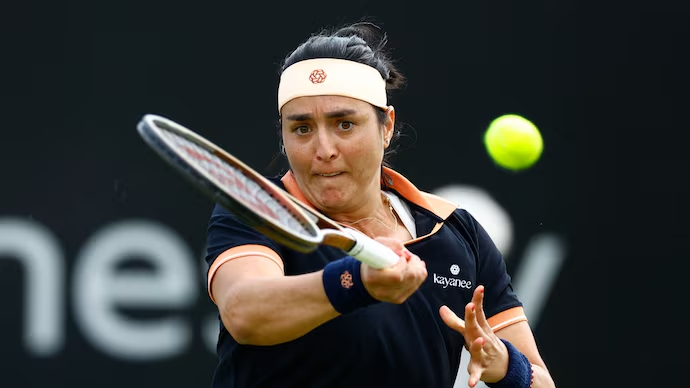
Three-time Grand Slam finalist Ons Jabeur has announced she is stepping away from competitive tennis, citing the need to prioritize her health and happiness.
The 30-year-old Tunisian made the announcement in a heartfelt statement shared on social media on Thursday.
Jabeur, who made history as the first Arab woman to reach a Grand Slam final, has faced a challenging season, failing to progress beyond the third round at any major tournament this year. Her most recent campaign at Wimbledon ended in disappointment when she was forced to retire from her opening-round match against Viktoriya Tomova due to physical difficulties, following an extended medical timeout.
A former world number two, Jabeur has long battled with asthma and suffered breathing issues earlier this year at the Australian Open. Despite her cheerful demeanor and the nickname “Minister of Happiness,” she revealed that she has been struggling to find joy on the court.
“For the past two years, I’ve pushed myself relentlessly playing through injuries and dealing with numerous challenges,” she wrote. “But deep down, I haven’t truly felt happy on the court for a while now.”
“While tennis is a beautiful sport, I believe it’s time for me to step back to breathe, to heal, and to reconnect with the simple joy of living.”
Jabeur, who is married to former fencer and coach Karim Kamoun, has previously expressed her desire to start a family.
She concluded her message with gratitude to her supporters: “Thank you to all my fans for your understanding. Your love and encouragement mean the world to me I carry them with me always.”
A massive N323.4 billion ($211.7 million) share transaction involving First HoldCo Plc, the parent company of First Bank of Nigeria, has set the Nigerian financial market abuzz with questions and guesses.
This deal, one of the biggest in the history of the Nigerian Exchange Limited (NGX), happened on July 16, 2025, involving the sale of 10.43 billion shares, which is about 25% of all First HoldCo’s shares, at N31 per share.
Unlike regular stock market trades, this was done privately through 17 “off-market” deals, meaning they were negotiated directly between the buyers and sellers.
The size of the deal, combined with uncertainty about who bought the shares and why, has everyone talking about what it means for First Bank, Nigeria’s oldest bank, and its future.
The shares were sold by two big players: Oba Otudeko, a former chairman of First HoldCo, and Tunde Hassan-Odukale, another ex-chairman.
Otudeko sold 7.79 billion shares through companies he controls, like Barbican Capital Limited (5.87 billion shares), Peace Account GASL Nominee (1.52 billion shares), and RAML/MEF9 (392.9 million shares).
Hassan-Odukale sold 2.28 billion shares through his companies, including Leadway Holdings Limited (1.03 billion shares) and Leadway Assurance Company (432.3 million shares), plus other pension and investment firms he’s linked to.
The buyer was listed as First Securities Ltd, a brokerage firm, and the deal was handled by several other firms like Cardinal Stone Securities and Meristem Stockbrokers.
The big question is whether Femi Otedola, the current chairman of First HoldCo and a wealthy businessman, bought these shares to gain more control of the bank.
According to reports, his ownership could have jumped from 11.8% (as reported in 2024) to as much as 36.7% or even 40%, making him the most powerful shareholder in First Bank and among Nigeria’s top banks.
But there’s a conflicting story suggesting a company called RC Investments Management Limited, possibly acting for the Nigerian government, bought the shares instead.
This confusion, along with no official announcement from First HoldCo or the NGX, is driving the speculation.
Why It Caused Speculations
Several reasons explain why this deal has everyone guessing about what’s happening:
Who Bought The Shares?
Nobody knows for sure who the buyer is. Many believe Otedola, who has been buying First HoldCo shares since 2021, is behind it. If true, he could now control up to 40% of the bank, giving him huge influence.
However, one report claims RC Investments Management Limited, linked to someone named Samuel Babatunde Sule and possibly the government, was the buyer.
The NGX rules say any deal involving 5% or more of a company’s shares must be publicly announced, but as of July 18, 2025, neither First HoldCo nor the NGX has said anything. This silence is fueling suspicions.
First Bank’s History Of Fights
First Bank has had years of drama among its big shareholders. Otudeko was chairman from 2012 to 2021 but was removed by the Central Bank of Nigeria (CBN) for breaking rules, like giving his own companies huge loans (one was N456 billion!).
He’s also facing a lawsuit from the Economic and Financial Crimes Commission (EFCC) over a N12.3 billion fraud case. Some say First HoldCo’s current leaders, led by Otedola, pushed Otudeko to sell his shares to avoid more legal trouble.
This deal gave Otudeko over N300 billion, letting him walk away from the bank’s problems.
Hassan-Odukale, who also fought for control in 2021, sold his shares too, possibly to invest in other businesses. These exits suggest a big shift in who runs the bank, making investors wonder what Otedola’s plans are.
New Government Rules
The CBN, which oversees banks in Nigeria, made new rules on June 13, 2025, called the Single Obligor Limit.
These rules stop banks from lending too much money to one person or company and require banks like First HoldCo to raise N500 billion in new capital by March 2026 to stay strong.
First HoldCo has raised N346 billion so far but still needs N154 billion. Some experts think this share deal was a way to reorganize the bank’s ownership to follow these rules, not just Otedola buying more shares. But without clear information, people are left guessing.
Big Market Reaction
After the deal, First HoldCo’s share price shot up by 9.9% to N32.2 on July 16 and climbed to N35.40 by July 18, a 20% increase in two days. This pushed the bank’s total value to over N1.3 trillion.
Investors are excited because Otedola has a good track record of turning around companies like Forte Oil and Geregu Power.
They hope he can fix First Bank’s problems, like its N1 trillion in bad loans (money lent out that might not be paid back).
But some smaller shareholders worry that if Otedola owns too much (like 30% or more), he could make decisions that favor him over them.
Earlier this year, these shareholders protested a N350 billion share sale plan, thinking it was Otedola’s way to take over quietly.
First Bank’s Challenges
First HoldCo is struggling with big issues, like its N1 trillion in bad loans and the need to raise more money to meet CBN rules. There are speculations because they want to know if Otedola, or whoever bought the shares, can solve these problems.
The CBN is also watching to make sure smaller shareholders aren’t pushed out, adding pressure to clear up the confusion.
Financial Outlook
This N323.4 billion deal could be a turning point for First HoldCo, potentially ending years of fights and instability.
If Femi Otedola now controls up to 40%, his experience could help fix First Bank’s bad loans and meet the CBN’s new rules. But the lack of clear information about who bought the shares and why, is making investors nervous.
The NGX and CBN need to share details soon to calm the market and protect smaller shareholders.
As Nigeria’s banks work to raise more money and follow new rules, this deal shows how powerful businessmen, government rules, and market hopes are shaping First HoldCo’s future.
Until there’s an official announcement, the speculation will keep growing, and everyone will be watching to see what happens next at Nigeria’s oldest bank.
With the recently enacted ISA 2025, cryptocurrency in Nigeria has moved from uncertainty into a clearly regulated space, now supervised by the Securities and Exchange Commission (SEC).
From exchanges to custodians, there’s finally a legal and structured framework guiding operations within the digital asset ecosystem. However, the bigger question remains will Nigerian banks and brokers embrace this opportunity early, or will they hesitate until global players dominate the space?
As the crypto industry begins to take shape under this new legal backing, many are watching to see how banks, brokers, and investors respond. The SEC’s oversight is expected to boost investor confidence and offer stronger protections, yet risks still exist from market volatility to regulatory compliance issues. Whether crypto can play a meaningful role in addressing Nigeria’s economic woes will depend not just on regulation but also on how effectively local financial institutions adapt and leverage the opportunities within this evolving market.
To provide the best experiences, we use technologies like cookies to store and/or access device information. Consenting to these technologies will allow us to process data such as browsing behaviour or unique IDs on this site. Not consenting or withdrawing consent, may adversely affect certain features and functions.
Functional
Always active
The technical storage or access is strictly necessary for the legitimate purpose of enabling the use of a specific service explicitly requested by the subscriber or user, or for the sole purpose of carrying out the transmission of a communication over an electronic communications network.
Preferences
The technical storage or access is necessary for the legitimate purpose of storing preferences that are not requested by the subscriber or user.
Statistics
The technical storage or access that is used exclusively for statistical purposes.The technical storage or access that is used exclusively for anonymous statistical purposes. Without a subpoena, voluntary compliance on the part of your Internet Service Provider, or additional records from a third party, information stored or retrieved for this purpose alone cannot usually be used to identify you.
Marketing
The technical storage or access is required to create user profiles to send advertising, or to track the user on a website or across several websites for similar marketing purposes.