The Nigerian Upstream Petroleum Regulatory Commission (NUPRC) has announced its readiness to enforce the ‘drill or drop’ policy targeting dormant oil licences.
Gbenga Komolafe, Chief Executive of the NUPRC, revealed this during a recent meeting with a delegation from the Independent Petroleum Producers Group (IPPG) at the commission’s headquarters in Abuja.
According to a statement issued by the commission, Komolafe stressed that oil and gas operators must either commence production within a defined timeframe or forfeit their licences. He explained that the initiative is designed to rejuvenate Nigeria’s oil sector, optimise asset usage, and increase government revenue.
“Komolafe also discussed the implementation of the ‘drill or drop’ policy, which requires operators to either begin production within a specified timeframe or relinquish their licenses. This policy aims to revitalise the oil sector, ensure optimal use of assets, and boost government revenue,” the NUPRC chief executive was quoted.
The Minister of State for Petroleum Resources (Oil), Heineken Lokpobiri, has consistently pledged that the ‘drill or drop’ policy will be enforced. He stated that the government would reclaim idle oil wells from operators who fail to utilise them.
At the meeting, Komolafe welcomed the visiting delegation and reaffirmed the commission’s commitment to maintaining a favourable business climate for industry stakeholders. He highlighted major policy reforms introduced since the passage of the Petroleum Industry Act, including the automation of key regulatory procedures such as licensing and permit issuance.
These reforms, he said, have helped reduce red tape and improved efficiency within the sector.
The IPPG delegation was led by its Chairman, Mr. Abdulrazaq Isa, who is also the Chairman of Waltersmith Group, a prominent indigenous oil and gas company.
“The visit was a strategic engagement aimed at strengthening collaboration between the commission and indigenous producers. It also served as an opportunity for the IPPG to formally express its appreciation to the NUPRC for the critical role it played in facilitating the recent divestment of assets by international oil companies.
These divestments, which were closely overseen by the commission, have enabled a significant transfer of upstream oil and gas assets to indigenous operators. This transition marks a pivotal shift in Nigeria’s energy landscape, creating new opportunities for local companies to scale up operations,” it was stated.
During the engagement, IPPG reaffirmed its support for the commission’s ‘Project One Million Barrels Incremental’ initiative, which is focused on increasing the nation’s daily crude oil output. The group also underlined its dedication to both oil and gas development as part of its long-term strategy.
On the early morning of June 12th, 2025, a series of coordinated Israeli airstrikes hit multiple military and suspected nuclear-linked sites across central Iran marking one of the most significant escalations in the decades long hostilities between the two nations. The strikes come after months of growing tension, covert operations, and mutual cyberattacks that have destabilized the already fragile Middle East security architecture.
The Israeli airstrikes on June 12th, 2025, did not come out of a vacuum, they are the result of years of mounting pressure, proxy battles, and strategic brinkmanship between Israel and Iran.
Tensions between Israel and Iran have escalated over years with Iran supporting militant groups like Hezbollah and Hamas, and Israel conducting preemptive strikes and sabotage operations. In 2025, Iran’s advancement to near-weapons-grade uranium enrichment and alleged involvement in assassination plots and regional drone attacks pushed Israel to act.
These developments, combined with rising hardline leadership in Tehran and a more aggressive Israeli defense posture, set the stage for the June 12th airstrikes the most open and direct military confrontation between the two in recent memory.
Casualties Due To The Airstrike
Iranian state media confirmed that at least 39 people were killed and over 120 injured in the strikes, many of them military personnel stationed near Isfahan and Natanz. The Iranian government has not publicly disclosed whether its nuclear facilities were damaged, but satellite imagery and initial Western intelligence suggest several missile defense systems and weapons storage sites were destroyed.
Hospitals in the region are reportedly overwhelmed, with emergency response teams working under disrupted power grids. Iran has declared three days of mourning for the victims and vowed “swift and decisive retaliation.”
Why Was There An Airstrike?
The Israeli Defense Forces (IDF) claim the operation was a direct response to what they called “an imminent Iranian threat” involving drone swarms and missile transfers to proxy groups operating in Syria and Lebanon. In recent weeks, Tehran had increased its missile shipments to Hezbollah and the Houthis, while also accelerating its uranium enrichment efforts according to IAEA reports.
Analysts point to a failed assassination attempt on an Israeli diplomat in Baku and an intercepted shipment of Iranian drones in the Red Sea as potential triggers for this preemptive strike. Israeli Prime Minister Benny Gantz said in a televised address, “We will not wait for another October 7th. Our red lines are clear we act to prevent, not to avenge.”
Public and Social Media Reactions
Iranian citizens, many already fatigued by years of sanctions and domestic unrest, flooded social media with scenes of smoke plumes rising over residential areas and military compounds. The hashtag #WeAreUnderAttack trended across Persian-language platforms, with users expressing both outrage at Israel and frustration at their own government’s handling of foreign policy.
Meanwhile, in Israel, reactions were mixed. Some praised the government’s “decisiveness,” while others warned the operation could spiral into full-scale war.
A post on X by user, VividProwess read: “I’m speechless. I knew Israel was capable of much more, but what we saw here will be recorded in the history books of wars. The deception, the airstrikes, the intelligence, Mossad’s inside job it’s insane. Iran is utterly humiliated. God bless Israel.”
I’m speechless. I knew Israel was capable of much more, but what we saw here will be recorded in the history books of wars.
The deception, the airstrikes, the intelligence, Mossad’s inside job—it’s insane.
Another X user HilzFuld tweeted: “So are we (and the media) going to completely ignore the fact that the only casualties from Israel’s attack on Iran were terrorists with zero collateral damage or civilian deaths? Interesting how that works, huh?”
So are we (and the media) going to completely ignore the fact that the only casualties from Israel’s attack on Iran were terrorists with zero collateral damage or civilian deaths?
U.S. President Kamala Harris has called for “restraint and de-escalation,” while the EU has called an emergency session of the UN Security Council.
What Next’s For Both Countries
Iran has placed its armed forces on high alert and warned that retaliation is “not a question of if, but when.” Hezbollah and other Iranian-aligned militias have also signaled readiness to launch attacks on Israeli interests regionally.
Regional airspaces remain partially closed, oil markets are reacting with volatility, and diplomatic hotlines between Washington, Riyadh, and Ankara are reportedly in near-constant use.
With both Iran and Israel unwilling to back down, the region now faces its most dangerous confrontation in years. The question remains: will this remain a limited exchange or will it ignite a broader war neither side claims to want?
The Defence Headquarters has confirmed the arrest of a Chinese national during a counter-terrorism operation carried out by Nigerian troops in Borno State.
The suspect, whose identity has not been made public, claimed to be a miner. However, he is currently in custody and undergoing interrogation to determine the circumstances surrounding his presence in an area of ongoing military operations.
This incident comes just days after the military disclosed the arrest of four Pakistani nationals in the region, who were allegedly involved in training terrorist elements.
Speaking during a media briefing in Abuja on Friday, the Director of Defence Media Operations, Major General Markus Kangye, revealed that five terrorist logistics suppliers and collaborators were also apprehended during coordinated military operations conducted between June 5 and 7, 2025, in Kukawa and Ngala Local Government Areas of Borno State, as well as Geidam Local Government Area of Yobe State.
“In addition to the arrest of five terrorist logistics suppliers and collaborators, our troops detained a Chinese national claiming to be a miner,” Kangye said. “Items recovered from the suspects include a vehicle, a motorcycle, several mobile phones, a Chinese international passport, and the sum of ₦10,000.”
Kangye raised questions about the foreign national’s presence in a high-risk operational zone.
“Whenever individuals are arrested, especially foreigners, they often deny involvement in illicit activities,” he said. “But we must ask: what was he doing in an area where military operations were ongoing?”
He assured that a full investigation is in progress to uncover the suspect’s motives and any potential connections to terrorist groups.
“The Chinese national remains in custody and is being thoroughly interrogated. Once investigations are complete, we will provide comprehensive details—including how and why he was found there, and whether he was acting alone or in concert with others,” Kangye added.
Addressing allegations that military forces are slow to respond to distress calls during attacks, particularly in remote communities, Kangye rejected such claims as inaccurate.
“Such assertions are misleading,” he said. “People must understand that our troops are not stationed in every village. In some cases, incidents happen 10 to 15 kilometres from the nearest military post.”
He explained that operational logistics—such as identifying the appropriate unit, assigning commanders, and preparing vehicles and supplies—affect response times.
“It’s similar to a hospital treating patients based on the severity of their conditions. If you’re not aware of internal priorities, you might feel overlooked. But it doesn’t mean no action is being taken,” he emphasized.
Kangye reiterated that all distress calls are treated seriously and assured the public of the military’s unwavering commitment to safeguarding lives and neutralizing threats.
“Let’s not be quick to accuse our troops of delays,” he said. “They are operating under extremely challenging conditions and are doing their utmost to respond whenever called upon.”
South African President Cyril Ramaphosa on Friday visited survivors of the deadly floods that claimed at least 78 lives in the Eastern Cape province, describing the disaster as a consequence of climate change.
During his tour of the affected areas, Ramaphosa met with residents whose homes, schools, roads, and health facilities were engulfed in mud and floodwaters. Many people in this impoverished region have been left with nothing.
Rescue teams continued going door to door, searching for both victims and survivors. Many people were trapped in their homes as the water surged in during the night. Some managed to escape to their rooftops, where they waited for hours to be rescued.
Ramaphosa visited the site where a school bus was swept away, resulting in the deaths of at least six children and three adults. Four children were still unaccounted for at the time of the visit.
He also met a woman who had lost her mother and at least two young nephews. The woman, overcome with emotion, wept as the president listened to her.
“This is a catastrophic disaster which is caused by climate change,” said Ramaphosa, noting that the floodwaters had risen more than four metres (13 feet) high.
“During winter, we expect cold as well as snow here in the Eastern Cape. Now that we are confronting floods, this goes to show the severity of the issue of climate change.”
While snow and rainfall are expected in winter, the coastal areas of South Africa experienced what Ramaphosa described as “unprecedented” weather conditions on Thursday.
According to the Green Climate Fund, South Africa is highly vulnerable to climate variability and change, which has intensified the frequency and severity of extreme weather events.
The official death toll stood at 78 as of Thursday, but authorities warned the number could rise. Bodies were still being recovered from a nearby river as of Friday morning.
The city of Mthatha, located roughly 800 kilometres (500 miles) south of Johannesburg, was among the hardest hit. This area also includes Qunu, the birthplace of former President and anti-apartheid icon Nelson Mandela.
The South African Red Cross Society reported that at least 3,500 households were impacted, with many people taking shelter in community halls.
On Thursday, AFP journalists witnessed a rescue team retrieve four bodies—some of them children—from a one-roomed house. The scene was filled with debris, and emotional locals looked on in grief.
“When we came out of the house, the water was above the knee, all the furniture inside was floating,” Sopiseka, a survivor, told AFP.
Ali Sablay, a representative of the disaster relief organisation Gift of the Givers Foundation, said the number of people needing assistance could rise significantly.
“The homes are fragile; they can collapse anytime. Food is contaminated, so people need to be evacuated,” said Sablay.
Local officials confirmed that at least 20 health facilities and 58 schools sustained damage during the floods.
Angry crowds flooded the streets of Nairobi, voicing their outrage over the death of a blogger who had been detained by police a week earlier. This protest comes amid fresh revelations from the police oversight body that 20 people have died in custody over the past four months.
Officers fired tear gas to scatter demonstrators gathered near the Parliament building on Thursday. The protesters were demanding justice for 31-year-old Albert Ojwang, who was arrested in Homa Bay after publishing criticism against Deputy Police Chief Eliud Lagat.
Police originally claimed Ojwang lost his life “after hitting his head against a cell wall.” But pathologist Bernard Midia, who participated in the post-mortem examination, said that the head trauma, neck compression, and tissue damage observed indicated that he died as a result of an assault.
On Wednesday, President William Ruto acknowledged Ojwang’s death “at the hands of the police,” contradicting the initial official version. He described the incident as “heartbreaking and unacceptable.”
Reports indicated that a police constable was taken into custody in connection with Ojwang’s death.
According to an eyewitness account from the protests, Ojwang known for commenting on political and social matters had previously made online posts accusing Lagat of involvement in a “bribery scandal.”
“It’s angered people that he was detained for that, and then days later, dead in a police station,” the reporter noted, adding that demonstrators were insisting Lagat be held responsible and were “persisting in throwing stones at the police in spite of one volley of tear gas after the next being fired at them.”
Ojwang’s case has stirred public concern about long-standing allegations against security forces, including unlawful killings and enforced disappearances.
During a parliamentary briefing on Thursday, Issak Hassan, chair of the Independent Policing Oversight Authority, confirmed that “20 deaths in police custody in the last four months” have occurred.
An official inquiry into Ojwang’s death has now begun.
Inspector General Douglas Kanja on Wednesday apologized for the previous claim that Ojwang’s death was self-inflicted, telling senators: “He did not hit his head against the wall.”
His death comes nearly a year after protesters and activists were killed or disappeared during demonstrations over a controversial finance bill — with several individuals still unaccounted for.
Those rallies triggered widespread criticism of President Ruto over the violent handling of dissent.
Amnesty International has called for Ojwang’s death in detention last Saturday to “be urgently, thoroughly and independently investigated.”
China has revealed its decision to completely remove tariffs on imports from African nations that share diplomatic ties with it. This development marks a significant adjustment aimed at strengthening its economic relationship with the continent as it solidifies its role as a vital partner in trade and investment.
This zero-tariff policy applies to Nigeria along with 52 other African nations but does not include Eswatini the sole country on the continent that maintains official relations with Taiwan.
This major shift was revealed after Chinese Foreign Minister Wang Yi met with top African representatives during a gathering held in Changsha, located in China’s Hunan province.
Previously, such exemptions from tariffs were granted only to the continent’s poorest economies, but this latest policy represents a broad extension beyond that limited scope.
Chinese leader Xi Jinping, in his official message to African foreign ministers, declared that “zero-tariff treatment for 100 per cent of tariff lines” will now benefit all 53 African countries that have formal diplomatic connections with Beijing.
This new approach expands upon promises made earlier at a China-Africa summit last September when preferential access was given to 33 of the continent’s least-developed nations.
The impact of these efforts is already showing, with Chinese exports to Africa climbing by 12.4% within the first five months of the year, hitting an unprecedented 963 billion yuan ($134 billion), as disclosed by China’s Foreign Ministry.
This gesture from Beijing arises against the backdrop of increasing friction in trade relations between Africa and the United States.
In the joint statement released after the meeting, countries, particularly the US, were urged to “return to the right track” of resolving trade disputes through dialogue based on mutual respect.
This message comes in response to President Trump’s latest move to impose high tariffs on various African countries.
The levies introduced include duties of up to 50 per cent on goods from Lesotho, 47 per cent on items from Madagascar, 40 per cent on products from Mauritius, 38 per cent on Botswana’s exports, and 31 per cent on goods coming from South Africa — the continent’s top industrial hub and leading U.S. trade partner.
More than 30 African nations now stand at risk of losing the trade benefits provided under the U.S. African Growth and Opportunity Act (AGOA), a critical trade framework that has faced growing doubts in recent times.
President Donald Trump had previously hinted at plans to introduce reciprocal tariffs on all American trading partners, raising fresh concerns about the continuity of AGOA and other similar special agreements.
China’s latest zero-tariff initiative is seen as offering Africa a more reliable and steady economic partnership, especially as global trade tensions intensify.
Protests swept across Kenya on Thursday following the shocking death of 31-year-old blogger and former teacher, Albert Ojwang, who died in police custody under suspicious circumstances sparking outrage over alleged police brutality and impunity.
Ojwang was arrested last week in Homa Bay, western Kenya, after publishing social media posts criticizing Deputy Inspector General of Police, Eliud Lagat, and linking him to a reported bribery scandal. After his arrest, Ojwang was transported over 200 miles to Nairobi, where he died just hours later.
Police initially claimed that the blogger had “hit his head on a cell wall,” but that narrative quickly unraveled after an autopsy revealed multiple signs of torture.
“The cause of death is very clear head injury, neck compression, and other injuries spread all over the body that are pointing towards assault,” said Dr. Bernard Midia, one of five pathologists who examined the body. “Multiple soft tissue injuries” were also documented.
Six police officers were on duty at the time of Ojwang’s death. One officer has been arrested and charged with murder, while two others remain at large. Kenya’s Independent Policing Oversight Authority has confirmed that more arrests are expected.
Demonstrations erupted almost immediately after news of Ojwang’s death became public earlier in the week, but Thursday’s protests were the largest yet paralyzing parts of Nairobi and several towns in western Kenya and the Rift Valley. Many businesses closed their doors as protestors blocked roads, set vehicles on fire, and clashed with police in attempts to march on Parliament.
“There’s no value for life; they are killing us every day,” said journalist and activist Hanifa Adan at one of the rallies. “We are here demanding justice.”
Chants of “No justice, no budget!” and “Lagat must go!” rang out from demonstrators holding signs and newspaper front pages highlighting the incident. The protests also served as a powerful echo of last year’s anti-tax demonstrations, which left more than 60 people dead and underscored growing public dissatisfaction with the government and security forces.
In a dramatic turn, Police Chief Douglas Kanja issued a public apology for initially misleading the nation about Ojwang’s death. During a tense parliamentary hearing, lawmakers grilled senior police officials amid growing pressure to reform law enforcement and account for the over 20 deaths in custody recorded in just the past four months.
As the investigation continues and more arrests loom, Kenyans are demanding real accountability not just for Ojwang, but for a police system many say has operated with near-total impunity.
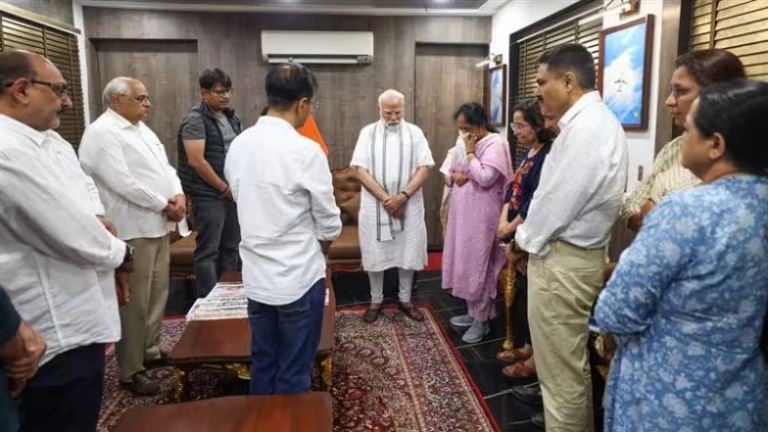
In a deeply emotional moment for Indian politics, Prime Minister Narendra Modi has paid a personal visit to the grieving family of Vijay Rupani, the former Chief Minister of Gujarat and a senior leader of the Bharatiya Janata Party (BJP), who was among the many killed in the catastrophic Air India plane crash on Thursday.
Rupani, a veteran politician and a close aide of the Prime Minister, was on board the ill-fated Boeing 787 Dreamliner that crashed shortly after takeoff from Ahmedabad. The crash claimed the lives of all passengers and crew — including Rupani, 169 Indian nationals, 52 British citizens, and others — marking one of the deadliest aviation disasters in recent Indian history.
As news of Rupani’s death sent shockwaves through the nation, Prime Minister Modi took to X (formerly Twitter) to share a heartfelt tribute to the man he had worked alongside for decades.
“It is unimaginable that Vijaybhai is not in our midst. I’ve known him for decades. We worked together, shoulder to shoulder, including during some of the most challenging times,” the Prime Minister wrote.
Modi’s visit to the Rupani family in Rajkot was marked by visible sorrow. Accompanied by senior BJP leaders and security personnel, Modi offered his condolences, spending several moments with family members — a rare personal gesture that underlined the deep political and emotional bond the two leaders shared.
“Will always cherish the interactions we had. My thoughts are with his family and friends in this hour of grief,” Modi added in his post.
Rupani, who served as Gujarat’s Chief Minister from 2016 to 2021, was a well-regarded figure in state and national politics, known for his quiet, effective leadership and organizational acumen within the BJP. His tenure was marked by infrastructural development, administrative reforms, and a firm alignment with Modi’s national vision for growth.
Modi described him as “humble and hardworking” and someone who had served “diligently” in his time as Gujarat’s top executive.
In the wake of the crash, tributes have poured in from across the political spectrum. Leaders from the Congress party, regional parties, and civil society have all expressed shock and extended condolences, particularly acknowledging Rupani’s contributions to Gujarat’s governance.
The Air India flight, bound for London, crashed into a building used for medical staff accommodation at Byramjee Jeejeebhoy Medical College and Civil Hospital, just minutes after takeoff. Authorities are still investigating the cause of the crash, though early reports suggest a sudden mechanical failure mid-air. A full inquiry has been launched by the Directorate General of Civil Aviation (DGCA).
In the midst of national mourning, Modi’s message has resonated with many who saw Rupani as part of the core leadership that helped shape the BJP’s rise in Gujarat and, eventually, India.
The Prime Minister’s deeply personal tone in the wake of the tragedy has not gone unnoticed. His words carried the weight of decades of shared political life, and for those familiar with Modi’s rarely public emotional expressions, the message on X served as both a eulogy and a tribute.
As India prepares to cremate and honor those lost in the tragedy, Vijay Rupani’s legacy will be remembered not just through his political career, but through the very personal loss felt by his closest ally — the Prime Minister of India himself.
The Movement for the Survival of Ogoni People (MOSOP), under the leadership of Fegalo Nsuke, has commended President Bola Tinubu for granting a posthumous presidential pardon to the nine Ogoni rights activists executed in 1995 by the military regime of General Sani Abacha.
Those pardoned include Ken Saro-Wiwa, Nubari Kiobel, Nordu Eawo, Saturday Doobee, John Kpuinen, Paul Levura, Daniel Gbokoo, Felix Nuate, and Baribor Bera. Nsuke described the gesture as a “historic and courageous act of national reckoning” and a crucial step toward healing the wounds inflicted on both the Ogoni people and the nation.
He further praised Tinubu for showing boldness and compassion in addressing a long-standing demand for justice, saying, “The President’s acknowledgment of the grave injustice done to the Ogoni Nine, especially the statement that their execution should never have happened, has been met with gratitude both within Nigeria and around the world.” However, Nsuke argued that while the pardon is important, it implies forgiveness of a crime that was never committed.
He urged the president to go further by establishing a Judicial Commission of Inquiry, stating, “Such an exoneration would be a stronger moral and legal correction, ensuring that their names are no longer burdened by the stain of injustice.”
Who Were The Ogoni Nine?
The Ogoni Nine were a group of nine activists from the Ogoni region of Nigeria who opposed the operating practices of the Royal Dutch Shell oil corporation in the Niger Delta.
Led by social activist Ken Saro-Wiwa, the group also included Saturday Dobee, Nordu Eawo, Daniel Gbooko, Paul Levera, Felix Nuate, Baribor Bera, Barinem Kiobel, and John Kpuine. Saro-Wiwa was the founder of Movement for the Survival of the Ogoni People (MOSOP) a movement representing over 700,000 Ogoni people campaigning for social, economic, and environmental justice through peaceful protest.
Ken Saro-Wiwa had previously been a critic of the Royal Dutch Shell oil corporation, and had been imprisoned for a year.
In 1995, under the military regime of General Sani Abacha, the Ogoni Nine were tried and executed by hanging on the 10th of November 1995 accused without presenting any evidence of inciting the murder of four Ogoni chiefs. They were buried in Port Harcourt Cemetery.
According to Amnesty International, “in May of 1994, the Ogoni chiefs Albert Badey, Edward Kobani, Samuel Orage and Theophilus Orage, were killed in Gokana. R. Boele, known to be opponents of MOSOP.
The executions provoked international condemnation and led to the increasing treatment of Nigeria as a pariah state until General Abacha’s mysterious death in 1998.
Ogoni Nine And What They Fought For?
The Ogoni Nine, through MOSOP, were engaged in a nonviolent struggle against environmental destruction, economic marginalization, and social injustice caused by oil exploration in their homeland.
Ogoniland had suffered extensive environmental degradation, primarily due to oil spills, These oil spills made the land uninhabitable in some areas, and unable to be farmed, a common livelihood of the Ogoni people and polluted the air and water crippling agriculture and fishing, the backbone of the Ogoni economy.
By 1992, MOSOP’s activism became sharply focused on the operations of oil companies in the Niger Delta, particularly Royal Dutch Shell. In early 1993, the movement intensified its international engagement, including appeals to the United Nations.
On January 4, 1993, over 300,000 Ogoni people marched peacefully in protest against oil production in their region. During that demonstration now commemorated annually as Ogoni Day, one Ogoni leader said, “We have woken up to find our lands devastated by agents of death called oil companies. Our atmosphere has been totally polluted, our lands degraded, our waters contaminated, our trees poisoned, so much so that our flora and fauna have virtually disappeared.”
The years that followed were marked by increased violence, particularly between 1993 and 1994. The Nigerian military was frequently deployed to suppress the movement, often resulting in brutal crackdowns.
In May 1994, four Ogoni chiefs were murdered, and the government swiftly blamed MOSOP, arresting dozens of its members including the Ogoni Nine despite lack of credible evidence. Later in 1994, Shell reportedly sought military assistance to secure a pipeline route through Ogoniland. Amid this, violence escalated dramatically, and it is estimated that as many as 2,000 people lost their lives during that period.
The continued resistance by MOSOP, led by Ken Saro-Wiwa, challenged both multinational corporations and the military dictatorship, drawing global attention to the plight of the Ogoni people and the human rights abuses in the Niger Delta.
What Has The Government Done Towards Ogoni Land’s Liberation
The Nigerian government has taken some steps toward addressing the environmental and social issues in Ogoniland. Various agencies, including the Federal Ministry of Environment, have engaged in cleanup efforts in collaboration with international partners.
In 2011, the United Nations Environment Programme (UNEP) released a comprehensive report detailing the extensive contamination in Ogoniland, calling for urgent remediation. Since then, initiatives aimed at environmental restoration and community rehabilitation have been launched, though progress has been slow and often criticized as inadequate by activists and local communities. The recent presidential pardon and calls for exoneration of the Ogoni Nine signal a renewed commitment at the federal level to acknowledge past injustices and promote reconciliation.
MOSOP and other civil society groups continue to urge the government to implement comprehensive cleanup and development programs that respect the rights and livelihoods of the Ogoni people, ensuring that environmental justice becomes a lasting reality.
The Current State Of Ogoni Land
Since the execution of the Ogoni Nine and throughout the early 2000s, Nigeria has witnessed numerous oil spills and extraction-related fires affecting many areas. While no further drilling has occurred in Ogoniland since 1993, the land remains severely damaged.
Underground pipelines continue to leak, worsening the environmental degradation. Shell has yet to conduct comprehensive cleanup efforts, though it paid £55 million in reparations in 2014 for two oil spills that happened in 2008.
Although gas flaring and acid rain across Ogoniland have reduced, pollution still severely impacts the vegetation and the land. Ogoni Day continues to be commemorated each year on January 4, with the 30th anniversary celebrated in 2023, as a reminder of the ongoing struggle for justice and environmental restoration.
Chief Olu Falae, a former Secretary to the Government of the Federation and the joint presidential candidate of the Alliance for Democracy (AD) and the All Peoples Party (APP) in the 1999 general elections, has claimed that he was the actual winner of the election that marked Nigeria’s return to civilian rule not former President Olusegun Obasanjo.
In an interview on Thursday, part of a Democracy Day special, Falae alleged that the results of the 1999 election were tampered with to favour Obasanjo, who ran on the platform of the Peoples Democratic Party (PDP).
Referencing a legal review conducted by his late lawyer, Chief J.O.K. Ajayi, Falae insisted he won the election by a wide margin.
“My lawyer, the late Chief J.O.K. Ajayi, after carefully reviewing the declared results, concluded that I won by more than one million votes,” Falae stated.
However, Falae explained that he opted not to challenge the outcome in court, choosing instead to preserve national peace and focus on ensuring a smooth return to civilian rule.
“We were more concerned about ensuring a peaceful transition to civilian rule after prolonged military governance. That was our focus at the time,” he said.
His statements have sparked renewed debate over the legitimacy of the 1999 transition process, which followed the death of General Sani Abacha and was coordinated under the leadership of General Abdulsalami Abubakar. That election was widely seen as a calculated effort to stabilize the country and address grievances from the South-West region following the annulled 1993 elections, which many believe were won by MKO Abiola.
Falae’s joint candidacy, supported by the two main opposition parties, was viewed as a conciliatory gesture to the Yoruba ethnic group. Obasanjo, also Yoruba and a former military ruler, was perceived to have the support of the political elite and military establishment.
“There was immense pressure on us not to upset the transition process,” Falae noted. “We made sacrifices to ensure that democracy could return. I accepted the outcome then in good faith, but the truth remains I won that election.”
Stressing the importance of setting the historical record straight, he added:
“This isn’t about me. It’s about the truth. Nigerians deserve to know what really happened at the dawn of this democratic era.”
Falae also expressed concern over the continued lack of credible elections in Nigeria, asserting that no truly free and fair election has taken place in the country since the annulled 1993 vote.
To provide the best experiences, we use technologies like cookies to store and/or access device information. Consenting to these technologies will allow us to process data such as browsing behaviour or unique IDs on this site. Not consenting or withdrawing consent, may adversely affect certain features and functions.
Functional
Always active
The technical storage or access is strictly necessary for the legitimate purpose of enabling the use of a specific service explicitly requested by the subscriber or user, or for the sole purpose of carrying out the transmission of a communication over an electronic communications network.
Preferences
The technical storage or access is necessary for the legitimate purpose of storing preferences that are not requested by the subscriber or user.
Statistics
The technical storage or access that is used exclusively for statistical purposes.The technical storage or access that is used exclusively for anonymous statistical purposes. Without a subpoena, voluntary compliance on the part of your Internet Service Provider, or additional records from a third party, information stored or retrieved for this purpose alone cannot usually be used to identify you.
Marketing
The technical storage or access is required to create user profiles to send advertising, or to track the user on a website or across several websites for similar marketing purposes.