Home Blog Page 156

Benue Governor Assures Corps Members Of Security And Welcomes Them As ‘Home Away From Home’

Benue State Governor, Hyacinth Alia, on Friday reaffirmed his commitment to ensuring the safety of all National Youth Service Corps (NYSC) members deployed to the state. Addressing the 2025 Batch A Stream II corps members, he encouraged them to regard Benue as their “home away from home.”

Represented by the Permanent Secretary of the Ministry of Youth, Sports, Development and Creativity, Dr. Phillip Nongu, the governor gave the assurance at the swearing-in ceremony of 1,303 corps members held at the NYSC Orientation Camp in Wannune, Tarka Local Government Area.

“It is understandable that finding yourselves in a strange land would create all sorts of doubt and fear, but I assure you that being in Benue State is just a home away from home,” he said.

He acknowledged the security issues confronting the country, noting that Benue State had also been affected. “Sadly, our nation is currently bedevilled by security challenges, and Benue State has not been left out. Therefore, let me quickly allay your fears and assure you that as a government, we are poised to ensure your security throughout your stay in the state,” he said.

“For the avoidance of doubt, our administration, in conjunction with all security agencies, has put in place proactive measures to ensure the safety of all locations and residential areas of corps members in the state.”

Governor Alia also urged the corps members to embrace all activities in camp and take their primary assignments seriously. He described these phases as crucial opportunities that could “open doors to great fortune.”

Earlier, the State Coordinator of the NYSC, Mrs. Veronica Garba, expressed appreciation to the governor for his continuous support. She encouraged the corps members to engage actively with the four core NYSC programmes, which include orientation courses, physical training, intellectual and motivational lectures, sporting activities, and Skill Acquisition and Entrepreneurship Development (SAED).

The Chief Judge of the state, Justice Maurice Ikpambese, represented by Justice J.N. Adagba, administered the oath of allegiance to the corps members.

Dangote Sugar Appoints Arnold Ekpe As New Board Chairman

Dangote Sugar Refinery Plc has announced the appointment of Mr. Arnold Ekpe as Chairman of its Board of Directors, effective June 16, 2025.

This was disclosed in a corporate statement dated June 11, 2025. Mr. Ekpe will be succeeding Alhaji Aliko Dangote (GCON), who is stepping down on the same date after nearly two decades of outstanding leadership and service to the company.

The Board stated that Mr. Ekpe’s appointment came after a thorough selection process to find a qualified successor capable of continuing the standard of excellence set during Alhaji Dangote’s tenure.

Highlighting the confidence in the new leadership, the Board described Mr. Ekpe’s deep knowledge of engineering, finance, and executive management as essential for guiding the company’s future growth and innovation.

About Mr. Arnold Ekpe

Mr. Arnold Ekpe is a highly regarded corporate leader with more than 30 years of experience in global banking and industrial sectors.

Born in Nigeria in August 1953, he attended King’s College, Lagos, graduating in 1972. He then moved to the United Kingdom for his higher education. Between 1973 and 1976, he studied Engineering at the University of Manchester, graduating with First Class Honours as a Shell Scholar. He later earned an MBA from Manchester Business School (1977–1979).

Mr. Ekpe began his career in 1977 at Schlumberger SA as a Wireline Logging Engineer. In 1979, he joined Alcan Aluminium Nigeria, where he served as Executive Assistant to the CEO, overseeing key operations such as purchasing and labour relations.

His shift into banking came in the early 1980s when he joined International Merchant Bank (IMB), affiliated with First Chicago, as Head of Strategy. From 1980 to 1986, he served as General Manager of IMB Securities, leading its investment banking and stockbroking activities.

From 1986 to 1987, he was General Manager and Head of Corporate Finance at City Securities Limited, part of First City Monument Bank. He later moved to Nigeria International Bank (now Citibank Nigeria), serving as General Manager from 1987 to 1990.

Mr. Ekpe is perhaps best known for his time as Group CEO of Ecobank Transnational Incorporated, a position he held until his retirement in 2012.

In 2024, he joined the Board of Dangote Sugar Refinery as an Independent Non-Executive Director, bringing extensive governance experience and strategic insight to the company. His elevation to Board Chairman reflects the company’s commitment to strong leadership and continued progress.

Were Nigerians On Crashed Air India flight AI17? What We Know So Far

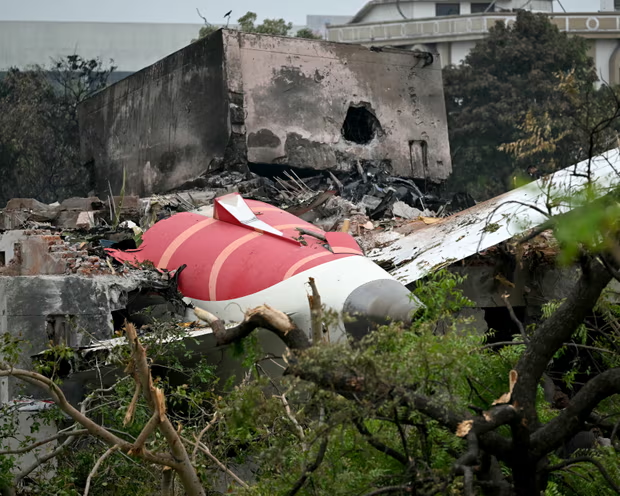
A tragic air disaster struck western India on Thursday when an Air India Boeing 787 Dreamliner crashed just moments after takeoff from Ahmedabad’s Sardar Vallabhbhai Patel International Airport.

The London-bound Flight AI171 was carrying 242 passengers and crew members and in a heartbreaking turn, only one person survived the crash, marking it as the deadliest plane disaster the country has seen in years and the first-ever crash involving the Boeing 787 Dreamliner model.

The crash also claimed lives on the ground as the aircraft plummeted into the BJ Medical College and Hospital hostel, bringing the total death toll to at least 290.

How It Happened

Shortly after taking off at 1:39 p.m. local time, the aircraft struggled to gain altitude, barely making it past 625 feet before its signal disappeared. Data from FlightRadar 24 shows that the plane suddenly plunged earthward at a rate of 475 feet per minute.

The flight crew quickly issued a Mayday call less than a minute after takeoff, signaling critical trouble to air traffic control.

Disturbing footage captured by eyewitnesses showed the jet struggling to stay aloft, its tail sinking as the nose pointed forward — before disappearing behind apartment buildings, followed by a towering fireball and dark smoke billowing into the sky.

“Thirty seconds after take-off, there was a loud noise and then the plane crashed. It all happened so quickly,” recalled the sole survivor, Vishwash Kumar Ramesh.

When It Happened

The crash occurred on Thursday, shortly after 1:39 p.m. local time, mere seconds after takeoff. The plane was scheduled to land at London Gatwick nine hours later but never made it past the skies of Ahmedabad.

Were There Nigerians on Board?

According to Air India, there were no Nigerians on board the ill-fated flight. The passengers included:

169 Indian nationals

53 British nationals

7 Portuguese nationals

1 Canadian national

Many on the flight were either returning to Britain after visiting family in India or traveling to reunite with relatives in the UK, reflecting the large Indian diaspora in Britain.

The Survivor’s Account

Astonishingly, one man survived the horrific disaster.

Vishwash Kumar Ramesh, a 40-year-old British father, walked away from the wreckage with injuries to his chest, eyes, and feet. Rescued by local authorities from a residential area near the crash site, Ramesh was taken to a nearby hospital for treatment.

Speaking from his hospital bed, Ramesh described the terrifying moments onboard:

“When I got up, there were bodies all around me. I was scared. I stood up and ran. There were pieces of the plane all around me. Someone grabbed hold of me and put me in an ambulance and brought me to the hospital,” he said.

Ramesh was flying home to London after visiting family in India. Tragically, he reported that his brother, who was also on the flight but seated elsewhere, was missing.

“I can’t find him anymore,” Ramesh said quietly.

As investigations continue into what caused this catastrophic crash, the world mourns the loss of so many lives in what should have been a routine journey.

The aviation industry and travelers alike are left with heavy hearts, awaiting answers and hoping for improved safety measures to prevent such a tragedy from ever happening again.

Benue River Banks and the Challenge of Insecurity – An Affirmation of Government’s Bold Response

4

In the not too distant past of the Benue River — silent, brooding, and beautiful — there echoes the pulse of a people so blessed as the best freshwater capital of Nigeria’s inland waterways. The banks of this great river, once a cradle of culture and commerce, have in recent times drawn deep sighs from bruises of anguish and suspicion, not for want of beauty, but for the insecurity that shadows its course like a lingering ghost.

Indeed, there is a poetic truth in the assertion that in every group there lies a deviant strain — an inevitable deviation from the moral arc of the collective. These deviants, if left unchecked, metastasize into saboteurs — carving from the sacred body of community their own selfish fiefdoms of chaos. In a society worth its salt, such saboteurs, who compromise the communal fabric, have often faced swift and resolute justice.

Yet, while it is valid to raise concern about the creeping threat that lurks upon the riverbanks, in arms trafficking, unregulated settlements, informants of the underworld, and the growing opacity around the identities and activities of riverine dwellers; it is equally important to balance this apprehension with sober appreciation of the sweeping, strategic actions already being undertaken by the Benue State Government under the visionary and dynamic leadership of His Excellency, Rev. Fr. Dr. Hyacinth Iormem Alia.

Lest, it is forgotten in a hurry that, for decades, the question of security along the Benue River and its tributaries had remained a rhetorical echo; raised in local gossip, muted in policy circles, and abandoned on the drawing tables of administrations past. But with the emergence of the Alia-led government, this ghost is currently underway of being confronted head-on.

For the first time in the history of Benue State, in a decisive demonstration of leadership courage by Governor Alia, the Chief of Naval Staff, Vice Admiral Emmanuel Ogalla, visited Makurdi in a landmark strategic tour made possible through the audacious diplomatic engagements of the Governor. The purpose was not ceremonial; it was surgical. This was followed swiftly by the groundbreaking establishment of a Naval Base and a Navy Marine Command outpost in Benue State. These installations are not mere symbolic gestures; they represent an unprecedented pivot to secure our inland waterways, monitor riverine movements, and flush out criminal enterprises operating under the veil of darkness along the banks.

Furthermore, under the Alia administration, the reinvigoration of the Benue State Community Protection Guards, and the mobilization of coordinated vigilante efforts have extended to critical flashpoints like Agatu, North Bank, Abinsi, Gbajimba, Buruku, New Garage and Katsina-Ala. Modern surveillance and digital mapping technologies are also being implemented for the profiling of riverbank households and boat operators, ensuring that no shadow remains without scrutiny.

In the Governor’s holistic vision of “Alianomics,” security is not a standalone pillar, but interwoven with development, social renewal, and administrative accountability. In partnership with federal agencies, there is a growing synergy to harmonize traditional, religious, and local leadership into a united front, not just for intelligence gathering but also for moral rearmament of our society.

Yes, the call to action is noble, but let it not descend into despair or unwarranted indictment of our collective progress. Where shadows loom, light must be acknowledged, and where efforts are in motion, encouragement is due. What we must do, as informed patriots, is amplify these gains, support the structures, report with accuracy, and refuse to glorify fear where hope is germinating.

Makurdi’s river island, once the pride of our youth’s recreation and cultural life, is not lost; it is being reclaimed. The reclamation, however, must happen not only in policy and enforcement but in the conscious re-awakening of our civic dignity and communal will. Let the people become the first line of defense, standing shoulder to shoulder with government efforts, not as accusers, but as co-builders.

We stand at a historic cusp: where the Benue River may no longer be whispered about as a corridor of insecurity, but proudly reclaimed as a lifeline of security, commerce, recreation, and culture — a new testament of possibility under a leadership that listens, acts, and leads with divine courage.

Let history record it today that the Alia administration has not only heard the cries from the riverbanks; His Excellency has responded, decisively, and history shall testify that Benue rose again because her leadership dared where past leadership floundered, and the good people of Benue State dared to believe.

Prof. Qrisstuberg Amua is a Pastor and a firm believer in the visionary and focused leadership of His Excellency Rev. Fr. Dr. Hyacinth Iormem Alia’s AliaNomICs blueprint, agenda and governance of Benue State.

June 12 Democracy Day: 10 Key Takeaways From President Tinubu’s Speech At The National Assembly

4

On June 12, 2025, Nigeria marked 26 years of uninterrupted democratic governance with a historic address by President Bola Ahmed Tinubu at a joint session of the National Assembly in Abuja.

The event, held in the revered chambers of the House of Representatives, was a poignant commemoration of Democracy Day—a date etched in Nigeria’s history due to the annulled 1993 presidential election won by Chief MKO Abiola.

With the nation’s capital under tight security, the address drew an illustrious audience, including Vice President Kashim Shettima, Senate President Godswill Akpabio, Speaker Abbas Tajudeen, and other dignitaries, reflecting its national significance.

President Tinubu’s speech was a blend of historical reflection, tributes to the heroes of democracy, and a forward-looking vision for Nigeria’s economic and social progress.

Here Are 10 Key Takeaways from the President’s Address:

Celebrating Nigeria’s Democratic Resilience

Tinubu opened his address by reflecting on Nigeria’s remarkable journey from military rule to democracy since 1999.

He described the National Assembly as “a parliament that embodies the will of the Nigerian people” and expressed a blend of pride and resolve upon entering the chamber.

“Today, as I entered this grand edifice built from the sweat and toil of our democratic yearning, my heart stirred. It was a blend of accomplishment and resolve,” he said.

He emphasized the enduring commitment of Nigerians to democratic ideals:

“Since 1999, democracy has risen from the ashes and destitution of military rule to take its rightful place as the only mode of governance for our resilient and beloved people.”

Honoring June 12 and Its Heroes

A central theme of the speech was a tribute to Chief MKO Abiola—whose 1993 election victory was annulled—and to other democracy activists who paid the ultimate price.

Tinubu announced posthumous national honors, including the Commander of the Federal Republic (CFR) for Kudirat Abiola, and awards for others like Shehu Musa Yar’Adua (GCFR) and Ken Saro-Wiwa (CON).

“Whilst Chief MKO Abiola is June 12’s central figure, we must not forget the long list of those who equally deserve to be called heroes of Nigerian democracy,” he stated.

He also honored Alhaja Kudirat Abiola, Pa Alfred Rewane, Gani Fawehinmi, and Anthony Enahoro:

“I mention these names not to exclude or degrade the profound contributions of anyone else, but to illustrate, through these few heroes, the universality of our pursuit of democracy.”

Gratitude to Buhari for Rectifying History

Tinubu praised former President Muhammadu Buhari for officially recognizing June 12 as Democracy Day and posthumously acknowledging Abiola and his running mate, Babagana Kingibe, as the rightful winners of the 1993 election.

“Let me pay tribute to former President Muhammadu Buhari for reaching back into history to rectify a national misdeed by making June 12 Democracy Day.”

He added that Buhari’s gesture was a critical step in healing a national wound.

Democracy as a Cultural Fabric

Tinubu emphasized that democracy is not just about elections but a way of life that must be sustained through dialogue, debate, and tolerance.

“Year by year, election after election, every time we debate instead of battle, discuss instead of fight, and argue instead of destroy, we preserve the institutions of democracy.”

He urged citizens to weave democratic values into the nation’s cultural fabric.

Dismissing One-Party State Fears

Addressing concerns that the All Progressives Congress (APC) is steering Nigeria toward a one-party system, Tinubu categorically dismissed such claims.

“To those who ring the alarm that the APC is intent on a one-party state, I offer you a most personal promise. While your alarm may be as a result of your panic, it rings in error.”

Reflecting on his time as Lagos State governor in 2003:

“I was the last of the progressive governors standing in my region. My allies had been induced into defeat. My adversaries held all the cards that mortal man could carry.”

He reaffirmed that a one-party state is not on the horizon and welcomed new APC members as proof of the party’s inclusiveness.

Economic Reforms Showing Progress

The president highlighted economic strides under his administration, citing a 3.4% GDP growth in 2024, with the fourth quarter hitting 4.6%—the highest in over a decade.

“We are already seeing results. GDP grew by 3.4 percent in 2024, with Q4 hitting 4.6 percent, the highest quarter of growth in over a decade.”

He noted that inflation is gradually easing, food prices are stabilizing, foreign reserves have increased fivefold, and the naira exchange rate has stabilized.

Expanding Opportunities Through Consumer Credit

Tinubu spotlighted the Nigerian Consumer Credit Corporation (CREDICORP), which has empowered over 100,000 Nigerians, including 35,000 civil servants, to access affordable credit.

“In less than one year, over one hundred thousand Nigerians… have benefited from affordable consumer credit through CREDICORP.”

He announced a new initiative launching in July to empower 400,000 young Nigerians, including youth corps members, with consumer credit access.

Driving Digital and Infrastructure Growth

He unveiled an ambitious initiative to lay fiber optic cables across the country as part of the “Nigeria First” digital policy.

“We have embarked on an ambitious project to lay fibre optic cables across the nation… to enhance connectivity and bridge the digital divide.”

He also emphasized investments in roads, ports, rail, and electricity infrastructure to create a conducive environment for manufacturing and industry.

Strengthening National Security

Tinubu reaffirmed his administration’s commitment to improving national security, citing improved intelligence coordination and safer highways.

“National security is the foundation of peace and progress. We have intensified security operations to reclaim communities from criminals and terrorists.”

He praised the armed forces and pledged continued investments in training and technology to bolster national safety.

Reaffirming June 12’s Enduring Ideals

In his closing remarks, Tinubu called on Nigerians to recommit to the ideals symbolized by June 12: freedom, transparency, accountability, and justice.

“Let us rededicate ourselves to the ideals of June 12—freedom, transparent and accountable government, social justice, active citizen participation, and a just society where no one is oppressed.”

He acknowledged Nigeria’s imperfections but celebrated its resilience:

“Our nation is not perfect, but it is strong. Our democracy is not invincible, but it is alive.”

He concluded with a prayer:

“Happy Democracy Day, and may God continue to bless the Federal Republic of Nigeria and protect our troops.”

President Tinubu’s address was a masterclass in balancing reflection with vision. Delivered with a deep sense of history and optimism, the speech reaffirmed his commitment to unity, reform, and democratic consolidation.

His call for collaboration was clear:

“It is fitting that I come to this chamber. You are the authors of the people’s law, and I must be their faithful implementer… While we may not always agree, we must forge a way to work together because this is what democracy demands of us.”

His tolerance for dissent stood out as he noted:

“Call me names, call me whatever you will, and I will still call upon democracy to defend your right to do so.”

As Nigeria marks 26 years of democracy, the president’s speech serves as a rallying cry for collective action, honoring the past, embracing the present, and building a prosperous future where democracy thrives and prosperity is shared.

The event—marked by heightened security and the conferral of national honors—will be remembered as a defining moment in Nigeria’s democratic journey.

President Tinubu’s Full Speech On Democracy Day 2025

On Thursday, June 12, 2025, President Bola Ahmed Tinubu delivered a national address before a joint session of the National Assembly in commemoration of Democracy Day.

 “With profound honour, I stand before this joint session of our National Assembly; a parliament that embodies the will of the Nigerian people,” the President began, reflecting on Nigeria’s democratic progress and sacrifices made since the June 12, 1993 elections. 

He paid tribute to Chief MKO Abiola and others, noting: “The struggle was never the province of any one group or section of the country, it was pan-Nigerian in its conception and will be even more pan-Nigerian as we strive to perfect it.”

The President addressed recent fears about political dominance, firmly rejecting claims of seeking a one-party state. 

“At no time in the past, nor any instance in the present, and at no future juncture shall I view the notion of a one-party state as good for Nigeria,” he declared. 

Citing his own political history, he added, “In 2003, when the then-governing party tried to sweep the nation clean of political opposition… I stood alone… Even with all of that, they could not control our national destiny because fate is written from above.” 

He continued, “A greater power did not want Nigeria to become a one-party state back then Nigeria will not become such a state now.”

He pointed to key reforms already yielding results: “GDP grew by 3.4 per cent in 2024, with Q4 hitting 4.6 per cent, the highest quarter of growth in over a decade.” He emphasized programs like CREDICORP and NELFUND for youth empowerment and skills training. 

“This July, we will launch a bold new initiative to empower four hundred thousand young Nigerians, including youth corpers, with consumer credit,” he announced. “We must learn to produce and grow most of our food and we are on the path to achieving food sovereignty.” 

Looking ahead to the second half of his administration, President Tinubu urged the legislature to partner in driving national development. 

 “I ask you, the legislature, to join me as we enter the second half of our term to put forth innovative legislation that further encourages industrial development and job creation in our urban centres while also drafting laws that improve food security and production”.

He further spoke about the democracy of the country and unkind words spoken about him. 

“Democracy requires a fair degree of tolerance for harsh words and stinging insults. Call me names, call me whatever you will, and I will still call upon democracy to defend your right to do so. Mr. Senate President, Mr. Speaker, Distinguished Senators and Honourable Members”

“Our nation is not perfect, but it is strong. Our democracy is not invincible, but it is alive. And this means our dream of a prosperous, happy nation is still within reach and worth fighting for”. 

Watch the full speech to hear the President’s full remarks.

President Tinubu Debunks One Party State Rumor In The Country 

President Bola Ahmed Tinubu debunked claims that the All Progressives Congress (APC) is steering Nigeria toward a one-party state, in his speech before a joint session of the National Assembly. 

He began by commending the lawmakers, stating, “On behalf of a grateful nation, I commend your invaluable role in lawmaking, oversight, and constituency representation.” Addressing the growing speculation, he continued, “At this point, I plead for your indulgence so that I may put a terrible rumour to bed.”

“To those who ring the alarm that the APC is intent on a one-party state, I offer you a most personal promise. While your alarm may be as a result of your panic, it rings in error. At no time in the past, nor any instance in the present, and at no future juncture shall I view the notion of a one-party state as good for Nigeria,” he declared. 

Citing his resistance to political domination in 2003, he said, “I was the last of the progressive governors standing in my region… they could not control our national destiny because fate is written from above.” 

Tinubu concluded, “Nigeria will not become such a state now… I dare not do such a favour to any political adversary by repeating the same mistake of political overreach.”

Aliko Dangote Steps Down As Chairman Of Dangote Sugar After 20 years

2

Aliko Dangote has officially stepped down as Chairman of the Board of Dangote Sugar Refinery Plc, concluding two decades of leadership at the company.

According to a statement issued on Wednesday by the company’s secretary, Temitope Hassan, his retirement will take effect on June 16, 2025.

Since assuming the leadership position in 2005, Dangote has played a pivotal role in transforming Dangote Sugar into a dominant force in Nigeria’s sugar sector. His tenure saw the execution of major expansion initiatives and the strengthening of corporate governance structures.

“In line with the principles of good corporate governance and succession planning, Dangote Sugar Refinery Plc hereby announces the retirement of our esteemed Chairman of the Board of Directors of the Company, Alhaji Aliko Dangote (GCON), effective June 16, 2025,” the statement read.

The company highlighted that under his stewardship, strategic Backward Integration Projects were launched in Adamawa, Taraba, and Nasarawa States to enhance domestic sugar production and lessen reliance on imports.

The Board has now named Arnold Ekpe, an Independent Non-Executive Director, as Dangote’s successor.

“Following a rigorous selection and transition process, the Board is pleased to announce the appointment of Mr. Arnold Ekpe, Independent Non-Executive Director as the new Chairman of Dangote Sugar Refinery Plc. effective 16th June 2025,” the statement added.

Ekpe brings a wealth of experience to the role, having previously served as Group CEO of Ecobank and held leadership positions across various industries.

“We welcome Mr. Ekpe to his new role and look forward to the next chapter in our Company’s journey under his leadership. We also express our deep appreciation to Alhaji Aliko Dangote for his years of exemplary service and unwavering commitment to excellence,” the statement concluded.

FG Invests $50m To Impact Fund For MSME Support And Job Creation

The Nigerian Federal Government has committed $50 million to the Nigeria Wholesale Impact Investment Fund (WIIF) to enhance funding for micro, small, and medium enterprises (MSMEs) and foster job creation in critical sectors.

In a post on X, the Federal Ministry of Finance highlighted this investment as a demonstration of the government’s commitment to driving sustainable economic progress.

The initiative supports President Bola Tinubu’s ambition to achieve a seven percent annual economic growth rate, focusing on key areas like agriculture, infrastructure, and digital innovation, according to the statement.

The statement noted that Mr. Wale Edun, Minister of Finance and Coordinating Minister of the Economy, held a strategic meeting with representatives from the Impact Investors Foundation (IIF), the Global Steering Group (GSG) for Impact Investment, and notable private-sector leaders.

It added, “The meeting, attended by Mrs. Ibukun Awosika, Chairman, IIF/GSG; Mr. Wale Adeosun, CEO, Kuramo Capital; Ms. Sanyade Okoli, Special Adviser to the President on Finance & Economy; and Mrs. Lydia Shehu Jafiya, Permanent Secretary, Federal Ministry of Finance, underscored the government’s resolve to leverage impact investment as a catalyst for job creation and poverty alleviation.

During the session, participants assessed the WIIF’s operational structure and outlined actionable steps, including formal coordination with the Development Bank of Nigeria (DBN) to establish the fund’s disbursement schedule.

Further talks focused on innovative financing solutions, such as government-backed guarantees, to boost private-sector engagement.

Edun emphasized that the collaboration showcases the effectiveness of public-private partnerships in advancing Nigeria’s economic goals, while stressing the government’s dedication to transparency, efficiency, and impactful resource allocation for the benefit of all citizens.

“This partnership exemplifies the power of public-private collaboration in advancing Nigeria’s economic priorities,” he said.

Air Peace And Oshiomhole Dispute Over Disruptive Conduct At Lagos Airport

0

Air Peace Airline has strongly criticized Senator Adams Oshiomhole for his disruptive conduct at Murtala Muhammed International Airport in Lagos, which caused a disturbance to flight operations.

According to the airline, the incident occurred when Senator Oshiomhole missed Flight P47120, scheduled to depart for Abuja at 6:30 a.m.

“The incident happened early yesterday morning when the politician arrived late for Flight P47120, which was scheduled to depart at 6:30 a.m. He arrived at 6:10 a.m. after boarding had already closed in line with Air Peace’s on-time departure policy.”

The airline reported that the senator reacted aggressively upon learning he missed his flight. “Upon being informed of the missed flight, the politician resorted to violence, physically assaulting our members of staff and forcefully barricading the terminal’s entrance. He went as far as sealing the entry gate and manning the access point, effectively obstructing other passengers from gaining entry into the terminal.”

This behavior significantly disrupted operations, impacting many passengers. “This unacceptable behaviour caused significant disruption to ongoing operations and affected numerous travellers scheduled for various flights. To minimise further inconvenience, Air Peace swiftly activated an operational contingency plan to board affected passengers through an alternate terminal, ensuring the continuity of their travel plans.”

Air Peace expressed disappointment over the senator’s actions, emphasizing their stance against such behavior.

“We are deeply saddened that such a high-profile figure displayed conduct so unbecoming and disruptive to fellow passengers and our personnel. Air Peace maintains a zero-tolerance stance on violence or any form of aggression against our members of staff and passengers.”

The airline called on passengers to remain respectful and cooperative, stressing the importance of adhering to strict aviation protocols.

“We are deeply saddened that such a high-profile figure displayed conduct so unbecoming and disruptive to fellow passengers and our personnel. Air Peace maintains a zero-tolerance stance on violence or any form of aggression against our members of staff and passengers.”

In response, Senator Oshiomhole provided his account of the incident at the airport’s Terminal 1, Zulu Hall. He narrated how passengers, including himself, were prevented from boarding an Air Peace flight to Abuja despite having checked in online.

Oshiomhole, addressing a viral video showing his heated exchange with an airport official, claimed the unrest stemmed from Air Peace’s actions.

“They delayed the flight for over five hours. In the end, they announced a cancellation. I had to get another ticket. Yesterday, I booked a flight for 6:30 a.m., which is their first flight today. I booked and asked them to check me in online, which I did, along with two other Ghanaians . We checked in online just to avoid the last-minute issues I’ve had with them a couple of times.”

He further alleged that despite arriving early and presenting proof of online check-in, he was denied boarding.

“I got there at about five minutes past six. They told me the counter was closed. I told them, ‘No, I’ve already checked in.’ I showed them the evidence of my online check-in. Even before then, they had asked if I had checked in, and I told them yes, and that I had no luggage. They looked at it but still said the gate had been closed. Meanwhile, I noticed they were still taking other people in.”

Oshiomhole accused the airline of exploiting passengers by reselling seats at higher prices. “Meanwhile, the airline was selling tickets on the spot for between N200,000 and N300,000. To take advantage of the situation, they discouraged those who had bought tickets online at lower rates and sold to people willing to pay more,” Oshiomhole stated, among others.

The airline also debunked Oshiomhole’s claims of extortion, asserting, “None of our staff ever extorted any passengers. No ticket was sold after the closure of check-in on that flight.

Everyone who flew bought their ticket before the flight closure.”The airline called on passengers to remain respectful and cooperative, stressing the importance of adhering to strict aviation protocols.

They further challenged Oshiomhole’s allegations, stating, “The Senator lied blatantly when he accused Air Peace of extorting its passengers. We challenge Senator Oshiomole to bring one piece of evidence of a passenger who was extorted.” Air Peace also clarified that the flight was not overbooked, noting, “The aircraft took off with over thirty (30) empty seats.”