Home Blog Page 157

June 12: Nigeria’s Democracy, a Stabilizing Force – Yusuf Tuggar

3

On Thursday, Ambassador Yusuf Tuggar, Nigeria’s Minister of Foreign Affairs, hailed the nation’s democratic system as a stabilizing force in West Africa, presenting it as a regional exemplar amid growing political instability.

In a Democracy Day statement released by his spokesperson, Alkasim Abdulkadir, Tuggar emphasized Nigeria’s steadfast commitment to democratic values through consistent elections, smooth power transitions, and respect for constitutional governance, even as democratic challenges persist across the subregion.

He highlighted that Nigeria’s dedication to electoral integrity, citizen engagement, and legal governance has maintained domestic stability and reinforced its image as a dependable democratic ally.

“Nigeria stands as a beacon of hope and stability in the region.

“Our democratic institutions may not be perfect, but they remain resilient.

“In a time when democracy is under assault in parts of West Africa, Nigeria has continued to demonstrate that the rule of law, electoral accountability, and civic participation are essential pillars for long-term peace and development,” the minister stated.

Tuggar’s comments come as the Economic Community of West African States grapples with political disruptions in nations such as Mali, Burkina Faso, Guinea, and Niger, where military coups have undermined democratic rule.

He reiterated Nigeria’s commitment to diplomatic initiatives aimed at reinstating civilian governance and stressed that democracy remains pivotal to resolving regional conflicts.

Referencing Nigeria’s contributions to past peacekeeping efforts and ECOWAS initiatives, Tuggar underscored the critical link between Nigeria’s political stability and the wider West African context.

He emphasized that democratic governance transcends national borders, serving as a key driver of regional peace.

“Democracy is not just an internal affair,” he said. “It is our strategic contribution to regional peace. Our progress strengthens the African democratic project as a whole.”

The minister also seized the opportunity to praise President Bola Tinubu’s leadership in guiding Nigeria toward economic recovery and political strengthening.

He expressed confidence that current reforms would pave the way for sustained prosperity.

June 12 Protest Begins In Abuja Amid Heavy Security

2

Nigeria’s Democracy Day, protests erupts across the Federal Capital Territory (FCT) and beyond, as citizens demonstrated against rising economic hardship and insecurity.

In Abuja, the protest commenced in the Apo district, where demonstrators were seen chanting solidarity songs and waving placards to express their grievances. The action, organized by the Take It Back Movement and various civil society groups, marks a nationwide call for better governance under President Bola Tinubu’s administration, which the organizers have criticized for “two years of misrule.”

Despite an initial announcement by the Take It Back Movement designating Eagle Square as the starting point in Abuja, the demonstrations began in Apo instead.

Security agencies had preemptively deployed heavily armed personnel to strategic locations across the city, including major junctions and the National Assembly, to manage potential protest hotspots. The heavy security presence was particularly noticeable as the protest coincided with President Tinubu’s scheduled address to a joint session of the National Assembly, a key event in the Democracy Day celebrations.

June 12 holds deep historical significance in Nigeria, commemorating the annulled 1993 presidential election and officially recognized as Democracy Day since 2018. This symbolic date amplifies the protesters’ demands for accountability and action on pressing issues like economic distress, insecurity, and shrinking civic freedoms.

The movement’s national coordinator, Juwon Sanyaolu, emphasized the intent behind the demonstrations, stating, “Our demands remain consistent. June 12 represents an opportunity for Nigerians to peacefully demand good governance and accountability”

Beyond Abuja, the protests have ignited a broader nationwide movement. The Take It Back Movement announced plans for demonstrations in at least 20 states, with specific rally points designated in cities such as Lagos, Akure, Benin City, and others.

While the protest in Apo marks the reported starting point in the FCT, the scale of the mobilization suggests multiple locations across Nigeria are witnessing similar actions as citizens voice their frustrations.

As the demonstrations unfold, the atmosphere remains tense with security forces on high alert.

Organizers have stressed that the protests are peaceful, aimed at exercising constitutional rights to demand change. With Nigeria marking Democracy Day, the protests underscore a critical moment for public expression amid ongoing national challenges.

Why President Bola Tinubu Cancelled The Democracy Day Broadcast

2

For the first time since June 12 was officially recognized as Nigeria’s Democracy Day, the traditional military parade and early morning presidential address were scrapped. President Bola Ahmed Tinubu’s administration opted for a different format to mark this year’s celebration, one that has sparked both curiosity and critique across the country.

So why the break from tradition? What does this mean for Nigerian democracy, and what is the enduring significance of June 12?

Let’s break it all down.

What Was Cancelled and Why?

This year, two major events were noticeably absent from the Democracy Day itinerary:

  • The 7:00 a.m. nationwide presidential broadcast, which has historically set the tone for the day.
  • The military and civil parade, typically held at Eagle Square with displays of national pride, service, and unity.

Instead, President Tinubu announced that he would deliver his address at a joint sitting of the National Assembly at noon, coinciding with the 25th anniversary of Nigeria’s 4th Republic and legislative democracy. The shift was presented as a symbolic realignment—emphasizing institutional reform and the centrality of the legislature in Nigeria’s democratic journey.

However, no detailed explanation was given for the cancellation of the parade, raising speculation about possible security, financial, or political motivations.

Reactions from the Public and Civil Society

While the government described the move as a scheduling shift, civil society groups and commentators saw it differently. The absence of a parade was interpreted by some as a missed opportunity to celebrate democratic resilience, while others viewed it as an honest reflection of growing public disillusionment.

Activist lawyer Deji Adeyanju declared the day “a tragedy,” arguing that Nigerian democracy now serves the elite while the masses suffer under economic pressure.

The coalition group #EndBadGovernance called for protests across major cities, condemning rising poverty, hunger, and insecurity, particularly in light of the fuel subsidy removal that has dramatically increased the cost of living for average Nigerians.

The Enduring Legacy of June 12

June 12 is not just another date—it’s a profound moment in Nigeria’s democratic journey. It marks the annulled 1993 presidential election, widely regarded as the freest and fairest in Nigeria’s history, presumably won by Chief M.K.O. Abiola.

For years, pro-democracy activists and civil society demanded national recognition of June 12’s significance. It wasn’t until 2018 that former President Muhammadu Buhari officially declared it Nigeria’s new Democracy Day, replacing May 29.

The move was widely praised and seen as a correction of historical injustice. Tinubu, who was part of the pro-democracy struggle in the 1990s, has often emphasized the importance of June 12—but this year’s decision has raised questions about whether the spirit of the day is being maintained or diluted.

President Tinubu’s decision to cancel the Democracy Day parade may have been strategic, practical, or symbolic—or all three. But it also raises deeper questions about the state of Nigeria’s democracy: Is it evolving or eroding?

June 12 will always be more than a date. It is a reminder of the people’s will, the sacrifices of pro-democracy heroes, and the unfulfilled promises of governance. As Nigeria moves forward, the hope is that future commemorations will not only reflect institutional rituals but also renew faith in a democracy that works for all.

Court to Rule June 30 On Bail For CBEX Operators

The Federal High Court in Abuja has adjourned ruling on the bail applications of three detained promoters of Crypto Bridge Exchange (CBEX) accused in a $1 billion fraud case. The decision, expected on June 30, comes after arguments from both the Economic and Financial Crimes Commission (EFCC) and defence counsel on Wednesday.

Justice Emeka Nwite set the date after EFCC’s counsel, Fadila Yusuf, and defence lawyers adopted their motions and presented their arguments.

On April 24, Justice Nwite had granted the EFCC permission to detain six CBEX operators pending investigation into the alleged fraud. The suspects include Adefowora Abiodun Olanipekun, Adefowora Oluwanisola, Emmanuel Uko, Seyi Oloyede, Avwerosuo Otorudo, and Chukwuebuka Ehirim.

According to court filings, the EFCC said, “the defendants are at large and a warrant of arrest is required to arrest the defendants for proper investigation and prosecution of this case.”

As of Wednesday’s hearing, Abiodun, Otorudo, and Ehirim were already in EFCC custody. Abiodun’s lawyer, Babatunde Busari, said they filed a bail application on May 20 and were ready to proceed, despite only receiving the EFCC’s counter affidavit earlier that day.

“We have a pending application dated 20th May, 2025 and filed same date. We are ready to proceed my lord,” Busari stated.

He argued the EFCC has detained Abiodun for over 40 days—far exceeding the 14-day statutory period without a formal charge.

Busari maintained, “Abiodun voluntarily surrendered himself to the commission” and that there was no substantial reason to assume he would flee if granted bail. He cited constitutional provisions and sections of the Administration of Criminal Justice Act (ACJA) to support his case.

Otorudo, representing the 5th and 6th defendants, made a similar argument, stating, “The 5th and 6th defendants voluntarily surrendered themselves to the investigation since April 25, and that up till date, they were still in custody without being admitted to bail.”

He emphasized that the charges were bailable and added, “We have four paragraphed affidavit in support. We also have two exhibits in urging my lord to grant the application.”

EFCC’s Yusuf, however, opposed all bail requests. “Our submission is that this prayer has been overtaken by event as a charge has already been filed before this honourable court and we urge you to so hold,” she stated, referring to Abiodun’s application.

Yusuf stressed the gravity of the alleged offense, saying, “It is in fact more than a budget of about 10 states joined together my lord,” noting that petitions from more victims were still being received.

The EFCC claimed the suspects used their company, ST Technologies International Limited, in partnership with CBEX, to lure people into investing in cryptocurrency schemes that promised returns of up to 100%. Once over $1 billion had been deposited, the platform allegedly became inaccessible to investors.

The EFCC said, “That following deposits valued at over 1 Billion Dollars by the victims, the CBEX investment platform became inaccessible to them and they could no longer withdraw from the investment made.”

Further investigation reportedly revealed that although ST Technologies was registered with the Corporate Affairs Commission (CAC), it had no registration with the Securities and Exchange Commission (SEC) for investment operations.

Justice Nwite is expected to deliver his ruling on the bail applications on June 30.

Petrol Tanker Explodes Sparks Chaos On Lagos-Ibadan Expressway

0

A major explosion occurred on Wednesday along the Lagos-Ibadan Expressway between the Oremeji and Olorunsogo areas, when a petrol-laden tanker overturned and burst into flames near the NASFAT U-turn axis. The incident triggered widespread panic, engulfed vehicles, and caused a severe traffic standstill.

The Federal Road Safety Corps (FRSC), Ogun State Sector Command, confirmed the incident to reporters. Florence Okpe, the command’s Education Officer, said that emergency teams from both the FRSC and the Ogun State Fire Service quickly arrived at the scene. She stated that casualty details were “still unconfirmed as of press time.”

Eyewitnesses described a terrifying scene as the explosion consumed multiple vehicles nearby, with thick plumes of black smoke rising into the sky—visible from kilometers away. Panic-stricken motorists and commuters abandoned their vehicles and fled to safety, fearing possible secondary explosions.

The Ogun State Traffic Compliance and Enforcement Agency (TRACE) also confirmed the explosion, calling it “severe.” TRACE spokesperson Babatunde Akinbiyi explained that the incident occurred on the outbound Lagos lane, severely disrupting traffic.

In a public advisory, Akinbiyi urged drivers to avoid the area and use alternate routes via Christ Embassy Camp while emergency efforts continued. “TRACE, FRSC, and police operatives are fully on ground, managing the situation,” he said.

Unlike typical fuel spills or accidents along this busy highway, Wednesday’s incident highlights the recurring threat posed by petrol tankers on Nigerian roads. It also reinforces the need for stricter safety protocols for transporting hazardous materials.

Authorities have urged motorists to remain calm, cooperate with rescue teams, and take alternate routes as clearing operations proceed.

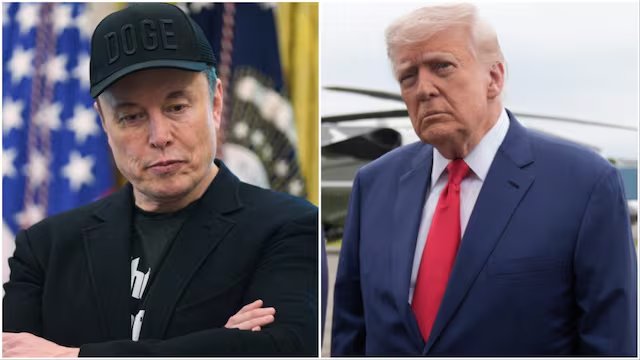
Elon Musk Regrets Recent Posts Targeted At Trump

Elon Musk expressed regret on Wednesday regarding some of his latest social media remarks directed at President Donald Trump.

“I regret some of my posts about President @realDonaldTrump last week. They went too far,” Musk posted on X.

Their once-strong rapport crumbled in full public view last week as both men exchanged sharp remarks across their personal social media platforms.

Not long ago, Musk stood as one of Trump’s strongest supporters within the administration, jointly heading the Department of Government Efficiency and leading sweeping job cuts in the federal workforce.

However, things turned bitter when Musk condemned Trump’s sweeping tax reduction and domestic agenda package, describing it as a “disgusting abomination” because of its expected harmful effects on the country’s fiscal stability.

Musk escalated his disapproval by reposting old statements made by Trump and other members of the Republican party, all of which highlighted issues around government spending and the national deficit.

Tesla’s stock price (TSLA) edged up after Musk softened his stance on X, showing a 2% increase in premarket activity.

Among Musk’s posts on X last week was a claim that Trump would have lost last year’s presidential election without him and – in the most incendiary missive – that Trump is “in” the Jeffrey Epstein files.

Epstein was a convicted sex offender who died behind bars in 2019 before standing trial for sex trafficking allegations. Musk did not present proof to support his claim that Trump’s name appears in confidential materials linked to Epstein.

It is worth noting that the mere presence of a person’s name in such documents does not imply they have committed any illegal acts.

Meanwhile, Trump posted on his Truth Social account last week that he might revoke government contracts and financial assistance granted to Musk’s businesses.

In a Friday interview, the president remarked that he was “not even thinking about Elon” and had no plans to communicate with Musk “for a while.”

Trump, during a recently released podcast episode, shared that he “was disappointed” in Musk. The president insisted he bore “no hard feelings” towards the tech entrepreneur but admitted he “was really surprised” by Musk’s critique of the tax legislation.

“I don’t know what his problem is, really, I don’t know. I haven’t thought too much about him in the last little while,” Trump said to the podcast host.

Senegal Ends England’s 22-Game Streak With 3-1 Victory

2

Senegal made headlines on Tuesday by defeating England 3-1 in an international friendly at the City Ground, ending the Three Lions’ 22-match unbeaten streak. Goals from Ismaila Sarr, Habib Diarra, and Cheikh Sabaly handed the African champions a landmark victory while extending their own unbeaten run to 24 games.

England, under new manager Thomas Tuchel, suffered their first defeat in four games. A late goal from Jude Bellingham was ruled out for handball in the build-up, adding to a frustrating night.

“Not good enough,” said England captain Harry Kane in a post-match interview with ITV. “We had our moments, but both with and without the ball, things aren’t clicking. We’re missing the tempo and that aggressive edge we used to have.”

Kane had opened the scoring early, finding the net in the seventh minute after Senegal goalkeeper Edouard Mendy spilled a shot from Anthony Gordon. But the lead didn’t last long.

Senegal equalized in the 40th minute as Sarr capitalized on a defensive lapse by Kyle Walker to convert Nicolas Jackson’s cross. In the 62nd minute, Diarra struck again, finishing between Dean Henderson’s legs after a long ball over the top.

Sabaly sealed the win with a third goal in stoppage time, triggering boos from the home fans.

Despite the loss, Kane remained calm. “We’re not going to panic, but we know we must improve. We have new ideas coming in, new players who are still finding their footing at international level. But we can’t make excuses. The World Cup is approaching quickly, and every camp is crucial.”

Senegal outshot England on target, testing Henderson nine times to England’s four. Sarr had earlier forced a strong save with a header, and Gordon missed a chance to extend England’s early lead. Mendy made a key late stop to deny Bukayo Saka an equalizer before Sabaly’s decisive strike.

Tuchel admitted the performance fell short. “A disappointing result. Maybe we deserved a bit more in terms of outcome,” he said. “But we looked a bit frozen, not proactive for long stretches of the match. We conceded two very preventable goals. Once we were behind, we reacted well, more energy, more freedom, more attacking intent but by then it was too late.”

Revamped FIFA Club World Cup Kicks Off in U.S

The revamped FIFA Club World Cup begins this weekend in the United States, featuring 32 teams from across the globe in a new quadrennial format.

Europe leads the representation with 12 clubs, followed by South America (6), while Asia, Africa, and the CONCACAF region each have four. Oceania is represented by one club, with the final spot reserved for a host nation representative.

Qualification is determined either by winning a continental championship or through a four-year club performance ranking in continental competitions.

Continental Champions

Sixteen clubs booked their place by clinching continental titles from 2021 to 2024:

  • UEFA Champions League: Chelsea (ENG/2021), Real Madrid (ESP/2022 & 2024), Manchester City (ENG/2023)
  • Copa Libertadores: Palmeiras (BRA/2021), Flamengo (BRA/2022), Fluminense (BRA/2023), Botafogo (BRA/2024)
  • AFC Champions League: Al Hilal (KSA/2021), Urawa Red Diamonds (JPN/2022), Al Ain (UAE/2023 & 2024)
  • CONCACAF Champions League: Monterrey (MEX/2021), Seattle Sounders (USA/2022), Pachuca (MEX/2024)
  • CAF Champions League: Al Ahly (EGY/2021, 2023, 2024), Wydad Casablanca (MAR/2022)
  • OFC Champions League: Auckland City (NZL/2022, 2023, 2024)

Ranking-Based Qualifiers

Fourteen clubs earned qualification through sustained high-level performances over four years:

  • Europe: Bayern Munich (GER), Paris Saint-Germain (FRA), Borussia Dortmund (GER), Inter Milan (ITA), Porto (POR), Atletico Madrid (ESP), Benfica (POR), Juventus (ITA), Red Bull Salzburg (AUT)
  • South America: River Plate (ARG), Boca Juniors (ARG)
  • Asia: Ulsan HD (KOR)
  • Africa: Esperance (TUN), Mamelodi Sundowns (RSA)

Host Nation Representatives

The final two spots are filled by clubs from the host nation:

Inter Miami, featuring Lionel Messi, qualified by winning the 2024 Supporters’ Shield for the best MLS regular-season performance. Despite LA Galaxy claiming the MLS Cup, Miami’s consistency earned them the nod.

Los Angeles FC secured the final berth with a 2-1 extra-time victory over Club America in a play-in match, following FIFA’s disqualification of Mexican club Leon. Leon were barred due to ownership conflicts involving Grupo Pachuca, which also owns fellow entrant Pachuca.

The tournament marks a significant expansion of FIFA’s global club competition, setting the stage for an exciting summer of international football.

Austria Shaken By Fatal School Attack As Nation Grieves

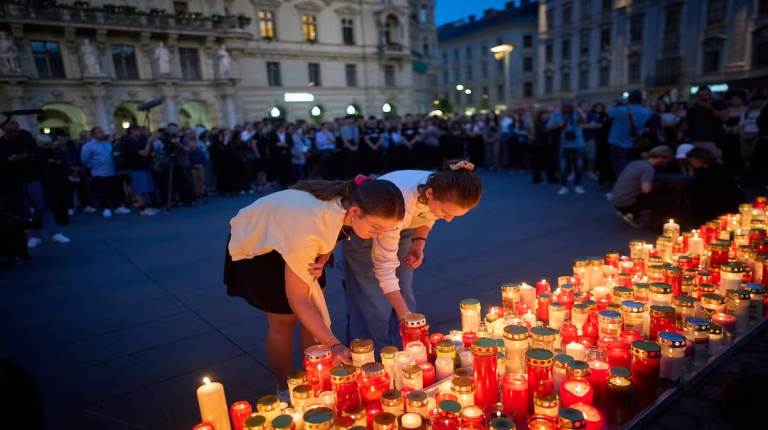
A devastating shooting incident took place in Graz on Tuesday, where a young man who once attended the school ended the lives of 10 individuals before taking his own, according to law enforcement officials. The tragedy ranks among the most severe such events in Europe in recent years.

Although lessons have been halted for at least a week, many students still showed up near the school premises on Wednesday morning, evidently unable to stay away from the place that had just witnessed a horrific act of violence.

A small crowd gathered near the high school grounds in Graz the scene where a former pupil carried out the deadly attack standing apart from other sympathizers and members of the press, within an area marked off by authorities.

Like countless other Austrians, they struggled to grasp how such brutal violence something they usually only associated with faraway headlines from America could suddenly erupt in their peaceful Alpine town.

“We’re just speechless this seems to have come from nowhere,” said Simone Saccon, 20, a university student who grew up in Graz. His home is close to the BORG Dreierschützengasse school, and he was among the many standing outside that day.

“It’s something you imagine happens in major cities or in the U.S., but that it would happen here?” he added.

The nation was wrapped in sorrow as the news spread. Black flags were hoisted atop the city’s public trams in Graz, a prosperous urban center and Austria’s second-largest city.

At 10 a.m., rail traffic came to a halt as the entire country paused for a moment of silence in remembrance of those lost.

Police reassured the public that there was no lingering threat, though authorities confirmed the discovery of an undetonated pipe bomb at the shooter’s residence. The 21-year-old perpetrator had left behind what officials described as a “farewell letter” along with a recorded video addressed to his parents, before returning to the very school where he had once been a student but never completed his education.

He then unleashed gunfire with both a handgun and a shotgun, ultimately taking his own life inside one of the school’s bathrooms, as stated by investigators.

According to officials, the contents of the farewell note shed little light on what could have driven this young man who lawfully owned his firearms to commit one of the deadliest school shootings Europe has seen in a decade. Franz Ruf, head of public security at Austria’s Interior Ministry, shared with a television channel that no clear motive could be gleaned from the document.

Thus, the nation was left grappling with unanswered questions a painful reflection mirrored by communities worldwide that have endured similar senseless violence.

“What’s really important now is to talk, to be silent together, to listen,” said Paul Nitsche, 51, a pastor and religion teacher at the school, as he stood in front of the space set aside for grieving students.

The Austrian chancellor, Christian Stocker, canceled his scheduled events to immediately travel to Graz, declaring three days of national mourning, including the observance of silence on Wednesday. Both citizens and leaders found themselves shaken by the scale of the tragedy.

Most of those who died were young students six girls and three boys aged between 14 and 17, according to law enforcement reports. Another victim, a teacher, succumbed to injuries at a hospital afterward.

Pastor Nitsche was alone in an empty classroom between lessons when he first heard the gunfire. His instinct told him to stay hidden and still. “It was as silent as if it was the middle of the night,” he said. “Everyone was playing dead — smart.”

When it seemed the danger had passed, he cautiously stepped into the hallway and caught sight of the attacker trying to force open a locked door by firing at it. Fleeing the scene, he noticed the lifeless body of a female student before dashing away and finally seeing the arrival of heavily armed officers. “So many uniforms can be really comforting,” he said.

US-China Reach Trade ‘Framework’ After Discussions In London

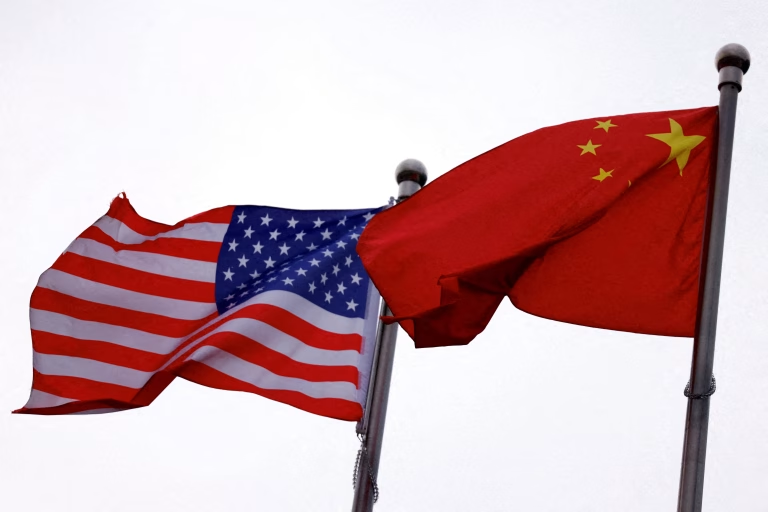
Senior representatives from both the United States and China revealed on Tuesday that they had come to an understanding on a “framework” aimed at progressing trade relations. These announcements followed two days of intense discussions in London, intended to ease long-standing economic disputes.

US Commerce Secretary Howard Lutnick sounded confident after a day of dialogue, expressing belief that the difficulties involving rare earth resources and magnets “will be resolved” as the arrangement moves into action.

However, the proposal must first secure the approval of top authorities in Washington and Beijing, officials indicated, as the diplomatic talks concluded at Lancaster House in the heart of London.

Both nations had struggled to break a deadlock over export restrictions, and attention was fixed on whether either side would make concessions. American officials had earlier raised concerns that Beijing was deliberately delaying clearances for rare earth shipments.

As the planet’s two economic heavyweights sought to halt their escalating tariff skirmish, with duties presently paused on a temporary basis, the hope for a durable agreement remained central.

“We’re moving as quickly as we can,” US Trade Representative Jamieson Greer told reporters.

“We would very much like to find an agreement that makes sense for both countries,” he added, noting that the relationship was complex.

“We feel positive about engaging with the Chinese,” he maintained.

Speaking separately to reporters, China International Trade Representative Li Chenggang said: “Our communication has been very professional, rational, in-depth and candid.”

Li expressed hope that progress made in London would help to boost trust on both sides.

– Constructive Negotiations –


US Treasury Secretary Scott Bessent had earlier described the closely-monitored talks as fruitful, even though scheduling demands required him to leave London while discussions were ongoing.

Bessent, alongside Lutnick and Greer, led the American delegation but was called back to Washington for Congressional testimony, according to a US official.

China’s negotiating team was headed by Vice Premier He Lifeng, accompanied by Li and Commerce Minister Wang Wentao.

No fresh meeting dates have yet been set by either side.

Still, Lutnick remarked that the US restrictions enacted when rare earth shipments “were not coming” could be eased if Beijing advanced with additional license approvals.

Global financial markets were uneasy but saw a modest rise in major US indexes on Tuesday amid optimism over a breakthrough.

This London session followed earlier discussions held in Geneva, where both countries had momentarily agreed to cut tariffs.

This time around, rare earth exports from China essential for items such as smartphones, electric vehicle batteries, and environmentally friendly technology were a central focus.

“In Geneva, we had agreed to lower tariffs on them, and they had agreed to release the magnets and rare earths that we need throughout the economy,” US President Donald Trump’s top economic adviser, Kevin Hassett, told CNBC on Monday.

Even though Beijing was releasing some supplies, “it was going a lot slower than some companies believed was optimal,” he added.

Both countries “have developed almost a mirror arsenal of trade and investment weapons that they can aim at each other,” said Emily Benson, head of strategy at Minerva Technology Futures.

As they make use of economic levers in their contest for global influence, she said, expecting a conventional trade pact might not be realistic.

Nonetheless, possibilities exist for reducing friction between the two powers.

A cooling of tensions may include improved Chinese procedures for handling export control permits, Benson noted. She remarked that Beijing might lack enough personnel to handle the volume of applications effectively.

For the US, this might involve loosening certain high-tech export restrictions, she added.

However, caution persisted among analysts, with Thomas Mathews of Capital Economics warning that Washington would likely not “back off completely.” Market uncertainty could linger as a result.

Since returning to office, Trump has imposed a 10 per cent duty on multiple trading partners, threatening higher tariffs on numerous economies.

These levies have dampened commerce, with Chinese figures showing a sharp drop in shipments to the US during May.

The World Bank on Tuesday aligned with other global bodies in reducing its forecast for 2025 global economic growth amid continued trade instability.

China is simultaneously holding discussions with other nations, including Japan and South Korea, in an attempt to form a collective stance in response to Trump’s trade policies.