Home Blog Page 196

European Reconstruction Bank Sites First West African Office In Nigeria

1

Nigeria’s efforts in international economic relations took a significant leap forward on Tuesday with the announcement that the European Bank for Reconstruction and Development (EBRD) will establish its first office in West Africa, choosing Lagos as its base. The federal government welcomed this move, viewing it as a strong indicator of trust in Nigeria’s economic policies.

During a meeting with Ambassador Gautier Mignot, who leads the European Union (EU) Delegation to Nigeria and ECOWAS, Vice President Kashim Shettima acknowledged the EU’s longstanding cooperation and reiterated the country’s desire to deepen its relationship with Europe.

“You are our natural partners and allies,” Shettima said. “Beyond the geography that binds us, we have a cultural affinity that goes back centuries. We see this partnership not just as economic, but also humanitarian and strategic.”

Shettima emphasized the Tinubu administration’s determination to reshape the nation’s economic landscape, pointing to the scrapping of fuel subsidies and the harmonization of exchange rates as key reforms that have enhanced investor trust.

“All the encumbrances toward investment in this country are gradually being eliminated,” Shettima said. “More than ever before, Nigeria is ready for business.”

In February 2025, Nigeria was officially accepted as the 77th member of the EBRD, following a decision by the bank to gradually expand into sub-Saharan Africa. The newly launched Lagos office will act as the bank’s central hub for its operations across the region.

The vice president also praised the EU’s contributions in areas affected by conflict, especially in Borno State, where he once held office as governor. “I know the prominent role that the EU played in humanitarian support in Borno. You deserve commendation, not condemnation.”

Ambassador Mignot, in his address, emphasized Nigeria’s importance to the EU amidst today’s evolving global challenges.

“With the global instability we are witnessing, it is essential to have reliable partnerships. Nigeria is one of those,” Mignot stated, adding that recent meetings among EU representatives had reaffirmed their dedication to working with Nigeria.

He further mentioned the EU’s willingness to expand collaborative efforts through initiatives such as the Nigeria Jubilee Fellows Programme (NJFP) and deepen engagement on matters related to migration and development.

EFCC Arrests Lagos Socialite E-Money for Alleged Naira Abuse

0

The Economic and Financial Crimes Commission (EFCC) has taken into custody well-known Lagos socialite, Emeka Okonkwo Daniel, popularly known as E-Money, over allegations of Naira abuse.

According to reports, the arrest occurred on Monday night at his residence located in the Omole area of Lagos.

Sources within the EFCC disclosed on Tuesday that E-Money was apprehended for allegedly spraying U.S. dollars, an act believed to contravene the Foreign Exchange Act.

“On Monday night, we arrested E-Money for Naira abuse and defacing foreign currencies. Specifically, he was alleged to have sprayed U.S. dollars, which is against the Foreign Exchange Act.
He was arrested at his Omole, Lagos residence. Preliminary investigations are ongoing, and he will be charged to court as soon as investigations are concluded,” a source confirmed.

Another official, who also verified the arrest, revealed that E-Money is currently being transported to Abuja for further interrogation.

“Yes, he has been arrested and is being flown to Abuja as I speak, to face investigators on the issue,” the source stated, requesting anonymity as they were not authorised to speak publicly.

Nigeria Police Resume Tinted Glass Permit Issuance Nationwide

0

The Nigeria Police Force has officially resumed the issuance of tinted glass permits nationwide, following a directive from the Inspector-General of Police, Kayode Egbetokun. The announcement was made in a statement issued on Wednesday by the Force Public Relations Officer, Olumuyiwa Adejobi.

This renewed initiative is a direct response to growing public concerns over the harassment of vehicle owners with factory-fitted tinted windows by law enforcement officers.

“The Nigeria Police Force, under the directive of the Inspector-General of Police, IGP Kayode Adeolu Egbetokun, Ph.D., NPM, has reactivated the issuance of Tinted Glass Permits (TGP) nationwide through a secure and user-friendly digital platform available at https://possap.gov.ng,” the statement said.

The statement further explained that the decision reflects the importance of a transparent and accountable system for regulating the legitimate use of tinted windows.

“This initiative comes in response to widespread public complaints about the harassment of motorists over the use of tinted windows and reflects the need for a clear, transparent, and accountable process for regularising factory-fitted tinted glass on vehicles,” it added.

Acknowledging the rise in modern vehicles designed with tinted glass for comfort and aesthetic appeal, the police underscored the necessity of regulation.

“With modern automobiles increasingly manufactured with tinted windows, it has become essential to provide a standardised system that accommodates legitimate use while ensuring public safety.
“Tinted vehicles have often been exploited for criminal purposes, including kidnapping, armed robbery, ‘one-chance’ scams, and other forms of banditry,” Adejobi stated.

He further highlighted the challenge that tinted windows present to law enforcement efforts.

“Their use hampers police visibility and impedes effective law enforcement, thereby contributing to public insecurity.
“The reactivation of the permit system is a strategic move to identify lawful users such as individuals with medical requirements or members of the security community while preventing misuse for criminal activities,” the statement said.

The newly relaunched system is expected to bolster national security efforts and assist police investigations. It includes several digital features for efficiency and authenticity.

“It is expected to enhance police investigative capabilities and strengthen national security efforts. Applicants can now process their permits online, with identity verification integrated through the National Identification Number (NIN) and Tax Identification Number (TIN), alongside biometric capture and background checks.
“The system also features QR-coded digital permits, with a streamlined processing timeline of 72 hours. To ensure a smooth transition, a 30-day grace period has been approved, effective from May 1st, 2025, within which motorists are expected to comply,” Adejobi added.

He also confirmed that enforcement would begin after the grace period, and that officers engaging in misconduct would face disciplinary action.

“Enforcement will commence at the end of this period. Officers found engaging in unprofessional conduct, such as extortion or harassment, in the course of enforcement will be decisively dealt with in accordance with extant disciplinary procedures,” he warned.

The Inspector-General assured the public of the Force’s dedication to modern and accountable policing.

“The Inspector-General of Police reiterates the Force’s commitment to a technologically driven and citizen-focused policing strategy.
“He urges the public to embrace the initiative in the interest of safer roads, enhanced public trust, and a more secure Nigeria,” the statement concluded.

UCL Semi-Final First Leg: PSG Edge Arsenal 1-0 at the Emirates

2

Paris Saint-Germain secured a narrow but crucial 1-0 victory over Arsenal in the first leg of their UEFA Champions League semi-final on Tuesday night, thanks to an early goal from Ousmane Dembele.

Early Advantage for PSG

PSG struck just four minutes into the match at the Emirates Stadium. Ousmane Dembele initiated and finished a slick attacking move after collecting the ball in the center circle and linking up with Khvicha Kvaratskhelia. The Georgian winger drove at Jurrien Timber before threading a perfect return pass to Dembele, who finished clinically off the far post.

Arsenal Struggle to Respond

The French champions maintained their lead with a composed and disciplined performance, frustrating an Arsenal side that had dismantled Real Madrid in the previous round. Despite the rousing pre-match atmosphere—including a motivational tunnel speech from Declan Rice and a video message from manager Mikel Arteta—Arsenal failed to replicate the intensity that saw them defeat Madrid 3-0 in the first leg of the quarter-final.

Arteta’s men were handed their first home European loss in 18 matches, delivering a blow to their hopes of securing a first-ever Champions League title.

Missed Chances on Both Ends

PSG continued to press after their opener, with Marquinhos narrowly missing a header and Kvaratskhelia seeing a strong penalty appeal waved away. Dembele also set up Desire Doue, whose low effort was parried by David Raya.

Arsenal’s best first-half chance came when Gabriel Martinelli latched onto a brilliant pass from Myles Lewis-Skelly, only to be denied by a stunning save from Gianluigi Donnarumma.

Just after the break, Mikel Merino thought he had equalised, but his header from Rice’s free-kick was ruled out by VAR for offside.

Leandro Trossard came close as well, bursting into the box only for Donnarumma to once again come to PSG’s rescue with a fingertip save.

PSG Hold Firm, but Waste Opportunities

As Arsenal pushed forward, PSG slowed the tempo and nearly doubled their lead. Substitute Bradley Barcola broke free but missed a clear one-on-one opportunity, dragging his shot wide. Moments later, Goncalo Ramos smashed the ball against the bar from close range, leaving manager Luis Enrique visibly frustrated.

With a 1-0 lead in hand, PSG head back to the Parc des Princes for the second leg on May 7, now favourites to reach the final against either Barcelona or Inter Milan. Still, their history of dramatic Champions League exits means they will approach with caution.

Meanwhile, Arsenal’s “beautiful story,” as described by Arteta, faces a tense second chapter in Paris—but the tie is far from over.

EFCC Apprehends Wanted Socialite Achimugu at Abuja Airport

0

The Economic and Financial Crimes Commission (EFCC) on Tuesday apprehended businesswoman Aisha Achimugu at the Nnamdi Azikiwe International Airport in Abuja.

Sources revealed that Achimugu was taken into custody around 5 a.m., shortly after arriving from London.

In March, the EFCC declared Achimugu wanted over alleged involvement in criminal conspiracy and money laundering.

On Monday, the Federal High Court in Abuja, under the supervision of Justice I.E. Ekwo, directed her to report to the EFCC on Tuesday and to appear before the court on Wednesday, April 30, 2025.

Her legal representative, Chief Chikaosolu Ojukwu, verified her arrest in a message to our correspondent, stating, “Aisha Achimugu, who arrived voluntarily into the country from London, was arrested by the EFCC around 5 a.m. on Tuesday.”

Ojukwu condemned the EFCC’s move, calling it a breach of a court directive.

“In light of what transpired in court on Monday, my client returned based on the undertaking before the court to honour the EFCC’s invitation, but was arrested at the airport,” he remarked.

He also noted that Achimugu had initiated a hunger strike in protest of what he described as a violation of her basic rights.

“She is a prisoner of conscience,” Ojukwu stated.

A high-ranking EFCC official, who requested anonymity due to lack of authorization to speak publicly, confirmed the arrest, saying, “We had earlier declared her wanted and we can’t allow her to continue to walk freely. Secondly, the court said she must appear before us today. We were not restricted from arresting her; what the court said was if she comes, she should not be detained.

“How are you sure she would appear before us today? Now that we have seen her, we have a course to ensure she appears.”

As of the time this report was filed, EFCC spokesperson Dele Oyewale had not responded to calls or messages regarding the incident.

Treason: FG Presents Evidence Against Kanu as Trial Resumes

0

The Federal Government has resumed the prosecution of Nnamdi Kanu, leader of the Indigenous People of Biafra (IPOB), over allegations of treason.

During Tuesday’s proceedings, the government’s prosecuting counsel, Adegboyega Awomolo (SAN), submitted a statement Kanu made to the Department of State Services (DSS) on October 15, 2015, following his initial arrest in Lagos, along with four suitcases retrieved from his hotel room.

A DSS prosecution witness read the statement aloud in court, and a video recording was also played. This followed Kanu’s claim that the statement had been taken without his lawyers present.

In the statement, Kanu asserted to DSS officials that “the agitation for self-determination is not a crime anywhere in the world,” and emphasized his commitment to “continue the struggle to emancipate the South East, South South and parts of Benue and Kogi states.”

He also denied participating in any violent acts within the country, maintaining that he had never been associated with such incidents.

The video clips presented in court showed Kanu confirming that he founded Radio Biafra in London, where it was officially registered. He acknowledged that he did not register the station with the National Broadcasting Commission (NBC), stating there was “no need for it.”

Additionally, the court was shown the contents of the four suitcases, which included Kanu’s personal items and equipment related to Radio Biafra.

Presiding over the case, Justice James Omotosho approved a request to keep the identities of the prosecution witnesses confidential. The judge granted the ex parte application submitted by Awomolo, who cited security concerns due to the case’s connection to terrorism.

Defence counsel Kanu Agabi (SAN) did not oppose the motion but requested that the Federal Government show similar consideration when addressing his client’s bail application.

Renowned Nigerian Musician, King Sunny Ade, Reportedly Missing

Renowned Nigerian music icon, King Sunny Ade, has reportedly gone missing. His daughter, Damilola Esther Adeniyi, raised the alarm through a series of posts shared on her Instagram page on Monday.

Expressing concern over her father’s safety and whereabouts, she voiced fears that he might have been abducted.
Although she did not provide substantial proof, Damilola accused certain individuals close to the veteran musician — including her stepbrother, who also serves as his manager — of being involved in the alleged abduction.

Sharing details of her last conversation with the music legend, Damilola Adeniyi alleged that her father is being compelled to work against his will.

Calling on the appropriate authorities to look into the matter, she stated, “King Sunny Ade has been kidnapped. The manager, Dayo is the culprit along with his mother, brothers, (Demola, Kenny) and his driver Ade.”

DR Congo Seeks Resource-Rich Coalition to Control Mineral Supply

0

The Democratic Republic of Congo (DRC) is pushing for a coalition of resource-rich nations—similar to OPEC—to regulate the global supply and pricing of strategic minerals.

Daniel Mukoko Samba, the country’s Deputy Prime Minister and Minister of Economy, revealed in an interview with Global South World that the DRC is currently in talks with Indonesia, the world’s second-largest cobalt producer, to explore joint strategies for coordinating the sale of minerals and other raw materials.

“We understand that we can’t do it alone—we need cooperation between major producers and exporters,” Mukoko said at the Crans Montana Forum in Casablanca. When asked about forming an alliance of mineral-producing countries, he responded, “That’s what we would like to see happening.”

The DRC, which accounts for 70% of global cobalt production, suspended its cobalt exports in February 2025 following a sharp decline in prices. Since then, Mukoko noted, prices have begun to recover, prompting a re-evaluation of the ban at the end of the four-month suspension period.

Discussions between the DRC and Indonesia have reportedly expanded beyond cobalt to include forestry products and other commodities, signaling a broader ambition to stabilize markets for key raw materials.

Cobalt plays a critical role in manufacturing rechargeable batteries and semiconductors, but its market remains volatile. Over the past decade, prices for cobalt have fluctuated dramatically—from highs above $80,000 per ton to lows under $30,000 per ton. This volatility is compounded by the fact that cobalt is often a byproduct of copper and nickel mining, making its production less responsive to demand trends.

DR Congo’s proposal mirrors the original mission of OPEC, formed in 1960 to coordinate oil production and maintain fair pricing. While OPEC’s influence has waned in recent years, it remains a model for managing the global supply of strategic resources.

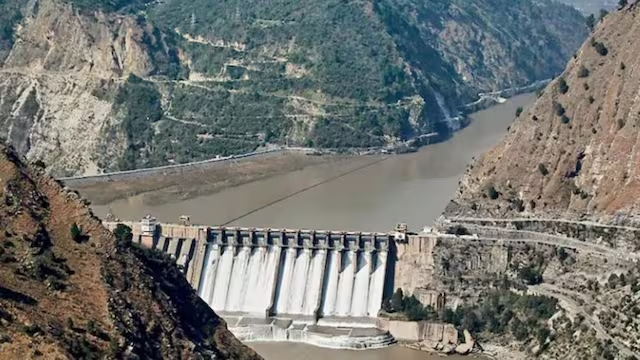
Pakistan Plans Legal Challenge Against India’s Suspension of Indus Waters Treaty

Pakistan is preparing to launch international legal action against India following the suspension of the Indus Waters Treaty, a decades-old water-sharing agreement brokered by the World Bank. The development comes amid rising tensions between the two nuclear-armed neighbors after a deadly attack in Indian-administered Kashmir.

Aqeel Malik, Pakistan’s Minister of State for Law and Justice, told Reuters that Islamabad is exploring at least three legal options, including filing a case with the World Bank, the treaty’s original facilitator. Other options include appealing to the Permanent Court of Arbitration and the International Court of Justice (ICJ) in The Hague, potentially citing a violation of the 1969 Vienna Convention on the Law of Treaties.

“Legal strategy consultations are almost complete,” Malik stated. “A final decision will be made soon, and we may pursue more than one legal path.”

India recently suspended its participation in the treaty, claiming it will not resume until Pakistan “credibly and irrevocably” ends support for cross-border terrorism. The move followed an attack in Kashmir that left 26 people dead—India alleges two of the attackers were Pakistani nationals, a claim Islamabad firmly denies.

Pakistan, in response, has suspended all trade with India and closed its airspace to Indian airlines, while warning that any attempt to block or divert its share of river waters would be regarded as an “act of war.”

The Indus Waters Treaty, signed in 1960, governs the distribution of water from the Indus River and its tributaries. It is vital to Pakistan, as the waters account for about 80% of its irrigated agriculture and hydropower needs. Remarkably, the treaty has survived several wars and prolonged periods of hostility between the two nations.

Malik also mentioned a fourth diplomatic option: raising the matter at the United Nations Security Council, reinforcing Pakistan’s intention to exhaust all available legal and diplomatic channels.

“The treaty cannot be suspended unilaterally. There is no such provision within its framework,” Malik emphasized.

Meanwhile, Indian officials have remained largely silent, though Kushvinder Vohra, former head of India’s Central Water Commission, commented that India’s actions are defensible under the treaty’s terms, which allow limited use of Pakistan-allocated rivers for hydropower projects without major water storage.

As legal and diplomatic pressure builds, the crisis could have serious implications for regional stability and for farmers already grappling with climate-driven water shortages.

INEC Seeks Constitutional Amendment to Enable Diaspora Voting

0

The Independent National Electoral Commission (INEC) is pushing for key constitutional amendments to expand voting rights to Nigerians in the diaspora, inmates, and citizens involved in essential services during elections.

The proposals are part of a broader set of electoral reform recommendations contained in INEC’s newly released document titled “Issues and Contentions in the Electoral Legal Framework: An Overview from INEC’s Submission.”

According to the commission, the aim is to make Nigeria’s elections more inclusive, transparent, and efficient by addressing current limitations in the electoral framework.

INEC is advocating for amendments to the 1999 Constitution and the Electoral Act (EA) 2022 to legalize early, special, out-of-country, and diaspora voting, ensuring that eligible voters, regardless of location or circumstance, are not disenfranchised.

“Amend Sections 12 and 45 of the EA 2022 to provide for early/special voting… for eligible voters on essential services, election personnel, those under incarceration, and Nigerians in the Diaspora,” the commission stated.

The commission is also calling for a modernization of the voter identification process, suggesting that electronically downloadable voter cards or other approved digital IDs be accepted in place of traditional PVCs.

“Review Sections 47 and 16 of the EA 2022 to allow alternative forms of identification acceptable to the commission,” the document added.

INEC’s recommendations extend to institutional reforms, proposing the establishment of:

  • An Electoral Offences Commission to investigate and prosecute election-related crimes
  • A Political Party Regulatory Agency to oversee party operations, internal democracy, and compliance with legal standards

These reforms would involve amending several sections of the Electoral Act to transfer party regulation functions from INEC to the proposed agency.

In addition, INEC has suggested granting it the authority to appoint and discipline Heads of State and FCT Offices, which would enhance administrative control and streamline election management nationwide.

The commission emphasized that these reforms are grounded in its operational experience, feedback from election observers, judicial interpretations, and stakeholder consultations.

While acknowledging that the Electoral Act 2022 brought significant progress, INEC insists that further legal refinement is crucial for sustaining Nigeria’s democratic development.

“Electoral legal framework reforms are essential to promote transparency, accountability, efficiency, and effectiveness in the electoral process… not only to resolve present challenges but also to ensure long-term credibility and inclusiveness,” the report concluded.

The proposed amendments have already undergone review by a Joint Technical Committee of the National Assembly and INEC, with legislative action anticipated in the near future.