The Adamawa State Government has officially commenced its civil service recruitment exercise for 2025, inviting qualified indigenes to apply for various positions.
According to a statement issued by the Adamawa State Civil Service Commission, the online application portal will be open from Tuesday, April 29, 2025, to Tuesday, May 13, 2025. The recruitment exercise follows the approval of Governor Ahmadu Fintiri.
The announcement, titled “Vacancy Advertisement for Online Recruitment,” was signed by Abubakar Maiha, the Commission’s Permanent Secretary. It states that applications are welcome from Adamawa indigenes aged 18 to 50 years.
Prospective candidates can access the application portal via www.csc.ad.gov.ng and are encouraged to submit their applications within the stipulated timeframe.
This recruitment drive aims to strengthen the state’s civil service workforce and provide job opportunities for eligible residents.
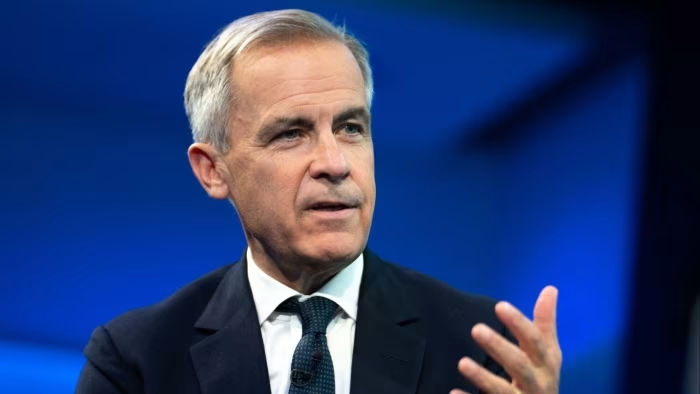
Mark Carney’s Liberal Party has won in Canada’s national election, marking a remarkable political comeback driven in part by Donald Trump’s annexation threats and escalating trade tensions.
As polls closed, projections indicated the Liberals were set to claim more of the 343 parliamentary seats than the Conservative Party. Carney successfully fended off a strong challenge from his closest competitor, Conservative leader Pierre Poilievre.
Carney has served as prime minister since March, following a decisive win in the Liberal Party leadership race. He replaced Justin Trudeau, who stepped down after leading Canada since 2015 amid mounting pressure from party members and declining approval ratings.
After assuming leadership, Carney called a snap election to secure a direct mandate from voters. His victory this week confirms that support.
In a triumphant speech delivered in Ottawa, Carney declared: “President Trump is trying to break us so that America can own us – that will never, ever happen.” He added: “We will fight back with everything we have to get the best deal for Canada.”
Who Is Mark Carney?
Mark Carney was born on March 16, 1965, in Fort Smith, Northwest Territories, and raised in Edmonton, Alberta. He holds Canadian, British, and Irish citizenship. Carney is married to British-born Diana Carney, and together they have four daughters.
He earned a bachelor’s degree in economics from Harvard University in 1988, followed by a master’s and doctorate in economics from Oxford University. Like many Canadians, he enjoyed hockey growing up and even played as a backup goaltender for Harvard.
His Life As A Bank Governor
Carney is perhaps best known internationally for his tenure as Governor of the Bank of England from 2013 to 2020. Before that, he served as Governor of the Bank of Canada from 2008 to 2013, helping steer the country through the global financial crisis.
During that time, he introduced emergency lending programs and provided transparent guidance on interest rates, an approach considered bold for central banks at the time. Speculation about his political ambitions was already circulating back then. When asked about it in 2012, Carney quipped: “Why don’t I become a circus clown?”
In 2013, Carney made history as the first non-British Governor of the Bank of England since its founding in 1694, and the first individual to lead two G7 central banks. Then-Chancellor George Osborne hailed him as the “outstanding central bank governor of his generation.”
Earlier in his career, Carney spent 13 years at Goldman Sachs. He was appointed Deputy Governor of the Bank of Canada in 2003, briefly left for a senior role in the Finance Ministry in 2004, and returned in 2008 to become governor.
Entry Into Politics
Despite his extensive financial background, Carney entered politics with no previous experience in elected office or campaigning.
He also never served in Justin Trudeau’s cabinet before taking the helm of the Liberal Party in March. On paper, he was a political newcomer, but his leadership has quickly proven impactful.
It’s been over a month since the devastating 7.7 magnitude earthquake struck central Myanmar on March 28, 2025. The country remains in a dire state, grappling with the aftermath of a disaster that has killed more than 3,600 people and left over 20 million affected.
The earthquake’s impact on Mandalay and Sagaing regions has been especially severe, with widespread destruction of homes, infrastructure, and access to basic services. Humanitarian needs are escalating daily—clean water, food, shelter, and medical supplies are critically short, with hospitals overwhelmed and disease risks rising. In areas like Sein Pan district, fires triggered by the quake destroyed hundreds of homes, further deepening the crisis.
Despite a temporary ceasefire declared by Myanmar’s military junta from April 2 to April 22, more than 120 military attacks have been reported since the quake—over 60 of them after the ceasefire began. Airstrikes and drone attacks have hit civilian zones, particularly in Sagaing, Shan, and Karen states. Aid groups say these actions, coupled with the junta’s interference in humanitarian efforts, have severely hindered relief operations.
International aid has trickled in: China pledged $137 million, India launched “Operation Brahma” with field hospitals, and nations like South Korea, Japan, and Vietnam have sent rescue teams. But the U.S. contribution has been criticized as limited, and the UN’s $275 million appeal is only 5% funded. Relief agencies stress the need to bypass junta restrictions by working through local networks.
As the monsoon season approaches, time is running out. While some rebel groups have declared ceasefires to facilitate aid, the ongoing military aggression and lack of access continue to threaten recovery efforts. With communication lines down and roads damaged, the full scale of devastation remains unknown. Myanmar’s people need urgent, unrestricted humanitarian support—before conditions worsen further.
A devastating car bomb killed Lieutenant General Yaroslav Moskalik, a top Russian military figure, in a residential area just outside Moscow on Friday, April 25, 2025.
Russian authorities were quick to blame Ukraine for the assassination, a development that has further inflamed tensions in the ongoing Russia-Ukraine war and cast a dark cloud over U.S.-led peace efforts.
The explosion struck in Balashikha, a suburb located east of Moscow, when a homemade improvised explosive device (IED) loaded with shrapnel detonated inside a parked Volkswagen Golf.
Security footage captured the dramatic moment when the blast tore through the quiet neighborhood, known for housing retired military officers.
Moskalik, 59, was killed instantly as he passed by the rigged vehicle. Russian media outlets gave varying reports, with some suggesting that a second victim may have also died in the explosion.
Moskalik, who served as the deputy head of the Main Operational Directorate of Russia’s General Staff, played a major role in overseeing military operations, including Russia’s campaign in Ukraine.
He was promoted to lieutenant general by President Vladimir Putin in 2021 and had been part of the 2015 Minsk ceasefire negotiations aimed at resolving the conflict in the Donbas region.
Russian war blogger Rybar praised Moskalik as “one of the most intelligent and demanding officers,” noting that he was once considered for a senior post at Russia’s National Defence Management Centre.
The Kremlin wasted no time assigning blame. “This is another terrorist act by the Kyiv regime,” declared Foreign Ministry spokesperson Maria Zakharova.
Kremlin spokesman Dmitry Peskov echoed the sentiment, calling it a “heinous attack.” On Saturday, Russia’s Federal Security Service (FSB) announced the arrest of Ignat Kuzi, whom they described as a Ukrainian agent recruited by Kyiv’s security services in 2023.
In a televised confession, Kuzi allegedly admitted to planting the bomb and triggering it remotely from Ukraine.
The FSB further claimed that the vehicle used in the bombing had been purchased by a Ukrainian man from Sumy, adding to suspicions of Kyiv’s direct involvement.
As of now, Ukraine has not issued an official comment regarding the killing, remaining consistent with its policy of refraining from publicly acknowledging such operations.
Nonetheless, the assassination mirrors previous attacks attributed to Ukraine’s Security Service (SBU).
Back in December 2024, the SBU claimed responsibility for the assassination of Lieutenant General Igor Kirillov, head of Russia’s chemical weapons division, in a similar car bombing in Moscow.
Ukrainian officials have previously defended such strikes as legitimate actions targeting individuals responsible for war crimes or Russia’s invasion.
The timing of Moskalik’s assassination adds further complexity. Just one day earlier, on April 24, Russia carried out a deadly airstrike on Kyiv, leaving 12 dead and dozens injured—a move that drew sharp criticism from U.S. President Donald Trump.
Moskalik’s death also coincided with a visit to Moscow by Steve Witkoff, Trump’s special envoy, who was there to discuss a potential U.S.-brokered peace deal.
Analysts suggest the assassination could reflect Ukraine’s rejection of peace proposals perceived to involve unfavorable territorial compromises.
The killing marks the latest in a series of high-profile attacks targeting Russian military and pro-war figures since Russia’s invasion of Ukraine in 2022.
Previous incidents include the 2022 car bombing that killed Darya Dugina, daughter of a prominent nationalist, and the 2023 café explosion that took the life of military blogger Vladlen Tatarsky.
These high-profile attacks, particularly those inside Moscow, have exposed significant vulnerabilities in Russia’s internal security, prompting President Putin to acknowledge “serious blunders” within his security agencies.
As Russia vows to retaliate, Moskalik’s assassination risks inflaming the conflict even further, complicating already fragile peace negotiations.
For residents of Balashikha, the explosion was a chilling reminder of the conflict’s reach. “This is supposed to be a secure area,” said one neighbor, who asked not to be named. “Now we’re all on edge.”
The death of Moskalik highlights the deepening shadow war between Russia and Ukraine, where targeted assassinations have become an entrenched and deadly tactic. With no end to the conflict on the horizon, the cycle of violence shows little sign of slowing down
The Catholic Church will hold a conclave starting May 7 to elect a new pope, following the death of Pope Francis. Cardinals under the age of 80 will convene in the Sistine Chapel to choose the next spiritual leader for the world’s 1.4 billion Catholics.
The date for the conclave was determined during a cardinals’ meeting on Monday, just two days after Pope Francis’s funeral.
All 252 cardinals were summoned to Rome after the 88-year-old pope’s passing, though only 135 are eligible to cast a vote in the conclave.
The cardinals have come from around the globe, and many are unfamiliar with each other. However, four “general congregations” were held last week to help them begin building connections.
Cardinal Gualtiero Bassetti, 83, a former leader of the Italian bishops’ conference, remarked that there was a “beautiful, fraternal atmosphere.”
“Of course, there may be some difficulties because the voters have never been so numerous and not everyone knows each other,” he shared with Italy’s Corriere della Sera newspaper.
The Vatican has already closed the Sistine Chapel, where the conclave will be conducted beneath Michelangelo’s iconic frescoes, to commence preparations.
At this stage, there are few clear indicators of whom the cardinals may select as the next pontiff.
“I believe that if Francis has been the pope of surprises, this conclave will be too, as it is not at all predictable,” Spanish Cardinal Jose Cobo told El Pais in an interview published Sunday.
Pope Francis’s funeral and burial on Saturday drew an estimated 400,000 attendees to St. Peter’s Square, with royalty, world leaders, and thousands of pilgrims among the crowd.
On Sunday, around 70,000 mourners visited his marble tomb at the Santa Maria Maggiore Basilica in Rome. The “pope of the poor” had requested to be laid to rest outside the Vatican walls.
– Bookmakers’ Odds –
Amid ongoing global conflicts and diplomatic tensions, Italian Cardinal Pietro Parolin, who served as Secretary of State under Pope Francis, is considered a frontrunner for the papacy.
British bookmaker William Hill currently lists Cardinal Pietro Parolin as the favorite, followed by Filipino Cardinal Luis Antonio Tagle, Metropolitan Archbishop emeritus of Manila, and Ghanaian Cardinal Peter Turkson.
Other names appearing in the odds include Matteo Zuppi, Archbishop of Bologna; Guinean Cardinal Robert Sarah; and Pierbattista Pizzaballa, Latin Patriarch of Jerusalem.
While Pope Francis earned widespread admiration for his efforts to make the Church more compassionate, his reforms also drew criticism from the Church’s conservative factions, especially in the United States and Africa.
Roberto Regoli, a professor of Church history and culture at the Pontifical Gregorian University in Rome, told AFP that the cardinals will be searching for a figure who can promote unity within the Church.
“We are in a period in which Catholicism is experiencing various polarisations, so I don’t imagine it will be a very, very quick conclave,” he explained.
Bassetti, who is now too old to participate in the voting, nonetheless predicted that it “will not be long.”
About 80% of the cardinal electors were appointed by Pope Francis himself. However, this does not guarantee that his successor will follow his particular style, as many of the voting cardinals are younger and attending their first conclave.
– ‘We Need a Courageous Leader’ –
The voting process is highly confidential and follows strict traditions and ceremonial procedures.
It could last several days or even longer, with four votes conducted daily—two in the morning and two in the afternoon—until a candidate secures a two-thirds majority.
Less than half of the eligible voters are European.
“The future pope must have a universal heart, love all the continents. We must not look at colour, at origin, but at what is proposed,” Cardinal Dieudonne Nzapalainga from the Central African Republic told the Italian newspaper Il Messaggero.
“We need a courageous leader, a bold one, capable of speaking forcefully, of holding the helm of the Church steady even in storms… offering stability in an era of great uncertainty.”
Patrizia Spotti, a 68-year-old Italian who traveled to Rome for the 2026 Jubilee Holy Year, shared with AFP her hope that the next pope will resemble Pope Francis.
She reflected that it is a challenging time for Catholicism.
“Churches are empty. And the Church itself has made mistakes, all the scandals with the children,” she said, referencing the widespread revelations of clerical sexual abuse.
At just 29 years old, after leading the Chicago Bulls to three straight NBA championships, Michael Jordan made the stunning announcement that he was retiring from basketball.
The devastating impact of the murder of his father earlier that year caused his passion for basketball to wane, leading to his shock decision just before the 1993/94 NBA season.
Rather than staying in basketball, Jordan made a bold switch, signing with the Minor League Baseball team Chicago White Sox to fulfill his late father’s dream.
The move was a smooth one, as the White Sox were also owned by Bulls owner Jerry Reinsdorf. Jordan officially signed his baseball contract on February 7, 1994.
He went on to participate in spring training in Sarasota, Florida, before moving into the minor league system, playing 127 regular-season games for the Birmingham Barons, the White Sox’s Double-A affiliate.
Jordan also suited up for the Scottsdale Scorpions in the Arizona Fall League, where he managed just three home runs during his baseball journey.
Remarkably, while Jordan was pursuing his baseball career, he still had an existing contract with the Bulls — and that very deal was honored, meaning Jordan continued to be paid handsomely despite stepping away from the NBA.
Eventually, Jordan decided to end his brief baseball career, worried he might be used as a replacement player during the Major League Baseball strike.
His dramatic return to basketball was announced in 1995 with a simple yet powerful press release stating, “I’m back.” Upon his return, he wore the No. 45 jersey — the same number he had donned during his baseball stint.
Following a slow start for the Bulls, Jordan quickly found his rhythm. After an early playoff exit, a reenergized “MJ” led the Bulls to another legendary three-peat, securing championships in 1996, 1997, and 1998.
Michael Jordan Donated a Full Year’s NBA Salary After retiring for the second time in 1999, Jordan transitioned into a leadership role as part owner and president of basketball operations for the Washington Wizards — a team he would later play for between 2001 and 2003 before officially ending his playing career.
During his time with the Wizards, Jordan demonstrated his generosity by donating a full year’s salary, dedicating the funds to victims of the September 11 attacks in New York City and their families.
Following an initial donation of $100,000, Jordan made a heartfelt pledge to donate the remainder of his salary to organizations assisting families connected to the tragic events.
Play at the Madrid Open came to an unexpected halt on Monday after a large-scale power outage swept through the Spanish capital, interrupting matches and forcing 15th seed Grigor Dimitrov and his British opponent Jacob Fearnley off the court as scoreboards went dark and overhead cameras lost power.
Their round of 32 match at the Manolo Santana Stadium, where Dimitrov was leading Fearnley 6-4 5-4, had to be suspended when a spidercam was left dangling too close to the court.
Fourth seed Coco Gauff, who had just secured a 6-4 6-2 victory over Belinda Bencic to advance to the quarter-finals, saw her post-match interview at the Arantxa Sanchez Stadium cut short when the microphone suddenly lost power.
The ATP confirmed that the power failure also disrupted the electronic line-calling systems, adding to the chaos, while spectators shared photos of darkened hallways throughout the Manzanares Park Tennis Center.
“Two singles matches and one doubles match at the ATP Masters 1000 event were underway when power was lost at 12:34 p.m. local time,” the ATP stated on its official website.
Matteo Arnaldi, who had upset Novak Djokovic on Saturday, was leading Damir Dzumhur 6-3 3-2 when their round of 32 clash was also brought to a sudden stop.
“We are working to restore normality as soon as possible,” tournament organizers assured as efforts to resolve the situation continued.
Local media reported that the outage also impacted traffic lights, several airports, and parts of the Madrid underground system. Spanish power grid operator Red Electrica confirmed it was collaborating with energy companies to bring power back to affected areas
In a series of impactful operations across Nigeria, the National Drug Law Enforcement Agency (NDLEA) has dealt major blows to drug trafficking syndicates, dismantling a sophisticated network operating from a Lagos hotel, seizing millions of opioid pills in Kano and Jigawa, intercepting cocaine shipments bound for Saudi Arabia, and arresting smugglers at the Seme border.
Carried out between April 20 and 26, 2025, these operations emphasize Nigeria’s intensifying fight against the illegal drug trade, a menace that fuels addiction, crime, and regional unrest.
On April 25–26, NDLEA operatives stormed The Hook Hotel, also known as Caesar Hotel and Caesar Lounge—an 80-room luxury facility on Waziri Ibrahim Street, Victoria Island, Lagos. The hotel, spread across five stories, served as a front for distributing Canadian Loud, a strong synthetic cannabis strain.
After conducting thorough searches for several hours, the operatives recovered 589 bags of the drug, totaling 417.3 kilograms and valued at ₦1.042 billion (approximately $2.5 million USD). Three individuals—Eze Ayitu, Ofuokwu Samuel, and Emmanuel Ameh—were apprehended, while two others, Noble Philip and Kenneth, are currently on the run.
Authorities also confiscated suspected proceeds from the drug operation, including a Toyota Prado Landcruiser Jeep (Lagos AKD 472 OZ), a Toyota Sienna (Lagos KJA 79 HJ), a Volkswagen Delivery Van (Lagos AAA 525 JE), a Kia Cerato (Lagos BDG 860 GQ), a Grand Caravan Dodge (Lagos APP 847 YF), 74 new and 10 used television sets, and 13 refrigerators.
The scale of the findings suggests that the hotel functioned as a major distribution hub, shedding light on how traffickers often leverage legitimate businesses to disguise their illicit operations. Given its appeal to wealthy networks, Victoria Island has increasingly become a focal point for NDLEA’s surveillance efforts.
Meanwhile, on April 23, NDLEA officers in Jigawa intercepted a Toyota Sienna (ABJ 182 NW) on the Kano-Ringim Road in Gumel Town around 2:30 a.m. The vehicle, headed toward Niger Republic and Yobe State, was found to be transporting 200,000 tramadol pills (250mg) and 217,500 pregabalin capsules.
Two suspects, Abba Ibrahim, 28, and Shuaibu Umar, 29, were taken into custody. Following up, a raid in Kano led to the arrest of the supplier, Jamilu Muhammad, 41, at his residence in Mil Tara, Layin Technical area. Investigators uncovered an additional 1,584,000 tramadol pills hidden inside a Nissan 18-seater bus (DAL 372 XA) and a room in Muhammad’s home, raising the total seizure to a staggering 2,001,500 pills.
Tramadol, a dangerously addictive opioid, has contributed to a severe public health crisis in Nigeria, with millions of pills illicitly imported each year from countries such as India and China. NDLEA’s intensified operations in Kano—a critical trading center—reflect its pivotal role in domestic distribution networks and cross-border smuggling routes to countries like Niger. The agency’s intelligence-led strategies have proven crucial in disrupting these trafficking chains.
Also, on April 23, the NDLEA’s Directorate of Operations and General Investigation (DOGI) intercepted 46 wraps of cocaine (547 grams) concealed in body cream at a Lagos-based courier firm, destined for Saudi Arabia. This bust follows a similar incident the week prior, where cocaine was found hidden inside religious books, also heading to Saudi Arabia.
That same day, operatives seized 1.8 kilograms of pentazocine injection and 60 grams of bromazepam tablets bound for Canada. These discoveries further highlight Nigeria’s growing role as a transit hub for international drug trafficking, where traffickers continuously innovate concealment methods to avoid detection at Lagos’s bustling ports and airports.
At the Seme border in Badagry, Lagos, on April 20, NDLEA officers apprehended three Ghanaian women—Haziza Zubairu, 42, Samirat Mustapha, 43, and Jamila Salifu, 26—attempting to smuggle 4.8 kilograms of Ghana Loud, another potent cannabis variety, into Nigeria.
The arrests at the Gbaji checkpoint reflect the ongoing challenges in securing Nigeria’s porous borders, which often enable the unchecked flow of drugs throughout West Africa. Ghana Loud, much like Canadian Loud, is highly prized for its potent THC content, making it a sought-after commodity across regional markets.
In Kano, NDLEA agents arrested a 60-year-old woman, Safiya Shamsu, on April 25 in the Samegu area of Kumbotso LGA, with 5.6 kilograms of skunk, a cannabis variant.
Another individual, Muntari Labaran, 35, was apprehended in Yelwa, Dala LGA, with 100 liters of codeine syrup, a substance frequently misused across Nigeria.
In Edo State, on April 24, NDLEA operatives destroyed 3,814.9 kilograms of skunk cultivated on two farms located in the Ugbodu community, Ovia North East LGA. Three suspects—Samuel Samson, 26, Daniel Peter, 20, and Abel Edah, 31—were arrested in connection with the plantations. These operations underline the agency’s broad reach, from bustling cities to remote cultivation sites.
To complement its enforcement efforts, the NDLEA’s War Against Drug Abuse (WADA) initiative continued community outreach campaigns.
Last week, WADA sensitization sessions were conducted at Dan-Doro Community Arabic Secondary School in Katsina, St. James Anglican School in Kebbi, Federal Government Girls College in Sokoto, and with the Oganiru age-grade group in Onitsha, Anambra.
The Lagos State Strategic Command also paid a WADA advocacy visit to the Ayangburen of Ikorodu, HRM Oba Kabir Adewale Shotobi, to engage traditional rulers in the ongoing campaign against drug abuse.
NDLEA Chairman/Chief Executive Officer Brig. Gen. Mohamed Buba Marwa (Retd.) praised the efforts of operatives from DOGI, Lagos, Kano, Jigawa, Edo, and Seme Commands for their professionalism. He emphasized the need for all commands to sustain a balance between supply reduction (through arrests and seizures) and demand reduction (through prevention and advocacy).
Since Brig. Gen. Marwa’s appointment in 2021, the agency has been revitalized, with 2024 statistics indicating over 52,000 arrests and 8,000 convictions annually, alongside the seizure of thousands of tons of illicit substances.
These latest operations showcase NDLEA’s robust and evolving response to the drug crisis, though the escape of two suspects in Lagos and the vast quantities of drugs seized underscore that much work remains.
As Nigeria continues to confront the devastating social and economic impacts of drug trafficking, the NDLEA’s actions remain a vital bulwark in protecting the nation’s future.
The Christian Rights Agenda has raised an urgent alarm over the growing threat of terrorism in Northern Nigeria, revealing that more than 80 communities across Benue, Plateau, and Borno states have fallen under the control of Islamic State West Africa Province fighters.
Reverend Kallamu Musa Dikwa, the group’s Secretary-General, said the occupation was part of a calculated plan to spread fear, fuel religious intolerance, and destabilize the region. Amid the worsening crisis, UNICEF has pledged to continue delivering vaccines and humanitarian support to displaced residents, despite the rising insecurity.
In a report issued on April 27, 2025, the Christian Rights Agenda stated that ISWAP, a faction that broke away from Boko Haram, has intensified its violent campaigns aimed at displacing Christian communities and enforcing extremist rule. The attacks have heavily affected several rural areas in Borno State, which has long been a hotspot for insurgent activities. Benue and Plateau states, located in Nigeria’s Middle Belt, have also come under serious threat, where the presence of armed groups has deepened longstanding tensions between farmers and herders.
According to the group, field teams sent to monitor the situation found widespread devastation in the affected areas. Thousands of mostly Christian residents have been forced to flee, adding to the growing number of internally displaced persons in Nigeria, a population where children make up almost 60 percent. The insurgents’ activities have not only resulted in the loss of lives and destruction of homes, churches, and farmland, but have also severely disrupted the livelihoods of farmers, raising fears of worsening food insecurity across the region.
The Christian Rights Agenda is currently building a detailed database of the attacks and plans to present its findings to the international community to draw attention to what it describes as the increasing persecution of Christians in Northern Nigeria. The group has warned that if urgent steps are not taken to counter the insurgents, even more communities risk falling under terrorist control, threatening to further destabilize the country.
On April 28, 2025, the Federal Capital Territory High Court in Abuja sentenced Peter Nwachukwu, husband of the late gospel singer Osinachi Nwachukwu, to death by hanging.
Justice Njideka Nwosu-Iheme delivered the judgment, convicting Nwachukwu of culpable homicide related to his wife’s death on April 8, 2022. The court found that the prosecution had convincingly proven its case against him.
Nwachukwu was charged with 23 counts by the Attorney-General of the Federation, including culpable homicide, spousal abuse, and cruelty to children. The prosecution presented 17 witnesses, including two of the couple’s children, and submitted 25 documentary exhibits. The defense, in response, called five witnesses and provided four exhibits.
Beyond the death penalty for Count 1, Nwachukwu was sentenced to two years imprisonment each for Counts 2, 3, 8, 9, 12, 13, and 18; six months for Count 10; three years for Count 11; and fines of ₦500,000 and ₦200,000 for Counts 6 and 7, respectively.
The case gained widespread attention following Osinachi’s death, initially thought to be from natural causes. Allegations of prolonged domestic violence surfaced, leading to Nwachukwu’s arrest and trial.
To provide the best experiences, we use technologies like cookies to store and/or access device information. Consenting to these technologies will allow us to process data such as browsing behaviour or unique IDs on this site. Not consenting or withdrawing consent, may adversely affect certain features and functions.
Functional
Always active
The technical storage or access is strictly necessary for the legitimate purpose of enabling the use of a specific service explicitly requested by the subscriber or user, or for the sole purpose of carrying out the transmission of a communication over an electronic communications network.
Preferences
The technical storage or access is necessary for the legitimate purpose of storing preferences that are not requested by the subscriber or user.
Statistics
The technical storage or access that is used exclusively for statistical purposes.The technical storage or access that is used exclusively for anonymous statistical purposes. Without a subpoena, voluntary compliance on the part of your Internet Service Provider, or additional records from a third party, information stored or retrieved for this purpose alone cannot usually be used to identify you.
Marketing
The technical storage or access is required to create user profiles to send advertising, or to track the user on a website or across several websites for similar marketing purposes.