Home Blog Page 210

NNPC Leadership: Why Mele Kyari Was Sacked

In a major shake-up aimed at repositioning Nigeria’s oil industry, President Bola Ahmed Tinubu has removed Mele Kyari as Group Chief Executive Officer (GCEO) of the Nigerian National Petroleum Company Limited (NNPCL) and dissolved its board.

The decision, effective April 2, 2025, marks a decisive effort to improve efficiency, restore investor confidence, and realign the corporation with Nigeria’s ambitious economic and energy goals.

Why Was Mele Kyari Sacked?

Although the presidency has not released an official statement pinpointing the exact reasons for Kyari’s removal, multiple sources and industry analysts cite key factors that likely contributed to his ousting:

Operational Inefficiencies: Under Kyari’s leadership, Nigeria’s crude oil production plummeted below one million barrels per day at its lowest point—far below the OPEC quota. Persistent pipeline vandalism and crude theft exacerbated this crisis, frustrating efforts to stabilize output.

  • Transparency Concerns: The NNPC, despite being commercialized under Kyari, continued to operate in opacity. Allegations of financial mismanagement, discrepancies in oil revenue reporting, and questionable subsidy claims cast doubt on the corporation’s credibility. Investors and policymakers increasingly pushed for reforms.
  • Investor Confidence: Nigeria struggled to attract and retain oil investments due to governance concerns. While NNPC announced billions in new oil sector deals, many remained speculative or stalled. The Tinubu administration’s ambition of building a $1 trillion economy necessitated a leadership change to remove barriers to growth.
  • Refinery Challenges: Despite Kyari’s assurances, Nigeria’s refineries remained largely non-functional, increasing reliance on imported petroleum products. The slow pace of rehabilitations at the Port Harcourt and Warri refineries signaled inefficiency.

In a scathing remark during a televised discussion, legal expert Barrister Felix captured the frustration surrounding Kyari’s tenure:

” “If you look at NNPC, it’s a reflection of Mele Kyari’s administration. Mele Kyari has been working against the progress of Nigeria as long as we can remember. It’s in the interest of Bola Ahmed Tinubu, who wants to make a $1 trillion economy, to remove whoever is standing as a clog in the wheel of progress.”

Energy expert Emmanuel Afimia added:

“The failure of NNPC has a direct bearing on the economic woes Nigeria has.”

Who is Bayo Ojulari, the New NNPC GCEO?

To replace Kyari, President Tinubu appointed Engr. Bashir Bayo Ojulari, a seasoned oil industry executive with over three decades of experience.

Ojulari, an alumnus of Ahmadu Bello University, Zaria, holds a degree in Mechanical Engineering. He started his career at Elf Aquitaine as a process engineer before joining Shell Petroleum Development Company in 1991. Over the years, he worked across Nigeria, Europe, and the Middle East in roles spanning petroleum engineering, asset management, and strategic planning. His tenure as Managing Director of Shell Nigeria Exploration and Production Company (SNEPCo) from 2015 to 2021 saw significant deepwater project developments.

Most recently, Ojulari served as Executive Vice President and Chief Operating Officer of Renaissance Africa Energy Company, leading a $2.4 billion acquisition of Shell Petroleum Development Company of Nigeria (SPDC). His appointment signals a shift towards private-sector expertise and accountability in NNPC’s leadership.

A New Era for NNPC?

The leadership transition at NNPC is not just about personnel changes—it represents a pivotal moment for Nigeria’s oil sector. The Tinubu administration has set bold targets for the industry:

  • Increase oil production to two million barrels per day by 2027 and three million by 2030.
  • Boost gas production to eight billion cubic feet daily by 2027 and ten billion by 2030.
  • Expand NNPC’s crude oil refining capacity to 200,000 barrels per day by 2027 and 500,000 by 2030.

To achieve these, the new NNPC board has been tasked with conducting a strategic portfolio review of joint venture assets, optimizing value, and prioritizing local content development.

Ojulari’s track record suggests he could be the right man for the job. His expertise in upstream and downstream operations, deal structuring, and strategic growth initiatives aligns with the administration’s push for a more commercially viable and transparent NNPC.

What’s Next?

The sacking of Mele Kyari and the appointment of Bayo Ojulari reflect President Tinubu’s commitment to overhauling the oil sector and strengthening Nigeria’s energy independence. The question now is whether Ojulari and the new NNPC leadership can rise to the challenge and deliver tangible results.

With pressing issues like crude oil theft, underperformance of refineries, and the need for increased foreign investment, stakeholders will be watching closely.

Is this the turning point Nigeria’s oil industry has been waiting for? Time will tell.

Sterling Bank Removes Transfer Fees On Online Transactions

0

Sterling Bank has announced the elimination of transfer fees on all local online transactions, making it the first major Nigerian bank to do so. This decision removes the long-standing charges associated with digital banking.

The bank confirmed this policy change on Tuesday through an official press release.

According to the statement, the bank reaffirmed its dedication to customer-focused banking, emphasizing that the zero-transfer-fee policy is real and takes effect immediately.

Obinna Ukachukwu, the bank’s Growth Executive for Consumer and Business Banking, highlighted that the initiative reflects the bank’s core values, ensuring a more inclusive financial system.

“We believe access to your own money shouldn’t come with a penalty. This is more than a financial decision—it’s about redefining banking to put customers first,” he stated.

Under this new policy, Sterling customers will no longer be charged for local transfers made through the bank’s mobile app.

The initiative is expected to ease financial burdens, particularly for individuals and small business owners who rely heavily on digital transactions.

Ukachukwu further stressed that this decision is about more than just competition in the banking industry.

“We’re not yet the biggest bank in Nigeria, but we’ve been the boldest. Sterling fearlessly believes in the future of Nigeria, and this is us backing Nigerians with more than words,” he added.

Who is Bayo Ojulari – The New NNPC Head

On Wednesday, President Bola Ahmed Tinubu appointed Bashir Bayo Ojulari as the new Group Chief Executive Officer (Group CEO) of the Nigerian National Petroleum Company (NNPC) Limited, succeeding Mele Kyari.

This appointment is part of a significant restructuring of the NNPC board, which also led to the removal of Group Chairman Chief Pius Akinyelure and the dismissal of other board members who were appointed alongside him in November 2023.

In an official statement, Bayo Onanuga, Special Adviser to the President on Information and Strategy, confirmed that Ojulari will now assume leadership as the CEO of the national oil company.

What You Need to Know About New NNPC GCEO, Bayo Ojulari

Bayo Ojulari hails from Kwara State in North Central Nigeria and holds a degree in Mechanical Engineering from Ahmadu Bello University, Zaria.

Ojulari is married with children, enjoys spending time at the beach, listens to music, and is currently working on returning to golfing.

Career

Ojulari’s career in the oil and gas sector began at Elf Aquitaine, where he worked as a fresh graduate from September 1989 to October 1991. During his studies in Mechanical Engineering between 1985 and 1989, he became the company’s first Nigerian process engineer.

His professional journey extends beyond Nigeria, having worked in Europe and the Middle East in various roles.

Mr. Ojulari is recognized as an energy expert and describes himself as “a business leader with a proven track record in the global energy sector.”

Over the years, he has taken on various roles in petroleum processing, production engineering, strategic planning, field development, and asset management.

According to his LinkedIn profile, Ojulari spent more than 24 years at global oil giant Shell, ultimately becoming the Managing Director of Shell Nigeria Exploration and Production Company (SNEPCo) in November 2015, a position he held until July 2021.

His LinkedIn profile shows that he first joined Shell in November 1991 as an Associate Production Technologist at Shell Petroleum Development Company (SPDC) after leaving Elf Petroleum Nigeria.

Upon joining Shell, he rose to become a member of the Integrated Studies Team at Shell headquarters in the Netherlands in June 1994, where he worked until October 1995.

Between April 1997 and November 1999, he served as Head of Planning Economics and Budgeting at SPDC Nigeria. Following this, he became the Asset Leader and Head of Production Technologist at Shell in Oman from December 1999 to September 2003.

He later took on the role of Sub-Saharan Africa Regional Planner at Shell headquarters in October 2003, holding this position until December 2004.

From January 2005 to October 2008, he served as Manager of Corporate Planning and Strategy at SPDC Nigeria, while also briefly taking on the role of Asset Production Technologist from November 2006 to March 2007.

At Shell, Ojulari remained in Nigeria from 2008, first becoming the Manager of Asset Development (Onshore and Shallow Water) at SPDC Nigeria, a role he held from October 2008 to October 2010.

He went on to become the Development Director at SPDC Nigeria from January 2010 to October 2015, after which he was promoted to Managing Director of SNEPCo from November 2015 to July 2021.

Following his departure from Shell, he founded BAT Advisory and Energy Company Nigeria Ltd in September 2021 and served as the company’s board chairman. The firm primarily provided consultancy services to businesses in the oil and gas/energy sector.

In January 2024, Ojulari was appointed Executive Vice President and Chief Operating Officer of Renaissance Africa Energy Company, a position he held until his appointment as NNPC’s Group CEO.

He only recently announced his role at Renaissance Africa on LinkedIn, noting:

“It’s been a while since I started my role at Renaissance Africa Energy Company as an Executive Vice President and Chief Operating Officer, but I wanted to share this update with everyone.”

Ojulari joined Renaissance Africa during the company’s acquisition of a Shell asset in Nigeria. As announced by Shell, “Renaissance now controls SPDC’s 30% stake in the SPDC JV, an unincorporated joint venture with the government-owned Nigerian National Petroleum Corporation (55%), Total Exploration and Production Nigeria Ltd (10%), and Agip Energy and Natural Resources (Nigeria) Limited (5%).”

Elanga’s Revenge: Nottingham Forest Stun Manchester United in Historic Win

2

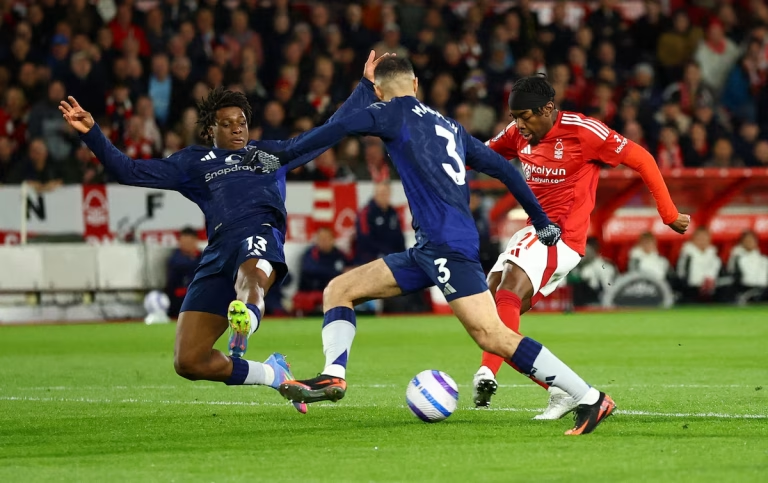
Nottingham Forest achieved a notable 1-0 victory over Manchester United at the City Ground. The decisive moment came from former United player Anthony Elanga, who scored a remarkable solo goal after an 85-meter sprint. This win bolstered Forest’s aspirations for Champions League qualification and marked their first league double over United since the 1991-92 season.

Despite United’s attempts to equalize, including a late effort from Harry Maguire, Forest’s defense held firm. Post-match, Forest’s head coach Nuno Espírito Santo praised his team’s dedication.

Other Football Battles Across Europe

Dunkerque vs. Paris Saint-Germain (PSG)

In the French Cup semifinals, PSG overcame a challenging first half to defeat Dunkerque 4-2, securing their place in the final. Dunkerque, a second-tier team, initially led with goals from Vincent Sasso and Muhannad Yahya Al-Saad within 27 minutes. PSG responded with two goals from Ousmane Dembélé, and additional goals from Marquinhos and Desire Doue. Manager Luis Enrique credited halftime adjustments for the turnaround. PSG will face the winner of Stade de Reims vs. Cannes in the final and are on the verge of clinching their fourth consecutive Ligue 1 title.

Real Madrid vs. Real Sociedad

Real Madrid secured their spot in the Copa del Rey final after a thrilling 4-4 draw against Real Sociedad, advancing with a 5-4 aggregate score. The match was a rollercoaster, with goals from Ander Barrenetxea, Endrick, Mikel Oyarzabal, an own goal by David Alaba, Jude Bellingham, Aurélien Tchouaméni, and a decisive header from Antonio Rüdiger in extra time. This will be Real Madrid’s 41st Copa del Rey final, having won 20 times previously. They will compete for the title on April 26 in Sevilla against the winner of Atlético de Madrid vs. Barcelona.

Arsenal vs. Fulham

Arsenal secured a 2-1 victory over Fulham at the Emirates Stadium. Mikel Merino opened the scoring for Arsenal in the first half. A significant moment occurred when Gabriel suffered a hamstring injury within the opening 20 minutes. Bukayo Saka made a triumphant return, scoring just seven minutes after coming onto the pitch, extending Arsenal’s lead to 2-0. Rodrigo Muniz scored for Fulham during added time, but it served only as a consolation as Arsenal emerged victorious.

Lagos Generates 1,040 Tonnes of Textile Waste Daily — LAWMA

0

The Lagos Waste Management Authority (LAWMA) is ramping up efforts to tackle the 1,040 tonnes of textile waste generated daily in Lagos State as part of its commitment to sustainable waste management.

LAWMA’s Managing Director, Dr. Muyiwa Gbadegesin, made this announcement on Monday in commemoration of International Zero Waste Day, themed “Towards Zero Waste in Fashion and Textiles.”

“Textile waste accounts for approximately 8% of the 13,000 tonnes of daily waste in Lagos. To address this, LAWMA plans to ban textile waste from all state landfills and collaborate with Tejuosho Market in Yaba to collect fabric waste for recycling,” Gbadegesin stated.

As part of the initiative, students at LAWMA Academy are being trained to upcycle textile waste into reusable products, fostering sustainability and economic empowerment.

Gbadegesin reaffirmed LAWMA’s dedication to achieving zero waste in Lagos, aligning with global best practices in waste reduction and resource recovery.

“International Zero Waste Day highlights our collective responsibility to protect the environment. LAWMA is fully committed to implementing waste sorting, recycling, and waste-to-energy initiatives. However, for these efforts to succeed, Lagosians must play an active role in proper waste disposal and environmental sustainability,” he added.

LAWMA’s bold move underscores the growing urgency for sustainable waste management and the need for collaborative efforts in reducing textile pollution across the state.

Taiwan Prepares Countermeasures as US Plans New Trade Tariffs

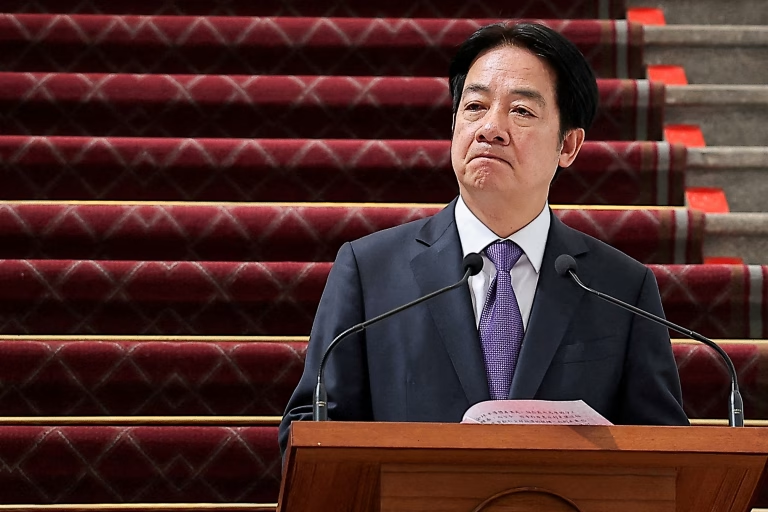
Taiwan’s Minister of Economic Affairs, Kuo Jyh-huei, has announced plans to support local industries that may be impacted by upcoming US tariffs, as President Donald Trump moves to impose widespread trade levies.

Trump is set to unveil “reciprocal tariffs” on Wednesday, calling it “Liberation Day,” in what he claims is a response to years of unfair trade practices against the US. Since returning to office in January, he has threatened tariffs to reduce trade imbalances and encourage companies to shift manufacturing operations back to the US.

Taiwan, which holds the seventh-largest trade surplus with the US at $73.9 billion in 2024, is closely monitoring the situation.

“Our countermeasures have been assessed and analyzed, including responses to potential 10% or 25% tariffs,” Kuo said.
“All scenarios have been evaluated to ensure the best possible support for domestic industries.”

Kuo added that Taiwan will unveil its official response on Thursday after Trump clarifies which industries will be affected.

As a global semiconductor powerhouse, Taiwan has sought to mitigate potential tariffs by increasing its investment in the US. Trump has accused Taiwan of undermining the US chip industry and has even threatened tariffs of up to 100% on semiconductor imports.

Taiwan is hopeful that TSMC’s recently announced $100 billion US investment will help shield its semiconductor sector—a critical pillar of Taiwan’s economy—from these trade restrictions.

Uromi Killings: Outrage Grows as 14 Suspects Transferred for Investigation

0

Public anger continues to mount over last week’s tragic killing of 16 hunters in Udune-Uromi, Esan North-East Local Government Area of Edo State. The incident has sparked widespread outrage, raising concerns over security and justice.

Governor Okpebholo’s Response and Investigation Efforts

In response to the escalating situation, Edo State Governor Monday Okpebholo has intensified efforts to prevent retaliatory actions and restore calm. To address the crisis, he traveled to Abuja and Kano, personally offering condolences and assuring stakeholders that those responsible will be brought to justice. Meanwhile, law enforcement authorities have transferred 14 suspects arrested in connection with the attack to Abuja for further investigation.

Circumstances of the Killings

The victims, a group of travelers, were intercepted by local vigilantes who, upon discovering weapons in their possession, suspected them of criminal intentions. This led to a tragic confrontation that resulted in their deaths. The incident has since drawn widespread criticism and heightened concerns over security in the region.

Reactions from Political Leaders

Governor Abba Yusuf (Kano State)

Kano State Governor Abba Yusuf expressed deep sorrow over the killings, calling for the suspects to be publicly paraded upon arrest to ease the grief of affected families. He also urged that compensation be provided to the bereaved, emphasizing the need to support them during this difficult time.

Senate President Godswill Akpabio

Senate President Godswill Akpabio weighed in on the issue, urging a thorough probe to ensure justice is served.

Deputy Senate President Jibrin Barau & Arewa Consultative Forum (ACF)

Deputy Senate President Jibrin Barau and the ACF condemned the attack, describing it as unnecessary and deeply troubling. Given that many of the slain hunters were from Kano State, the tragedy has sparked strong reactions across the northern region.

President Tinubu’s Intervention and Lawmakers’ Reactions

In reaction to the growing national outcry, President Bola Ahmed Tinubu instructed security agencies to track down and apprehend those behind the killings. Lawmakers, including Speaker of the House of Representatives Tajudeen Abbas, also condemned the brutal attack and called for urgent justice. The ACF commended President Tinubu for his swift intervention and commitment to ensuring accountability.

Governor Okpebholo’s Commitment to Justice and Security

Governor Okpebholo strongly denounced the attack, labeling it a senseless act of violence that cannot be tolerated. Confirming the transfer of the suspects, he stated:

“I was deeply saddened by this unfortunate incident. Upon my arrival, I met with my Hausa brothers, who had generously supported me during my election campaign. We have implemented robust security measures to hold all those involved accountable. Security agencies have already launched investigations to bring the culprits to justice.”

He emphasized that such an attack is a grave concern and goes against the fundamental principles of a just society:

“This cowardly act contradicts the fundamental principles of our society, which are deeply rooted in both Islamic and Christian teachings. So far, 14 suspects have been arrested in connection with the killings. As Kano remains dear to my heart, we will continue to uphold the value of being our brother’s keeper.”

Security Measures to Prevent Reprisal Attacks

Kano State Governor Abba Yusuf commended Okpebholo for his swift and decisive actions, noting that they have helped to manage the rising tension. He further called for strong security measures to prevent any retaliatory attacks and insisted that those arrested should be publicly paraded to bring relief to the victims’ families and ensure accountability.

Support for Victims’ Families

Speaking to journalists after Okpebholo’s visit, Governor Yusuf acknowledged the Edo governor’s proactive response to the tragedy:

“We appreciate the Governor of Edo State for his prompt response to this tragic event. It is well known that our people were returning from Port Harcourt (Rivers State capital) when they were brutally murdered. The majority of the victims were from two local governments in Kano State. Governor Okpebholo immediately visited the scene, ensured that the bodies were retrieved, and arranged for their proper burial. He also made commitments to support the affected families, and I can confirm that he has fulfilled his promises.”

He further expressed confidence in Okpebholo’s assurance that those responsible would face the full weight of the law:

“We trust his assurance that the culprits will be brought to book, as justice remains our utmost priority. The people of Kano State are peaceful and hospitable. This tragedy serves as a lesson to all, and I urge all leaders across Nigeria to ensure the safety and protection of all citizens, regardless of their location. Governor Okpebholo’s visit today is a mark of true leadership, and we appreciate his gesture.”

As investigations progress, many are closely watching how authorities handle the case and whether these measures will be enough to prevent similar incidents in the future. The demand for justice continues to grow, with many calling for comprehensive security reforms to prevent such tragedies from recurring.

Nigeria Police Recruitment: Latest Updates and Next Steps

0

The Nigeria Police Force (NPF) is one of the country’s largest employers, providing thousands of young Nigerians with opportunities to serve in law enforcement.

Over the years, the recruitment process has evolved, facing several challenges while presenting career prospects for those seeking stable employment.

Here’s an in-depth look at the requirements, challenges, training effectiveness, and what applicants need to do now that the recruitment process has advanced.

Recruitment Status Update

Although the recruitment exercise has successfully completed its initial stages, including application submission and screening, shortlisted candidates have undergone physical screening and aptitude tests.

The next phase requires applicants to check their status to determine if they have been selected for training.

Successful candidates are expected to commence training on April 12, 2025 at designated police training institutions.

Recruitment Criteria and Requirements

Candidates who applied had to meet the following eligibility requirements:

  • Age: Between 18 and 25 years old.
  • Education: A minimum of four credits, including Mathematics and English, in SSCE, NECO, or GCE.
  • Physical Fitness: Male applicants must be at least 1.67m (5ft 6in) tall, while female applicants should be 1.64m (5ft 4in). Male candidates must also have an expanded chest size of at least 86cm.
  • Nationality: Only Nigerian citizens by birth with a National Identification Number (NIN) were eligible.
  • Medical Fitness: Candidates had to be in good physical and mental health, free from any form of disability.

    Challenges in the Recruitment Process
  • Training Deficiencies: Many officers receive minimal training in modern policing techniques, community relations, and human rights, reducing their effectiveness in the field.
  • Resource Constraints: The lack of adequate equipment and training facilities limits the preparedness of new recruits.

    Opportunities for Job Seekers

    Joining the police force provides several benefits, including:
  • Stable Employment: Securing a police job offers financial security in a country with high unemployment rates.
  • Career Growth: Officers have opportunities to rise through the ranks and specialize in different units such as intelligence, counterterrorism, or cybercrime.
  • Community Service: Serving in law enforcement allows individuals to contribute directly to national security and public safety. Effectiveness of Police Training
    The efficiency of the Nigerian police force largely depends on how well officers are trained. While the government continues to improve training programs, challenges still exist:
  • Outdated Curriculum: Training modules often lack critical areas such as ethics, human rights, and technology-driven policing.
  • Inadequate Facilities: Many police training colleges lack modern resources and infrastructure.
  • Limited Practical Exposure: Officers sometimes enter the field with insufficient hands-on experience, affecting their decision-making and crisis management skills.

Steps to Check Your Status After Screening

If you applied for the Nigeria Police recruitment and completed the screening process, the following steps are required to check your application status:

  1. Visit the official recruitment portal: Go to www.policerecruitment.gov.ng.
  2. Log in to your account: Use the email and password you registered with.
  3. Click on ‘Check Recruitment Status’: This will take you to the page displaying shortlisted candidates.
  4. Enter your details: Provide your application number or National Identification Number (NIN) to search for your status.
  5. Download your call-up slip (if shortlisted): If successful, print your invitation slip for training.
  6. Prepare for training dates must report to their assigned training institutions on April 12, 2025 with all required documents.

As the force continues to evolve, improvements in training, transparency, and resource allocation will be essential in building a more effective and professional police service..

Minister Reaffirms Government Commitment to Elevating Nigeria’s Art Scene

0

Nigeria’s Minister of Art, Culture, and Creative Economy, Hannatu Musawa, has called for increased collaboration between the government and private sector to drive growth and sustainability in the country’s art industry.

Speaking at the International Art Fair held at the Ecobank Pan African Centre in Lagos on Monday, Musawa praised the diverse artistic displays, including paintings, photography, and sculptures, highlighting their role in shaping Nigeria’s creative economy.

She acknowledged the contributions of Ecobank Nigeria, the Africa Finance Corporation, Soto Gallery, and other sponsors for providing a platform for emerging artists. Musawa reaffirmed the ministry’s commitment to supporting initiatives that foster value creation within the creative sector.

“This event beautifully reflects the richness of Nigeria’s emerging talent and creative ideology. It serves as a bridge to the future, drawing inspiration from our artistic heritage,” she stated.

Musawa emphasized the necessity of government participation in ensuring the long-term success of the art industry. Her attendance at the fair’s second edition, she noted, was a testament to the government’s dedication to elevating Nigeria’s creative sector on the global stage.

She assured attendees that the government would continue providing strategic support to strengthen Nigeria’s presence in the international art community.

Edo Killing: 5 Shocking Cases of Jungle Justice in Nigeria

0

At least seven suspected kidnappers were burned alive in a brutal mob attack in Uromi, a town in Edo State, Nigeria, according to the state’s governor. Governor Monday Okpebholo condemned the lynching, vowing that those responsible would face prosecution to the fullest extent of the law.

Preliminary investigations revealed that the victims, identified as northern Hausa hunters, were stopped by local security forces while traveling in a commercial truck. A search of the vehicle uncovered firearms, which prompted a mob of residents to accuse the men of being kidnappers and Fulani herders.

“The commissioner of police has been directed to carry out a full investigation into the incident,” Okpebholo stated, adding that at least four people had been arrested in connection with the attack.

Kidnapping for ransom and violence attributed to Fulani herders have become a growing crisis in Nigeria, contributing to widespread insecurity, displacement, and inter-ethnic tensions. In recent years, clashes between the semi-nomadic Fulani herders and settled farming communities have led to hundreds of deaths.

Jungle Justice Killings in Nigeria

Jungle justice refers to situations where people are subjected to violent punishment or killing by mobs, often without due process of law. These actions are typically carried out by citizens who believe that the authorities won’t take swift action or bring perpetrators to justice. Here are five notable cases of jungle justice killings in Nigeria:

The Aluu Four (2011):

In October 2012 (though it falls just outside 2011), Aluu community near Port Harcourt, Rivers State, four university students from the University of Port Harcourt identified as Lloyd, Chidiaka, Tekena, and Ugonna had run into a local vigilante group at dawn.

There had been a spate of robberies in the area and at that time of the morning, people became suspicions. Accused of being petty thieves, the four – Llody Toku, Ugonna Obuzor, Chiadika Biringa and Tekena Elkanah – were given a mock trial and found guilty.
Their punishment was handed out immediately: they were stripped, marched around the community, brutally beaten and set alight by the mob as thousands watched and filmed.

The students were beaten, tortured, and publicly lynched by a mob. Their deaths were filmed and circulated on social media, sparking widespread outrage and discussions about the issue of jungle justice in Nigeria.

Following widespread outrage, several arrests were made. In 2017, three individuals were convicted and sentenced to death for their roles in the killings, while four others were acquitted due to insufficient evidence.

Deborah Samuel In Sokoto(2022):

In May 2022, a Christian student named Deborah Samuel was arrested in Sokoto, northern Nigeria, at the Shehu Shagari College of Education in Sokoto, and killed by a mob after being accused of blasphemy for allegedly making derogatory remarks about the Prophet Muhammad in a WhatsApp group.

The incident occurred on May 12, 2022 when a group of students at the college attacked Deborah, beating her and then setting her on fire. Her killing was widely condemned both within Nigeria and internationally.

The arrest of the two suspects came after public outcry and a series of investigations by the Nigerian authorities. While the case drew attention to the issue of religious intolerance and mob violence, it also led to concerns about the increasing frequency of blasphemy-related killings in the country. The arrest of the suspects was part of the government’s efforts to address such acts of violence and to hold individuals accountable for crimes, especially in cases involving blasphemy accusations.

Following Deborah’s death, there were calls from human rights organizations and some religious leaders for stronger measures to combat mob justice and religious extremism in the country. The killing also highlighted the tensions between different religious groups in Nigeria, particularly in the northern states where Islamic law is sometimes interpreted and enforced more strictly.

Two suspects were arrested and charged with criminal conspiracy and inciting public disturbance. However, they were later acquitted due to the absence of prosecution lawyers during the trial.

Oluwatoyin Salau in Lagos (2020):

In 2020, Oluwatoyin Salau, a 22-year-old lady was lynched by a mob in Lagos after being accused of kidnapping. The incident occurred in the Ketu area of Lagos, The mob’s actions were reportedly driven by rumors, though there was no solid evidence to support the claim. Her death sparked widespread outrage. The woman was brutally beaten to death, and later, the police confirmed that no substantial proof of kidnapping was found.

Monday in Lagos(2024):

In September 2024, a man identified as Monday was beaten to death in Lagos state over alleged cable theft. The mob used copper wire to tie his neck, strangling him to death.

The Lagos State Police Command has arrested two suspects in connection with the mob killing.

The arrests were confirmed by Lagos Police spokesperson Benjamin Hundeyin, who stated that the investigation was ongoing and that authorities were searching for other individuals involved in the crime. The victim’s body was moved to Mainland General Hospital in Yaba for an autopsy as part of the investigation.

Unidentified civilian in Ogun State (2024):

A yet-to-be-identified man was lynched and set ablaze by a mob in Ilisha-Remo, Ikenne Local Government Area of Ogun State. The attack, carried out by commercial motorcyclists (Okada riders), was allegedly over the theft of motorcycles.

In the ensuing violence, the mob also attacked a soldier, stabbing him multiple times. The soldier, who was wearing his uniform, managed to escape into a nearby building. The Okada riders, determined to capture him, demanded his whereabouts, escalating the chaos.

Security forces, including soldiers and police officers, were deployed to restore order, leading to further clashes with the mob. The situation caused significant unrest in the community as authorities worked to contain the violence.

Suspected Kidnappers in Enugu (2011):

In 2011, a group of individuals suspected of being involved in kidnapping activities was apprehended by a mob in Enugu State. The suspects were brutally beaten and killed by the crowd, despite the lack of formal charges or legal proceedings.

These incidents highlights the increasing tendency for people to take justice into their own hands, particularly amid rising concerns over kidnappings in various parts of Nigeria. The cases underscored the dangers of jungle justice, where individuals are punished without due process, often based on suspicion and rumors.

Government Efforts to Address Jungle Justice

The Nigerian government has recognized the dangers of jungle justice and has initiated several measures to combat it:

Enforcement of Anti-Mob Laws:

Several state governments have introduced stricter penalties for jungle justice participants, including life imprisonment and the death penalty.

Public Condemnation and Calls for Justice:

Traditional and religious leaders, such as the Sokoto Sultanate Council, have publicly condemned acts of mob violence and called for the arrest and prosecution of perpetrators.

Legal Actions and Sentencing:

In notable cases like the Aluu Four, the judiciary has prosecuted and sentenced individuals involved in mob killings, demonstrating a commitment to upholding the rule of law.

Public Awareness Campaigns:

Various organizations and media outlets have highlighted the dangers and injustices of mob actions, aiming to educate the public and discourage participation in such acts.

While progress has been made, jungle justice remains a significant problem in Nigeria, often fueled by distrust in the justice system, religious tensions, and the rise in violent crime. More concerted efforts are needed to ensure justice is served through legal means rather than mob actions.