Home Blog Page 211

Fuel Prices Set To Rise As Naira-for-Crude Agreement Stalls

0

Operators in Nigeria’s downstream oil and gas sector are anxiously awaiting the Federal Government’s decision on the naira-for-crude agreement between the Nigerian National Petroleum Company Limited (NNPCL) and the Dangote Petroleum Refinery as the deal officially expires today, March 31, 2025.

The six-month agreement, which began in October 2024, was aimed at stabilizing fuel supply, saving foreign exchange, and controlling petrol prices. However, discussions on extending or terminating the deal remain inconclusive, causing uncertainty and fuel price hikes across the country.

Fuel Prices Rise as Naira-for-Crude Talks Stall

Within a week, petrol prices have jumped from N860 per liter to over N930 per liter, with marketers warning that prices could surpass N1,000 per liter if the deal is not renewed.

The Dangote refinery, which processes 650,000 barrels per day, is also set to shut down its petrol-producing unit for maintenance in June, a move that could further worsen fuel supply challenges.

Dangote Suspends Naira-Denominated Fuel Sales

On March 19, 2025, the Dangote Refinery announced a temporary halt to petroleum product sales in naira, citing a currency mismatch between its sales revenue (in naira) and its crude oil procurement obligations (in US dollars).

“Our sales of petroleum products in naira have exceeded the value of naira-denominated crude received. To align with our crude procurement currency, we must temporarily adjust our sales currency,” the refinery stated.

Following this announcement, private depot prices in Lagos surged from N850 to N900 per liter, while pump prices reached N930 in Lagos, N950 in Abuja, and N960 in the North.

Industry Stakeholders Call for Urgent Intervention

Oil marketers blame the Federal Government for failing to renew the deal, which they argue has exacerbated fuel price volatility.

“We’ve called for a stakeholders’ meeting to address this crisis. Selling crude oil in naira was a critical policy, and any deviation affects us all,” said Chinedu Ukadike, National Publicity Secretary of the Independent Petroleum Marketers Association of Nigeria (IPMAN).

The meeting, initially scheduled for March, was postponed to May 1, 2025, due to the Eid-el-Fitr and Easter holidays. It will include representatives from IPMAN, the *Petroleum Products Retail Outlets Owners Association of Nigeria, and other key industry players.

Petrol Prices Could Hit N1,000 Per Liter

IPMAN Vice President, Hammed Fashola, expressed concerns that petrol prices could exceed N1,000 per liter if the naira-for-crude arrangement isn’t reinstated.

“The Federal Government must act swiftly. The economic burden of dollar-based fuel pricing is unsustainable for Nigerians,” Fashola warned.

Meanwhile, Dangote refinery reportedly faced pressure from major distributors such as MRS, Heyden, and Ardova, leading to an increase in petrol prices over the Eid-el-Fitr weekend.

With no clear resolution in sight, the ongoing uncertainty threatens higher fuel prices, increased transportation costs, and greater economic strain on Nigerians.

How Segun Olanrewaju Nigerian Boxer Died During Fight in Ghana

0

Segun ‘Success’ Olanrewaju, a National and West African light-heavyweight champion, has passed away after collapsing during a boxing match in Ghana on Saturday, March 29.

Olanrewaju ‘Success’ the Boxer

Olanrewaju, 40, was a Lagos-based boxer who turned professional in 2019. He won his debut fight against Jimoh Najeem on July 30, 2019, securing two more victories before suffering his first loss to Durodola Olanrewaju via a fourth-round technical knockout.

At the time of his final bout, he was on a four-fight losing streak, having suffered defeats to Russia’s Savely Sadoma, Ibragim Estemirov, Muibi Lekan, and Rashid Idowu. He had also lost all eight of his fights outside Nigeria—six in Russia and two in Ghana. His professional record stood at 13 wins, 9 losses, and 2 draws, with 12 of his victories coming by knockout.

The Ghana Boxing Authority (GBA), which sanctioned the fight, has yet to comment on the tragedy.

What Happened to Segun Olanrewaju

 Segun Olanrewaju

The fight, which was part of the Bel 7 Star Professional Boxing League at the Bukom Boxing Arena, featured Olanrewaju against Ghanaian-Nigerian boxer Jonathan Mbanugu (also known as “Jon Power”). Mbanugu entered the fight with a record of 12 wins, 1 loss, and 1 draw, with all 12 victories by knockout.

The scheduled eight-round contest took a tragic turn within seconds. Olanrewaju landed two weak punches before Mbanugu countered with a right hand to his face. Almost immediately, Olanrewaju staggered backward, fell against the ropes, and collapsed, shocking the crowd.

As the referee began the mandatory count, the Nigerian boxer lay motionless, his throat resting against the ropes. His corner team rushed in, removed his gum shield, and attempted to resuscitate him. Despite swift intervention by the emergency medical team, he was transported to Korle Bu Teaching Hospital, where he was later pronounced dead.

Other Tragic Boxing Incidents

Olanrewaju’s death is a painful reminder of past boxing tragedies involving Nigerian fighters.

  • Chukwuemeka Igboanugo (2022 National Sports Festival, Asaba, Nigeria)
    Competing in the 86kg category for Imo State, Igboanugo collapsed after being knocked out by Prince Gaby Amagor of Anambra State. Despite immediate medical attention, he was pronounced dead. Officials suggested an underlying health condition may have contributed.
  • Sherif Lawal (2024, London, England)
    On May 14, 2024, London-based Nigerian boxer Sherif Lawal collapsed in the fourth round of his professional debut against Malam Varela at Harrow Leisure Centre. Despite prompt medical intervention, including CPR and defibrillation, he was pronounced dead at Northwick Park Hospital.
  • Asymin Mustapha (1982, England)
    Known as “Young Ali,” Mustapha’s promising career ended in tragedy. Facing Barry McGuigan, he was knocked out in the sixth round and lapsed into a coma. He never regained consciousness, passing away while his wife was pregnant.

Myanmar, Thailand Earthquake Leaves Over 2,000 Dead

0

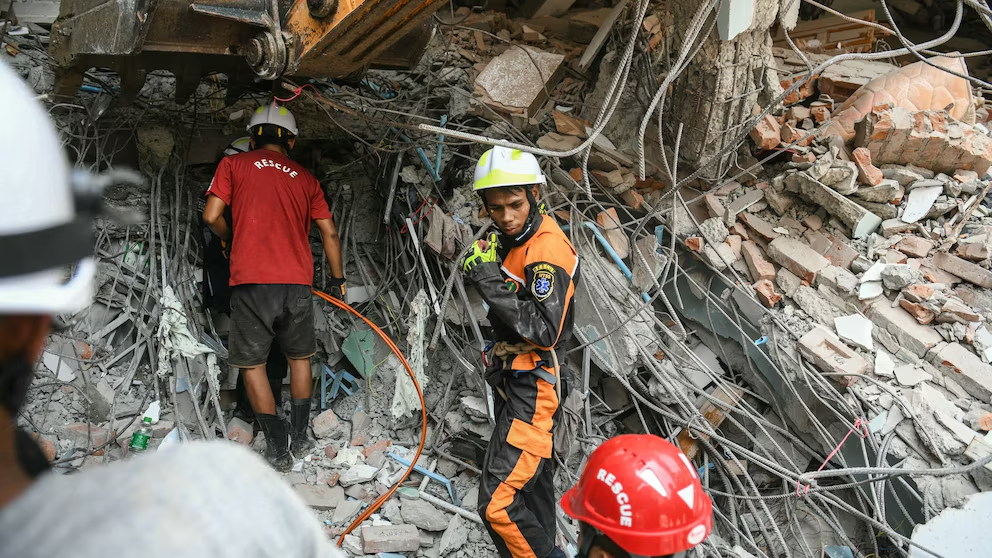
The powerful 7.7-magnitude earthquake which shook Myanmar’s central region near Mandalay on March 28, 2025, has caused massive destruction, reverberating across Southeast Asia.

The tremors were felt as far as China and India, underscoring the intensity of the seismic activity.

Casualties and Structural Damage

In Myanmar, authorities have confirmed at least 1,700 fatalities, with over 3,400 people injured and more than 300 still missing.

Mandalay, one of the hardest-hit cities, has witnessed collapsed bridges, crumbling infrastructure, and widespread damage.

The historic city of Bagan, home to centuries-old temples and pagodas, has also suffered extensive ruin, with many structures either heavily damaged or reduced to rubble.

Meanwhile, in nei Thailand, the impact has also been severe, with reports confirming at least 18 deaths and 33 injuries. In Bangkok, a 30-story building under construction crumbled in the Chatuchak district, leaving several workers trapped beneath the debris.

The earthquake affected 56 out of Thailand’s 76 provinces, causing significant structural damage and panic among residents.

Ongoing Rescue and Relief Efforts

Search and rescue teams are racing against time to pull survivors from the wreckage in both Myanmar and Thailand.

Emergency response crews, alongside international aid organizations, are on the ground providing medical assistance and relief supplies. In Mandalay, teams face logistical hurdles due to damaged roads and persistent aftershocks, making access to affected areas more challenging.

Several countries, including China and India, have dispatched search and rescue teams, medical personnel, and emergency supplies to assist Myanmar.

Despite these efforts, the response in Myanmar is complicated by the country’s ongoing political turmoil.

Myanmar’s Political Landscape Complicates Aid Distribution

The relief operation in Myanmar faces additional challenges due to the nation’s internal conflict. The opposition-led National Unity Government (NUG) and the People’s Defense Force have declared a temporary ceasefire in earthquake-affected zones to allow aid to be delivered.

However, concerns persist about whether Myanmar’s military-led government will fairly distribute assistance to all communities, given its history of uneven disaster response.

Thailand’s Response and Future Prevention Measures

Thailand has swiftly mobilized emergency relief efforts, with Prime Minister Paetongtarn Shinawatra declaring Bangkok a disaster zone. Investigations have been launched to determine why certain structures, including the collapsed high-rise in Chatuchak, failed to withstand the tremors.

To mitigate future risks, Thailand is now exploring advanced earthquake-resistant technologies. One proposed measure involves implementing seismic isolation systems, which elevate buildings and allow them to absorb shock waves more effectively.

Additionally, authorities are reviewing building codes and urban planning strategies to improve structural resilience across the country.

Aftershocks and the Road to Recovery

Myanmar and Thailand, both located in seismically active zones, have experienced numerous earthquakes throughout history. Myanmar, in particular, sits along the boundary of the Indian and Eurasian tectonic plates, making it highly prone to devastating tremors. The country has recorded several major quakes, including the 1839 Ava earthquake, the 1912 Maymyo quake, and more recently, the 2012 Thabeikkyin earthquake. However, the March 28, 2025, 7.7-magnitude quake stands as one of the deadliest in Myanmar’s modern history, leaving over 1,700 dead and thousands injured.

Thailand, though less prone to powerful earthquakes, has also felt the impact of seismic activity over the years. Notable quakes include the 1975 northern region earthquake, the 1983 Kanchanaburi tremor, and the 2014 Mae Lao earthquake in Chiang Rai province. The latest disaster originating from Myanmar sent shockwaves through Thailand, causing a 30-story building collapse in Bangkok and affecting 56 out of the country’s 76 provinces.

The region continues to experience aftershocks, raising concerns about further damage to already weakened structures. Authorities are urging residents to remain in safe areas and avoid returning to unstable buildings. The full scale of the destruction is still being assessed, and as rescue efforts continue, the death toll is expected to rise.

This earthquake has been one of the most devastating in Southeast Asia in recent history, underscoring the urgent need for coordinated international support and robust disaster preparedness plans to mitigate the impact of future seismic events.

Uromi Massacre: How 16 Hunters Were Killed in Edo State

0

A violent attack in Uromi, Edo State, has left 16 hunters dead, sparking widespread outrage and discussions about security oversight in the region.

What Really Happened?

The incident, which took place on Friday, March 28, 2025, involved a local vigilante group and residents of Udune Efandion, who allegedly profiled and attacked a group of northern Nigerian travelers, accusing them of being kidnappers.

The victims were on their way from Elele in Rivers State to Kano for the Muslim Eid al-Fitr festivities when their truck was intercepted along the Uromi/Obajana Expressway at around 1:30 p.m.

Survivors’ Account

About 16 people were reportedly killed but survivors have recounted how they were ordered to disembark before being beaten.

Some managed to escape, while others were not as fortunate.

Dayabu Yahaya, a resident of Kano State, described the attack:

“They [the vigilantes] ordered everyone to get down. I was confused as to why, but we obeyed. As soon as we did, they began flogging us aggressively and gathered us in one place.”

According to him, the attackers did not find anything incriminating but seized their hunting knives, locally made guns, and palm oil.

“These guns are licensed, but they seized the documents and our luggage and burned them,” Dayabu added. “We were 27 in number. Right now, 20 people are missing, five are here, and two are in the hospital.”

Another survivor, Mustapha Alhassan from Katsina State, managed to escape and shared his ordeal:

“After stopping our vehicle, the vigilantes gathered onlookers, who were residents of the town, and then stepped aside, leaving us to their mercy. They kept on beating us as if they were out to kill us. Some of us ran- I was fortunate to be among those who escaped. While on the run, I was divinely connected with some of our Hausa brothers, who contributed money for my transport fare to get to our king’s house.”

“No one interrogated us. They just started beating us,” he added.

The Nigerian police confirmed the incident, stating that the group of travelers, who identified themselves as hunters, were found in possession of 19 locally fabricated firearms.

The vigilantes, unconvinced by their explanation, assumed they were kidnappers and took matters into their own hands.

It remains unclear whether the victims were members of the Nigerian Hunter and Forest Security Service (NHFSS), the recognized body for hunters in the country. NHFSS has yet to respond to requests for comments.

But a manhunt is ongoing for others involved in the attack. The Inspector-General of Police has directed the Force Criminal Investigation Department to take over the case, underscoring the gravity of the incident.

What is the state government’s response so far

Edo State Governor, Monday Okpebholo, has condemned the attack, emphasizing that “nobody has the right to take another man’s life.”

He assured that those responsible would be brought to justice.

Following the tragic event, the governor has suspended the commander of the Edo State Security Corps, Friday Ibadin, and banned unregistered vigilante groups operating within the state.

The Edo State Government clarified that the vigilante group responsible for the killings was operating illegally.

“It is to be reiterated that the local vigilante group involved in the gruesome killing of 27th March was never profiled or registered with Edo State Security Corps,” the statement read.

The statement further emphasized that the actions of the group “do not reflect the core values, character and principles of the Okpebholo administration, or the objectives of the corps as enshrined in the Edo State Security Corps Governance Law.”

So far, 14 individuals have been arrested in connection with the attack, while a special police team is actively pursuing other suspects.

The Edo State Government reaffirmed its commitment to upholding citizens’ constitutional rights, particularly the freedom of movement and lawful business activities. Officials are currently in contact with the victims’ families, community leaders, and authorities from Kano State, where most of the deceased were from.

The government urged the public to remain calm, assuring that “the State Government remains committed to ensuring that justice is done in a most efficient, transparent and proactive manner.”

President Bola Tinubu also directed the police and other security agencies to conduct a thorough investigation and ensure that the perpetrators face legal consequences.

With investigations ongoing, many are questioning whether the suspension of security officials and the crackdown on unregistered vigilante groups will be enough to prevent future tragedies. The situation remains a critical test of Edo State’s security framework.

Obasa Stands Firm on Lawsuit Against Meranda Despite Tinubu’s Intervention

0

Despite President Bola Tinubu’s mediation in the Lagos Assembly leadership crisis, Speaker Mudashiru Obasa is proceeding with his lawsuit against former Speaker Meranda and other Assembly members.

Chief Afolabi Fashanu (SAN), Obasa’s lawyer, confirmed that the case would not be withdrawn, stating that his legal team is awaiting the court’s judgment. This stance contradicts reports suggesting that part of Tinubu’s resolution required Obasa to drop the lawsuit.

Justice Yetunde Pinheiro of the Lagos State High Court reserved judgment on March 17, 2025, following objections from the defendants’ lawyers. The court will communicate the ruling date to all parties.

“We are just waiting for the judgment. The court will inform us when it is ready,” Fashanu stated.

When asked about the possibility of withdrawing the suit, he firmly responded, “That does not arise anymore. Arguments have been concluded, and he’s not withdrawing.”

Meanwhile, former Lagos APC chairman Otunba Henry Ajomale expressed confidence that Obasa would eventually withdraw the case due to Tinubu’s intervention. Speaking at an event honoring Governor Babajide Sanwo-Olu, he stated:

“Very soon, at the next sitting, you will see the difference… Since the President has intervened, the issue will not escalate into a bigger problem.”

Obasa, who was removed as Speaker on January 13, 2025, fought for reinstatement, eventually regaining the position after Meranda’s resignation following a 49-day tenure. The APC’s national leadership played a crucial role in resolving the dispute.

On March 12, 2025, all 40 Lagos Assembly members met with President Tinubu in Abuja to settle their differences. However, the House has not convened since March 3, with its next sitting expected after the Sallah break.

Meanwhile, sources revealed that Obasa is currently in Mecca for a holy pilgrimage, further delaying legislative activities.

FA Cup Quarter-Finals: Rashford Fires Villa to Victory

0

Aston Villa secured a dominant 3-0 win over Preston North End in the FA Cup quarter-finals at Deepdale Stadium. Marcus Rashford was the star of the match, scoring twice in the second half to put Villa firmly in control. His first goal came from a well-placed Lucas Digne cross, while his second was a coolly converted penalty. Jacob Ramsey sealed the victory with a late goal, sending Unai Emery’s side to the semi-finals for the first time since 2015.

Despite Preston’s spirited first-half performance, their lack of cutting edge in attack proved costly. The Championship side was the only non-Premier League team left in the competition, but they ultimately couldn’t match Villa’s quality.

Bournemouth vs Manchester City: Late Comeback Seals City’s Progress

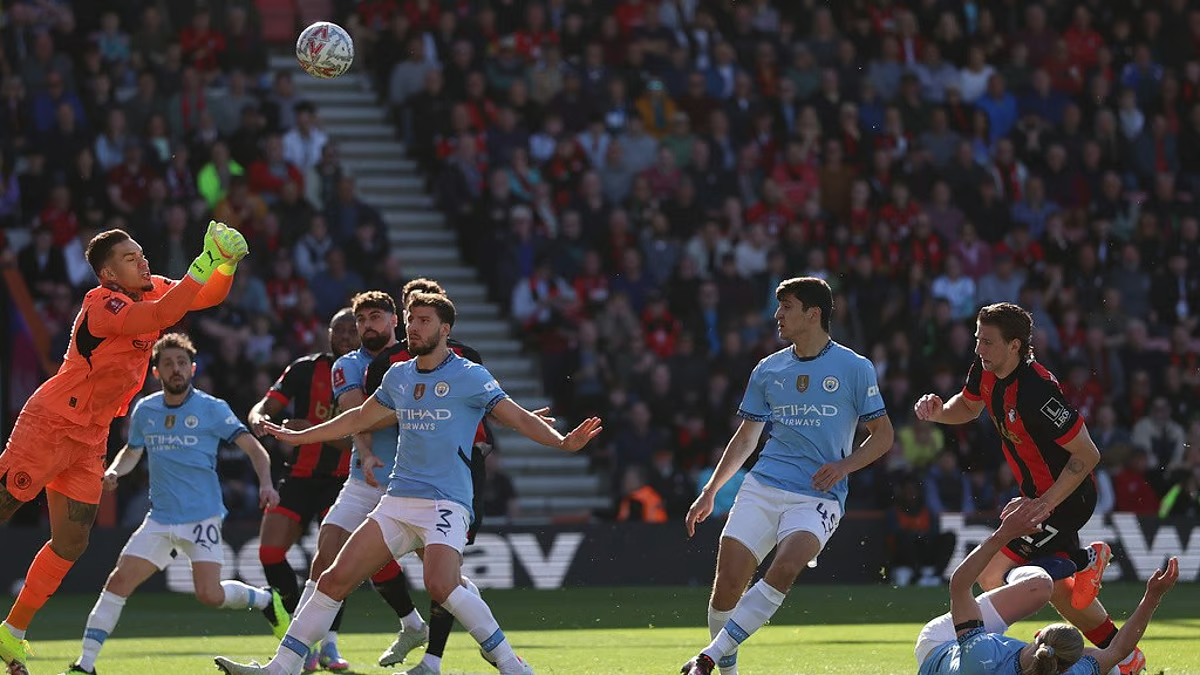
Manchester City had to fight hard to overcome Bournemouth in a 2-1 comeback win. Bournemouth stunned the Premier League champions by taking the lead through Evanilson and even managed to deny Erling Haaland from the penalty spot. However, City’s relentless pressure paid off in the second half as Haaland redeemed himself with a well-taken equalizer. Omar Marmoush then scored the winner, securing City’s place in the semi-finals.

FA Cup Semi-Final Lineup Confirmed

With these results, the FA Cup semi-finals will feature:

  • Aston Villa vs Crystal Palace
  • Manchester City vs Manchester United (or Liverpool, pending their quarter-final result)

The semi-finals promise exciting matchups, with Aston Villa looking to continue their dream FA Cup run, while Manchester City aims to retain their dominance in English football.

Is Fintech The Future Of Banking For Nigerians?

0

Banking in Nigeria has undergone a significant transformation in recent years. The traditional banking system, once the primary financial service provider, is now facing stiff competition from fintech companies. These digital-first financial institutions are reshaping the industry, offering Nigerians more convenience, better financial returns, and innovative banking experiences.

With the increasing demand for seamless financial services, young people must understand the future of banking and how they can benefit from these changes. The real question is: will commercial banks adapt, or will fintech completely take over?

Fintech vs. Commercial Banks: Understanding the Difference

Before diving into the advantages and challenges of both banking systems, let’s establish a clear distinction:

  • Commercial Banks: These are traditional institutions like GTBank, Zenith Bank, and First Bank, offering physical branches, savings accounts, loans, and other financial services.
  • Fintech Banks: Digital financial institutions such as Kuda, Opay, and Palmpay operate online, leveraging technology to provide banking solutions with little to no physical infrastructure.

The primary difference lies in their approach—commercial banks rely on legacy systems with bureaucratic processes, while fintech banks focus on innovation, speed, and customer-centric services.

How Fintech Banks Are Adding Value to Customers

Fintech banks are rapidly becoming the preferred choice for Nigerians, and here’s why:

1. Higher Interest on Savings and Zero Maintenance Fees

Unlike commercial banks, which often charge maintenance fees and offer low-interest rates on savings, fintech banks provide higher returns. For example, platforms like PiggyVest and Kuda offer competitive interest rates on savings accounts with zero hidden charges.

2. Instant Transactions and Seamless Banking Experience

Fintech banks prioritize efficiency, ensuring that transfers, bill payments, and withdrawals happen instantly. With commercial banks, failed transactions and unnecessary delays are common frustrations.

3. Easy Access to Loans Without Excessive Paperwork

Young entrepreneurs and freelancers often struggle to access credit facilities from traditional banks due to strict requirements. Fintech companies like Carbon and FairMoney provide quick, collateral-free loans within minutes.

4. Investment Opportunities at Your Fingertips

Beyond just saving, fintech banks integrate investment options that help young Nigerians grow their wealth. Apps like Cowrywise and RiseVest offer automated investment plans in local and international markets.

Where Commercial Banks Are Falling Behind

Despite their long-standing presence, commercial banks have several shortcomings that make them less attractive to younger generations:

1. High Fees and Hidden Charges

From ATM maintenance fees to SMS alerts and transfer charges, traditional banks make money from multiple deductions, eating into customers’ balances.

2. Bureaucracy and Slow Processes

Opening an account, requesting a loan, or resolving an issue with a commercial bank often involves endless paperwork and long wait times.

3. Limited Financial Inclusion for Young Entrepreneurs

Most traditional banks still follow outdated lending policies that make it difficult for startups and freelancers to access financial support.

The Future of Banking for Nigerians

The future of banking in Nigeria will be shaped by digital-first solutions. For many Nigerians, the choice between fintech and commercial banks depends on personal financial goals. However, fintech banks are proving to be the future of banking by offering better financial incentives, seamless experiences, and innovative solutions tailored to a digital generation.

To stay ahead, young Nigerians should explore fintech options while keeping an eye on how traditional banks evolve. The future of banking is digital, and those who embrace it will benefit the most.

TETFund to Establish 18 Innovation Hubs in Nigerian Institutions by 2025

0

The Tertiary Education Trust Fund (TETFund) has announced plans to establish 18 new Innovation Hubs in tertiary institutions across Nigeria in 2025. The initiative aims to enhance research, innovation, and technological advancement in the country.

TETFund’s Executive Secretary, Arch. Sonny Echono, made the announcement at the closing ceremony of the 30th Cohort of the Research for Impact (R4i) initiative, held at Innov8 Technology Hub in Abuja.

According to Echono, the establishment of these hubs aligns with TETFund’s commitment to fostering problem-solving research, entrepreneurship, and stronger research-industry linkages. He highlighted the role of education and research in national development and reaffirmed the Fund’s dedication to institutionalizing Research & Development (R&D) in Nigerian universities.

Echono also commended Innov8 Technology Hub for its contributions to transforming the country’s innovation ecosystem.

Meanwhile, Edward Singhatey, Director of Innov8 Hub, urged participants to share the knowledge and tools gained from the R4i programme with their institutions and students to further drive innovation.

The R4i programme, a collaboration between TETFund and Innov8 Technology Hub, is designed to empower researchers and academics with the skills needed to conduct solution-driven research that addresses key societal challenges.

NELFUND MD Hails President Tinubu’s Leadership on His 73rd Birthday

0

The Managing Director and Chief Executive of the Nigeria Education Loan Fund (NELFUND), Mr. Akintunde Sawyerr, has extended heartfelt congratulations to President Bola Ahmed Tinubu, GCFR, as he marks his 73rd birthday.

In a statement, Mr. Sawyerr lauded President Tinubu’s unwavering commitment to the Renewed Hope Agenda, particularly in the education sector, where his administration has championed bold reforms to eradicate illiteracy and foster national development. He highlighted the President’s belief that education is fundamental in the fight against poverty, emphasizing how this vision has led to key policy initiatives aimed at building a more competitive and prosperous future for Nigerian youth.

A major milestone of President Tinubu’s administration is the establishment of the Nigeria Education Loan Fund (NELFUND), a transformative initiative providing interest-free student loans. This program has already seen over 500,000 student registrations, ensuring that financial constraints no longer hinder access to quality education.

Speaking on the occasion, Mr. Sawyerr reaffirmed NELFUND’s commitment to supporting the President’s vision of accessible and sustainable education financing.

“On behalf of NELFUND, I extend my warmest wishes to Mr. President on his birthday. Your dedication to education and national development continues to inspire us. May you be blessed with good health, wisdom, and many more years of impactful leadership as you steer Nigeria toward a brighter future,” he stated.

As Nigeria celebrates the President’s leadership, NELFUND remains steadfast in its mission to empower students and secure a better future through accessible education.

From Prof. Wole Soyinka To Farooq Oreagba: Five Nigerians Who Survived Cancer

11

Abisola Kola-Daisi, the eldest daughter of the late Senator Abiola Ajimobi, former Governor of Oyo State, passed away at the age of 42.

Known as Bisola, she reportedly died early on Thursday after a battle with cancer. She passed away in the United Kingdom, leaving behind her husband, Kolapo Kola-Daisi, and their three children.

At the time of her death, Bisola was serving as a Special Adviser to Atiku Bagudu, Nigeria’s Minister of Budget and Planning. She was also deeply involved in her family’s businesses and owned the luxury store, Florence H Boutique.

Bolaji Tunji, the Special Adviser to her late father, confirmed the news of her passing, stating, “Yes. It has been confirmed.” This marks another tragic loss for the Ajimobi family, as Bisola’s father, Senator Abiola Ajimobi, passed away in June 2020 at the age of 70.

What You Need to Know About Cancer

Cancer is the uncontrolled growth of abnormal cells in the body. These abnormal cells, known as cancer cells, malignant cells, or tumor cells, can invade normal tissues. Many cancers are named after the tissue from which they originated (e.g., breast cancer, lung cancer, colorectal cancer).

Cancer affects not only humans but also animals and other living organisms. Normally, damaged or altered cells die off, but if they remain alive and continue to grow uncontrollably, they can develop into cancer.

Types of Cancer

There are over 100 types of cancer, classified based on their origin and the tissue they affect. These classifications include:

Solid cancers: The most common form, comprising 80% to 90% of cases. These include carcinomas (affecting epithelial tissue like the skin, breast, colon, and lungs) and sarcomas (affecting bone and connective tissue).

Blood cancers: These cancers originate in blood cells or the lymphatic system, such as leukemia, lymphoma, and multiple myeloma.

Mixed cancers: These involve two or more classifications or subtypes, such as carcinosarcoma and adenosquamous carcinoma.

The most common cancers among different groups include:
Men: Prostate, lung, and colorectal cancer
Women: Breast, lung, and colorectal cancer
Children: Leukemia, brain tumors, and lymphoma

Symptoms of Cancer

The symptoms of cancer vary depending on the type, location, and spread of the cancer. For instance, breast cancer might manifest as a lump or nipple discharge, while metastatic breast cancer could cause pain (if spread to the bones), fatigue (if spread to the lungs), or seizures (if spread to the brain). Some people may not show symptoms until the cancer is advanced.

General cancer symptoms may include:

  • Fatigue
  • Nighttime fever
  • Loss of appetite
  • Night sweats
  • Persistent pain
  • Changes in the skin, especially moles that alter in shape or size, or new moles
  • Unexplained weight loss

Certain cancers may also produce organ-specific symptoms, such as:

  • Blood in urine or stool
  • Changes in skin moles
  • Coughing up blood
  • New lumps or bumps

These symptoms don’t necessarily indicate cancer but warrant medical attention.

5 Nigerians Who Survived Cancer

Banky W – Olubankole Wellington

Olubankole Wellington, known as Banky W, is a Nigerian-American singer, rapper, actor, entrepreneur, and politician. Diagnosed with skin cancer in 2007, Banky W has had four surgeries to fight the disease. In May 2024, he shared his success after his fourth surgery on Instagram. He is currently pursuing a Master’s Degree in Policy at Georgetown University.

Prof. Wole Soyinka

Nobel Prize-winning playwright, Prof. Wole Soyinka, was diagnosed with prostate cancer in 2014 during a routine checkup. In an interview with media personality Chude, he shared the challenges of his treatment, particularly the need to drink gallons of water. He used proton therapy to treat his condition, and he later told his wife they would face the fight together.

Farooq Oreagba

Farooq Oreagba, a British-educated financial services executive, was diagnosed with bone marrow cancer in February 2014. He has since been involved in numerous cancer awareness campaigns. In an interview with Arise TV, Oreagba reflected on how his diagnosis reshaped his life and priorities, and he remains a prominent advocate for cancer treatment and prevention.

Temitope Osoba

Nollywood actress Temitope Osoba opened up about her battle with breast cancer in November 2024. After her initial surgery, she sought financial support to continue her treatment. In an emotional interview with BBC News Yoruba, she shared her fears and challenges, expressing gratitude for the help she received from friends and colleagues.

Bracket – Nwachukwu Ozioko

Nwachukwu Ozioko, known as Vast of the music duo Bracket, was diagnosed with lymphoma (blood cancer) in February 2013. After experiencing severe pain, headaches, and weight loss, he sought treatment in the UK. Following several rounds of chemotherapy, he was declared cancer-free after seven months. In 2016, Vast and his partner, Smash, established the Bracket Foundation to raise funds for cancer patients in Nigeria, especially those unable to afford treatment abroad.