Nigeria spends over $10 billion every year on food imports, including wheat, rice, sugar, fish, and even tomato paste, according to the Minister of Agriculture and Food Security, Abubakar Kyari.
Kyari disclosed this on Tuesday in Lagos at the First Bank of Nigeria Ltd. 2025 Agric and Export Expo. Represented by his Special Adviser, Ibrahim Alkali, the minister described the rising dependence on food imports as unsustainable and called for stronger financing in agriculture to drive local production and boost exports.
“Agriculture already contributes 35 percent to our GDP and employs the same percentage of our workforce. We have 85 million hectares of arable land and a youthful population, with over 70 percent under 30 years old. Yet Nigeria accounts for less than 0.5 percent of global agro-exports and earns less than $400 million from the sector,” Kyari said.
He stressed that President Bola Tinubu’s administration remains committed to achieving food sovereignty, which he described as essential to reducing dependency on foreign food supplies. “Food sovereignty means ensuring no Nigerian goes hungry due to global supply shocks. It means empowering every community to thrive on our land, our people, and our productivity,” he added.
According to him, scaling up domestic food production and supporting exports must go hand in hand. He noted that while the country has the land, labour, and market, what is lacking are financing systems, infrastructure, and value addition that can transform potential into real prosperity.
Kyari urged a shift from reliance on oil revenues to resilience in agriculture and agribusiness. He emphasized innovative financing mechanisms such as performance-based agricultural funding, revenue-sharing, factoring forward contracts, and Pay-as-Harvest schemes as proven models that could strengthen food security in Nigeria.
“Nigeria can do better if we embrace critical thinking and adopt tested strategies that are already working in other economies,” he said.
The Federal Government has commenced a fully automated admission process for Federal Unity Colleges across the country, aimed at improving transparency, efficiency, and capacity management in secondary school placements.
In a statement on Tuesday, the Director of Press and Public Relations at the Ministry of Education, Boriowo Folasade, said the reform was introduced under the leadership of the Minister of Education, Dr. Maruf Tunji Alausa.
According to the ministry, the initiative eliminates the problem of overcrowding in Unity Colleges by ensuring admissions are strictly within each school’s approved capacity.
Dr. Alausa described the reform as a guarantee of “fairness, operational efficiency, and sustained quality” in the colleges.
The current cycle covers 80 conventional Federal Unity Colleges for Junior Secondary School 1, while admissions for 42 Federal Technical Colleges under the Technical and Vocational Education and Training (TVET) programme will be released later.
Director of Senior Secondary Education, Hajia Binta Abdulkadri, hailed the automation as a “game-changer,” saying it will streamline the process, strengthen accountability, and create better learning environments for students.
The ministry added that parents and students can check admission results on its official website, reaffirming its commitment to delivering quality education in safe and conducive environments nationwide.
The African Nations Championship (CHAN) 2024 has reached a decisive stage, with six countries already booking their places in the quarter-finals. Hosts Kenya, Tanzania, and Uganda have made history by progressing together, while Morocco, Algeria, and Madagascar have also secured passage to the knockout rounds.
Kenya — A Dream Debut For The Hosts
Kenya, playing in their first-ever CHAN tournament, have defied expectations by finishing top of Group A with 10 points. The Harambee Stars stunned seasoned sides, beating DR Congo and Morocco 1–0 apiece, before sealing their group with a narrow 1–0 victory over Zambia. Their only slip came in a 1–1 draw with Angola. Conceding just once in the group stage, Kenya look well-drilled and resilient. They will face Madagascar in the quarter-finals at Kasarani on Friday, August 22.
Tanzania — Relentless And Compact
Group B belonged to Tanzania, who finished unbeaten with 10 points. The Taifa Stars showcased strong organization, conceding only a single goal across four matches. Even a final-day 0–0 draw against the Central African Republic could not dent their momentum. With the Dar es Salaam crowd behind them, Tanzania are set for a high-profile quarter-final showdown against Morocco under the lights at Benjamin Mkapa Stadium.
Uganda — Nerves And History In Kampala
Uganda’s path to the quarter-finals was dramatic and emotional. Facing South Africa in their final Group C game, the Cranes fought back from 3–1 down to earn a 3–3 draw, thanks to two late penalties including one deep into stoppage time. That result pushed them to seven points, enough to top the group for the first time in their CHAN history. Uganda will now face the runners-up of Group D at Mandela National Stadium in Kampala, aiming to extend their fairytale run.
Algeria — Efficiency Over Flair
Algeria had to dig deep to qualify, edging through as Group C runners-up on six points. A tense goalless draw with Niger on the final day proved just enough to see them advance on goal difference, ahead of South Africa. Though not yet at their sparkling best, Algeria’s tournament know-how makes them a dangerous knockout opponent. They will face the winners of Group D in Zanzibar’s Amaan Stadium.
Morocco — Champions Show Their Edge
Two-time CHAN champions Morocco once again proved their pedigree. After slipping to second place behind Kenya in Group A, the Atlas Lions sealed qualification with a commanding 3–1 victory over DR Congo. With nine points from four games, Morocco have shown attacking flair and tournament maturity, setting up a heavyweight clash with hosts Tanzania in Dar es Salaam.
Madagascar — The Island Nation Rising
Madagascar’s story has been one of resilience and determination. The Barea clinched second place in Group B with seven points, edging out Mauritania on goal difference after a decisive 2–1 win over Burkina Faso. Their reward is a quarter-final clash against Kenya in Nairobi, a fixture that promises both excitement and unpredictability.
Quarter-Final Fixtures Confirmed
The stage is set for a thrilling knockout phase. Kenya will face Madagascar in Nairobi, Tanzania battle Morocco in Dar es Salaam, Algeria take on the Group D winners in Zanzibar, while Uganda host the Group D runners-up in Kampala. With the co-hosts thriving and traditional heavyweights still in the mix, CHAN 2024 promises a quarter-final round rich with drama, passion, and history in the making.
The simmering rivalry between two of Yorubaland’s most revered traditional rulers, the Alaafin of Oyo and the Ooni of Ife, has once again come to the fore following a sharp disagreement over the conferment of a chieftaincy title.
At the weekend, the Ooni of Ife, Oba Enitan Adeyeye Ogunwusi, conferred the title of Okanlomo of Yorubaland on Ibadan-based businessman, Engineer Dotun Sanusi.
The event, held during the unveiling of 2geda, an indigenous social media and business networking platform at Ilaji Hotel, Ibadan, was described by the Ooni as a recognition of Sanusi’s “unparalleled commitment to the cultural and economic growth of the Yoruba race.”
However, the Alaafin of Oyo, Oba Abimbola Akeem Owoade, swiftly rejected the move, accusing the Ooni of overstepping his traditional authority.
In a strongly worded statement issued on Monday through his media aide, Bode Durojaiye, the Alaafin demanded that the title be revoked within 48 hours or the Ooni should “face the consequences.”
“The attention of the Alaafin of Oyo and the Titan of Yorubaland, Oba Engineer Abimbola Akeem Owoade I, has been drawn to the purported conferment of the chieftaincy title of Okanlomo of Yorubaland on a business tycoon, Dotun Sanusi, by the Ooni of Ife, Oba Enitan Adeyeye Ogunwusi,” the statement read.
“The Ooni of Ife is behaving as if there is no authority to check and call him to order. Because of that ‘above-the-law’ syndrome of his, he is in the habit of walking on everybody’s back, including the apex court in the country, the Supreme Court, which had ruled on the exclusive preserve of the Alaafin to confer any chieftaincy title that covers the entire Yorubaland.”
Who Holds Greater Authority?
At the heart of the dispute lies the question of hierarchy in Yorubaland’s traditional structure. Historically, both the Alaafin of Oyo and the Ooni of Ife command deep cultural significance: the Ooni as the spiritual custodian of the Yoruba people, and the Alaafin as the political authority with sovereignty traced back to the old Oyo Empire.
Court rulings and traditional protocols, however, have long emphasized that only the Alaafin has the exclusive authority to bestow titles with jurisdiction over the entire Yorubaland. The Ooni’s authority, by contrast, is officially limited to Ile-Ife and its surrounding areas, specifically Ife Central, Ife North, and Ife South Local Government Areas.
This was the basis of Oba Owoade’s warning, as he accused the Ooni of undermining Yoruba unity and disregarding his peace-building efforts.
Consequences For Defiance
The Alaafin’s 48-hour ultimatum raises the question of what consequences might follow if the Ooni refuses to comply. While no direct sanctions over a traditional ruler are spelt out in law, Oba Owoade’s threat suggests that the matter could escalate either through legal channels, relying on the earlier Supreme Court ruling, or through cultural and political pressure within Yoruba traditional institutions.
“The dictum that nobody is above the law of the land is now being put to a crucial test,” the Alaafin warned. “The Ooni must revoke the so-called Okanlomo of Yorubaland title conferred on Engineer Dotun Sanusi within 48 hours or face the consequences.”
The Vietnamese government has expressed its interest in expanding cooperation with Nigeria in areas such as trade, agriculture, education, and security.
Vietnam’s Ambassador to Nigeria, Bui Hung, made this known on Tuesday in Abuja during events marking the 80th anniversary of the August Revolution and the founding of Vietnam’s Ministry of Foreign Affairs.
Hung noted that while trade relations have improved, there is still significant untapped potential. He disclosed that bilateral trade rose to $1 billion in 2024, up from an average of $600 million in previous years, mainly due to Vietnam’s increased crude oil imports from Nigeria.
“Last year was the first time our trade volume reached $1 billion, largely because of oil purchases. But oil and gas should not be the main focus. Agriculture offers more sustainable opportunities,” the envoy said.
According to him, Vietnam currently exports electronics, textiles, footwear, and other consumer goods to Nigeria while importing cashew nuts and limited agricultural products in return. He identified rice as a key challenge, noting that high tariffs and taste preferences have hindered access to Nigeria’s market.
“Vietnamese rice faces nearly 70 percent tariffs in Nigeria, and while Nigerians prefer basmati, ours is jasmine and sticky. Yet globally, our rice is in high demand, with major buyers including the US, Japan, and Southeast Asia,” he explained.
The envoy suggested stronger collaboration in agriculture, highlighting Vietnam’s expertise in rice production. He revealed that one Vietnamese farmer is already cultivating rice successfully in Benue State, demonstrating the potential for partnerships in the sector.
Hung also disclosed that a proposal for a Free Trade Agreement between the two countries has been awaiting Nigeria’s response for over a year. “Such an agreement would reduce tariffs and enhance trade flows, as we have achieved with Japan, Korea, and others,” he said.
On security and defence, he said military exchanges already exist, with some Nigerian officers receiving training in Vietnam. “We are open to expanding this cooperation, including technology transfer,” he added.
The ambassador further emphasized education and skills development, stating that Nigerian students are already studying maritime, agribusiness, and ICT in Vietnam. He said Vietnam is willing to host more students and professionals for training, especially in emerging fields such as artificial intelligence.
While acknowledging challenges such as insecurity, Hung expressed optimism about future cooperation. “Nigeria has fertile land, abundant water, and a young workforce. With the right framework, we can build stronger ties that benefit both nations,” he concluded.
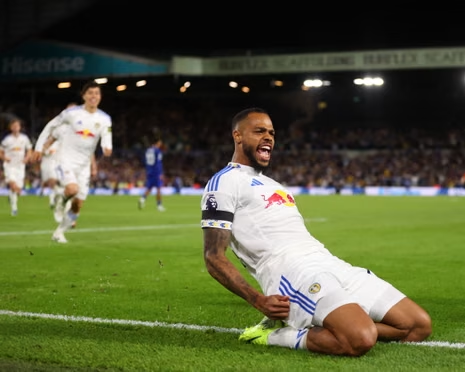
Leeds United marked their Premier League return with a dramatic 1–0 win over Everton at Elland Road. The game, played on Monday night, was finely balanced until the 84th minute when substitute Lukas Nmecha converted a penalty to seal the victory. While the three points delighted the Leeds faithful, the nature of the decisive moment left Everton fuming and set the tone for renewed debates on refereeing standards in the league.
The Penalty Incident
The controversy arose when Everton defender James Tarkowski blocked Anton Stach’s shot inside the area. The ball struck his arm, which appeared tucked against his body. Referee Simon Hooper immediately pointed to the spot, and VAR upheld the decision after review. Officials explained that Tarkowski had “leaned into the ball,” thereby creating an unfair barrier. The interpretation, however, sparked fierce disagreement, with many Everton players and staff insisting that the defender could do nothing to avoid contact.
Moyes Lashes Out At Officials
Everton manager David Moyes could not hide his anger at full-time. Charging onto the pitch, he demanded an explanation from the referee. In his post-match comments, Moyes delivered a scathing assessment of the standard of officiating across the league’s opening weekend. “That’s never a penalty,” he said, before sarcastically adding, “What’s he supposed to do, chop his arm off?” Moyes warned that if such decisions continued, the credibility of refereeing in the Premier League would be under serious threat.
Tarkowski: “The Explanation Was Bizarre”
James Tarkowski himself spoke out, echoing his manager’s frustration. The defender argued that his arm had been in a natural position and accused the officials of poor judgment. “I had my arm by my side, and somehow the linesman, 45 yards away, claimed otherwise,” Tarkowski said. “The explanation I was given was bizarre. I don’t know what more I could have done.” His remarks underline the growing sense among players that VAR is being applied inconsistently.
Pundits Take A Different View
Despite the backlash from Everton, pundits Jamie Carragher and Gary Neville took a contrasting stance in the Sky Sports studio. Both analysts insisted that Tarkowski’s body movement was enough to justify the decision, noting that he leaned into the path of the ball. Their defense of the officials highlighted the divide between those on the pitch and those interpreting the laws from the sidelines.
Leeds Take The Momentum
While Everton focused on the officiating, Leeds quietly celebrated a winning return to the top flight. For manager Daniel Farke, the result was proof of his side’s resilience and ability to seize key moments. The win lifted Leeds into seventh place after the first round of fixtures, giving them an early psychological boost in what is expected to be a tough campaign. Nmecha, who calmly slotted the penalty, could prove a valuable asset in tight matches this season.
Everton’s Concerns Beyond The Referees
For Everton, the loss raises concerns beyond refereeing decisions. Moyes admitted that star signing Jack Grealish would need to be eased into the squad, hinting that fans should temper expectations of immediate impact. With the team already feeling unlucky after one match, Moyes now faces the dual challenge of keeping spirits high while pushing for improved performances on the pitch.
What This Means Going Forward
The fallout from Elland Road is bigger than one result. Leeds can draw confidence from their ability to win scrappy matches, a vital trait for survival. Everton, however, risk being dragged into frustration if they allow refereeing debates to overshadow their football. More broadly, the game reignites the wider conversation about VAR’s interpretation of handball laws, a debate that shows no sign of fading as the season unfolds.
President Donald Trump and Russian President Vladimir Putin held a highly anticipated summit in Anchorage on Friday, August 15, 2025, marking the most direct effort so far to find an end to the war in Ukraine.
While the meeting ran for several hours, no joint statement was issued, and both leaders left with different tones: Trump focusing on a “peace agreement” rather than an immediate ceasefire, and Putin signaling readiness for wider negotiations without making concrete concessions.
Why The Meeting
The Alaska talks were the first face-to-face encounter between Trump and Putin since the Russian invasion began in 2022.
Expectations had been high for a breakthrough ceasefire, but instead Trump signaled a shift away from halting the fighting immediately, choosing to frame the meeting as a first step toward a broader settlement.
Ukrainian President Volodymyr Zelenskyy, preparing for follow-up meetings in Washington, cautioned that any agreement must provide lasting security and not merely a pause that allows Russia to regroup.
Key Outcomes of the Meeting
Although no written deal emerged, both leaders touched on key issues that could shape the next phase of diplomacy. Trump suggested that Ukraine could receive security guarantees similar to NATO protections without formally joining the alliance, and Putin did not dismiss this idea, but linked it to Kyiv dropping its pursuit of NATO membership.
Reports of potential territorial arrangements also surfaced, including recognition of Russian control over Crimea and parts of Donetsk and Luhansk, alongside discussions of Russia freezing further advances in the south. None of these terms has been accepted by Ukraine.
The shift from ceasefire to long-term peace agreement highlights the gulf between Trump’s new approach and the urgency felt in Kyiv. While Trump portrayed the meeting as progress, critics argue that without immediate steps to halt the fighting, the war could intensify as both sides seek stronger positions before any settlement is signed.
European and Ukrainian Response
Zelenskyy restated Ukraine’s firm opposition to territorial concessions, insisting that Ukraine’s sovereignty and borders are non-negotiable. His administration warned that rewarding Russian aggression would only set a dangerous precedent.
European leaders reacted swiftly to the summit. Britain’s Prime Minister Keir Starmer, France’s Emmanuel Macron, Germany’s Friedrich Merz, and Italy’s Giorgia Meloni coordinated with Kyiv and announced plans to join Zelenskyy in Washington to influence the emerging framework. NATO Secretary General Mark Rutte and EU Commission President Ursula von der Leyen also pledged to ensure Ukraine’s voice remains central.
The U.S. administration struck a cautious note, with Secretary of State Marco Rubio acknowledging that progress was made but stressing that “big areas of disagreement” remain. His comments about the need for “concessions on both sides” drew mixed reactions in Washington and Europe, with some fearing the language could signal pressure on Kyiv to compromise.
What Is The Social Media Saying
The summit quickly set off a wave of debate online. Ukrainian users voiced anger at the absence of a ceasefire.
An X comment by User Martha reads: “I think Putin showed Trump his copy of the #EpsteinFiles during the Beast ride right away, to demean & terrify Trump. It all went downhill from there. Then I have to wonder if some of that was shown to the US delegation during the meeting; they all freaked and went home.”
i think putin showed trump his copy of the #EpsteinFiles during the Beast ride–right away, to demean & terrify trump. it all went downhill from there. then i have to wonder if some of that was shown to the US delegation during the meeting, they all freaked and went home.
American reactions were divided along political lines. Trump supporters celebrated the meeting as evidence of his ability to “open doors” and negotiate with adversaries, while critics accused him of “handing Putin the advantage.” One viral post by X user mmpadellan read: “Trump’s Alaska meeting with Putin was so horrible, I STILL haven’t forgotten about the Epstein files. Don’t stop asking.”
trump's Alaska meeting with Putin was so horrible, I STILL haven't forgotten about the Epstein files.
The Trump–Putin meeting in Anchorage is being viewed as a potential turning point in the war, though not in the way many had hoped.
By prioritizing a broader peace deal over an immediate ceasefire, Trump has left Ukraine and its allies wary of concessions that could undermine Kyiv’s sovereignty. While some see the talks as a step toward eventual compromise, others warn they risk entrenching the conflict rather than resolving it.
Like many pivotal moments in modern diplomacy, the outcome will be defined not by what was said at the summit, but by what happens next as Ukraine, Europe, and the United States decide whether peace will mean justice, or merely another pause in a war that shows no sign of ending soon.
Nigeria’s crude oil production averaged 1.507 million barrels per day (bpd) in July, slightly above the 1.5 million bpd quota set by the Organisation of the Petroleum Exporting Countries (OPEC).
The OPEC Monthly Oil Market Report showed a marginal rise of 2,000 bpd compared to June’s 1.505 million bpd. This marks the second consecutive month the country has produced above its OPEC quota, and the third time in 2025 — January, June, and July.
Nigeria’s production has fluctuated this year, with February recording 1.46 million bpd, March dropping further to 1.40 million bpd, and a gradual recovery in April (1.48 million bpd) before sliding again in May (1.45 million bpd).
Industry regulators attribute the recent gains to the federal government’s efforts under the Project One Million Barrels Initiative, launched in 2024. Gbenga Komolafe, Chief Executive of the Nigerian Upstream Petroleum Regulatory Commission (NUPRC), said dormant oil fields are being revived, regulatory approvals fast-tracked, and efficiencies improved across the sector.
According to Komolafe, production has risen by about 300,000 bpd under the current administration, with combined crude and condensate output now between 1.7 and 1.83 million bpd. He added that the government is targeting 2 million bpd in the near term and up to 2.5 million bpd by 2026.
The United States Mission in Nigeria has announced that all visa applicants must provide details of their social media activity covering the past five years as part of the application process.
The directive, shared on the Mission’s official X handle on Monday, follows the U.S. Department of State’s renewed push to strengthen national security through more rigorous screening procedures.
According to the Mission, applicants are required to list every username and handle they have used across all social media platforms within the five-year period on the DS-160 visa application form.
It cautioned that withholding such information could result in visa denial and possible disqualification from obtaining future U.S. visas.
The statement read: “Visa applicants are required to list all social media usernames or handles of every platform they have used from the last 5 years on the DS-160 visa application form. Applicants certify that the information in their visa application is true and correct before they sign and submit. Omitting social media information could lead to visa denial and ineligibility for future visas.”
Nigeria’s inflation rate has eased for the fourth straight month, dropping to 21.88% in July 2025 from 22.22% in June, according to new data from the National Bureau of Statistics (NBS).
The Consumer Price Index (CPI) report released on Friday showed that July’s figure was 0.34 percentage points lower than June’s rate and significantly below the 33.40% recorded in July 2024.
The NBS stated:
“The Consumer Price Index rose to 125.9 in July 2025, up from 123.4 in June. The Headline inflation rate eased to 21.88% compared to 22.22% in June, reflecting a decrease of 0.34 percentage points.”
The bureau explained that the sharp year-on-year decline partly reflects the recent adjustment in the CPI base year.
Despite the slowdown in annual inflation, short-term pressures remain. Month-on-month inflation rose to 1.99% in July from 1.68% in June, indicating that households are still facing higher costs.
Food inflation was reported at 22.74% year-on-year, a steep fall compared to 39.53% in July 2024. On a monthly basis, food prices rose by 3.12%, slightly less than June’s 3.25%. The moderation was driven by slower price increases in items such as vegetable oil, rice, maize flour, guinea corn, wheat flour, and millet.
Urban inflation stood at 22.01% year-on-year, while rural inflation was slightly lower at 21.08%. However, rural communities experienced sharper monthly increases at 2.30% compared to 1.86% in urban areas.
Core inflation, which strips out food and energy, eased to 21.33% in July from 27.47% a year earlier. On a monthly basis, it fell to 0.97% from 2.46% in June, reflecting reduced pressures in non-food categories.
At the state level, Borno (34.52%), Niger (27.18%), and Benue (25.73%) recorded the highest inflation rates, while Yobe (11.43%), Zamfara (12.75%), and Katsina (15.64%) posted the lowest.
While the figures confirm a steady decline in annual inflation, the continued rise in monthly prices highlights that the cost of living remains a challenge for many Nigerians.
To provide the best experiences, we use technologies like cookies to store and/or access device information. Consenting to these technologies will allow us to process data such as browsing behaviour or unique IDs on this site. Not consenting or withdrawing consent, may adversely affect certain features and functions.
Functional
Always active
The technical storage or access is strictly necessary for the legitimate purpose of enabling the use of a specific service explicitly requested by the subscriber or user, or for the sole purpose of carrying out the transmission of a communication over an electronic communications network.
Preferences
The technical storage or access is necessary for the legitimate purpose of storing preferences that are not requested by the subscriber or user.
Statistics
The technical storage or access that is used exclusively for statistical purposes.The technical storage or access that is used exclusively for anonymous statistical purposes. Without a subpoena, voluntary compliance on the part of your Internet Service Provider, or additional records from a third party, information stored or retrieved for this purpose alone cannot usually be used to identify you.
Marketing
The technical storage or access is required to create user profiles to send advertising, or to track the user on a website or across several websites for similar marketing purposes.