Home Blog Page 76

M23 Rebels Kill 140+ Civilians in DR Congo’s Rutshuru

0

At least 140 civilians were killed in July by Rwanda-backed M23 rebels in eastern Democratic Republic of Congo (DRC), HRW reported on August 20, 2025. The group warned the real death toll may exceed 300, aligning with UN findings.

Despite ongoing peace efforts—including a U.S.-brokered deal on June 27 and Qatar-hosted talks—the massacres unfolded across 14 villages in Rutshuru territory, near Virunga National Park.

Survivor and Witness Testimonies Reveal Horror


Survivors offered harrowing accounts. One woman said she and about 70 women and children were marched to a riverbank, then shot—she escaped only by falling into the water.

Another witness described finding a man and his four teenage children brutally slain in a field. “We found him in his field with his head cut off,” he recalled, adding they were “all killed with machetes.”

A third survivor recounted crossing open land with others through the day toward the meeting of two rivers. “If a child cried, they threatened to kill them,” she said, describing how they were told to sit by the water’s edge—only to be shot. She survived because she slipped into the river before the firing began.

What’s Behind the Violence?

These attacks appear to be part of a targeted military campaign against the FDLR, a Rwandan Hutu militia. Most victims were ethnic Hutu, with some Nande. Satellite imagery and witness evidence show M23 blocked escape routes and executed civilians in fields and near rivers.

Congo Declares Start of Campaign Against Rwandan Hutu Rebels

The UN estimates around 319 civilians were killed in Rutshuru between July 9 and 21—one of the highest death tolls since M23’s resurgence in 2022. Many victims were farmers camping in their fields during planting season.

Despite denunciations and peace accords, violence continues unchecked. HRW and UN calls for accountability have so far gone unheeded.

Diphtheria Kills 87 in Somalia Amid Aid Cuts

0

Somalia is experiencing a sharp increase in diphtheria cases, driven by vaccine shortages and slashed humanitarian aid, according to health officials and aid agencies.

Over 1,600 diphtheria cases, including 87 confirmed deaths, have been reported across Somalia in 2025—nearly double the previous year’s figures. The surge is directly linked to vaccine shortfalls and a steep drop in international assistance, particularly from the United States.

Children are the most severely impacted. At Mogadishu’s main pediatric centre, children make up 97% of all diphtheria cases. In the small central town of Ceeldheere, Deka Mohamed Ali lost her 8-year-old son to the disease, while her two other toddlers remain hospitalised and unvaccinated.

Somalia faces diphtheria surge amid vaccine shortages and aid cuts |  MarketScreener

The crisis follows a drastic cut in U.S. funding to Somalia, which dropped from $765 million to just $149 million over the past year. The pullback has forced aid groups to shut down immunisation programs and mobile clinics, especially in hard-to-reach rural areas.

Diphtheria Cases Surge In Somalia Amid Vaccine Shortages, US Aid Cuts -  Arise News

Children at Risk Amid Health System Breakdown


The diphtheria outbreak is just one part of a broader health emergency. Since April, cases of preventable diseases such as measles, cholera, and whooping cough have more than doubled—from 22,600 to over 46,000—according to Save the Children. Around 60% of these patients are children under five.

World News: Somalia faces diphtheria surge amid vaccine shortages and aid  cuts

The country’s ongoing conflict has further disrupted access to healthcare. Many displaced families now live in makeshift camps without clean water, medical access, or basic sanitation—conditions ripe for the spread of infections.

Compounding the crisis, Somalia’s domestic health budget has declined sharply. In 2023, the government allocated 8.5% of its national budget to health, but that figure dropped to 4.8% in 2024, leaving the country more dependent than ever on donor support.

Aid agencies warn that without immediate intervention, the death toll from diphtheria and other preventable diseases will continue to climb. Some NGOs have been forced to halt nutritional and medical services altogether, putting tens of thousands of children at further risk.

Somalia’s Ministry of Health has announced plans to launch a nationwide vaccination campaign, but no clear timeline or logistics plan has been released. Meanwhile, frontline doctors say they are overwhelmed and under-equipped.

The worsening health crisis in Somalia has drawn concern from global health bodies. Many see it as a case study in how political instability, resource scarcity, and donor fatigue can quickly collapse fragile health systems.

Mali Ex-PM Choguel Maïga Charged With Embezzlement

0

Choguel Kokalla Maïga, Mali’s former civilian prime minister, has been formally charged with the embezzlement of public funds, his legal representative Cheick Oumar Konare confirmed on Tuesday.

The 66-year-old politician was taken into custody after appearing before the Supreme Court, where prosecutors also accused him of forgery and using fraudulent documents.

No official date has been announced for his upcoming trial. Judicial authorities state that the investigation is ongoing, and further charges may be forthcoming.

Maïga was appointed prime minister in June 2021 following Mali’s second military coup in less than a year. However, he was abruptly removed from office in November 2024 after making bold public remarks against the junta.

Mali : Choguel Maïga, Premier ministre et maintenant youtubeur ?

He openly criticised the military leadership for its ambiguous timeline regarding the return to civilian rule, fueling tensions within the transitional government.

Shortly after his dismissal, General Abdoulaye Maïga—previously a government spokesperson—was named as his replacement by the junta.

Mali's junta names Abdoulaye Maiga new prime minister, state TV reports

Junta Tightens Grip Following Coup Plot Allegations

Maïga’s arrest occurred just a week ago, triggering the detention of eight of his former close aides, including senior advisors from his time in office.

His former chief of staff, however, has been released pending trial after being held briefly during the investigation phase.

Lawyers representing Maïga stated that the former head of government remains composed while detained, expressing faith in Mali’s judicial process.

The charges come amid a wider crackdown by the junta, which recently launched mass arrests within the army to foil what it called an attempted internal coup plot.
The timing of Maïga’s arrest—coming just days after this alleged plot—has further fueled speculation that the junta is using legal tools to suppress political opposition and consolidate power.

Mali has been under military rule since the twin coups of 2020 and 2021, with transitional deadlines repeatedly delayed. The junta has faced both internal dissent and growing pressure from regional blocs and international partners.

Olena Zelenska Sends Letter To Melania Trump Amid Ukraine Talks

5

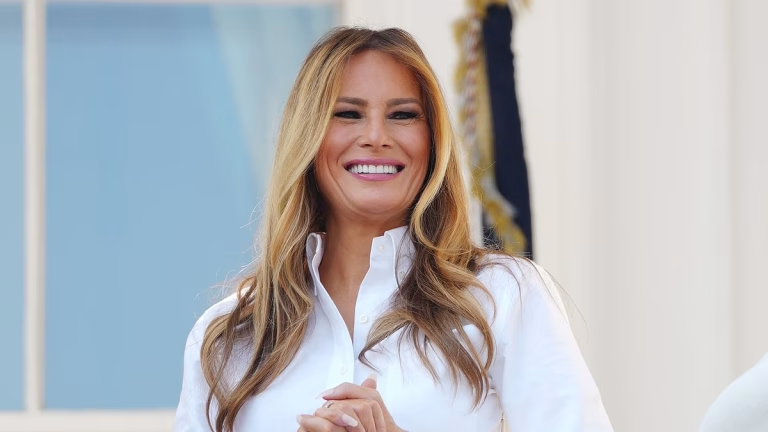
Ukrainian President Volodymyr Zelensky used his recent White House meeting with U.S. President Donald Trump to deliver a handwritten message from his wife, First Lady Olena Zelenska, to Melania Trump. In a lighthearted gesture, Zelensky handed over the letter while telling Trump, “It’s not to you, it’s to your wife.”

The moment came during a highly watched Oval Office encounter, just days after Trump’s Alaska meeting with Russian President Vladimir Putin ended without a ceasefire deal in the ongoing Ukraine war. The exchange drew attention not only for its symbolism but also for the unusual backchannel it highlighted between the two first ladies.

Earlier, Melania Trump had penned her own letter to Vladimir Putin, calling on him to protect children caught in the conflict. In her words, every child carries the same quiet hopes for “love, possibility, and safety from danger,” and she urged the Russian leader to restore to them “their melodic laughter.” The letter, widely circulated, positioned her as an unexpected voice in international appeals around the war.

Olena Zelenska’s message to Melania Trump, delivered by her husband, expressed gratitude for that humanitarian stance. By addressing her counterpart directly, Zelenska emphasized her appreciation for Melania’s efforts to spotlight the suffering of Ukraine’s youngest and most vulnerable.

The exchange also underscored the broader crisis facing Ukraine’s children. Rights groups and Ukrainian authorities estimate that nearly 20,000 minors have been forcibly removed from the country, a move widely condemned as an attempt to strip them of their identity and heritage. The Bring Kids Back UA initiative has pushed to return them, with international organizations including the United Nations and the Organization for Security and Co-operation in Europe labeling the abductions a grave violation of human rights.

For Kyiv, the letter served as both a diplomatic gesture and a reminder of the human cost of the war. By engaging Melania Trump, Zelenska tapped into a different channel of influence—an emotional appeal framed around families and children—that stood apart from the political negotiations between leaders.

Akpabio Returns To Nigeria: The State Of His Health

1

Senate President Godswill Akpabio returned to the country in the early hours of Monday, putting to rest speculations about his health status.

Akpabio, who arrived at the Nnamdi Azikiwe International Airport in Abuja around 4 a.m., was received at the presidential wing by senators, aides, and supporters. His return followed weeks of rumours on social media suggesting that he had been critically ill and hospitalised abroad.

Addressing journalists shortly after landing, the Senate President dismissed the claims, insisting he was never sick.

“There’s nothing like such. I’m fit as a fiddle. I only stopped over in London for a short vacation,” he said.

Why Akpabio Was Abroad?

Before heading to London for his vacation, Akpabio attended the Sixth World Conference of Speakers of Parliament in Geneva, Switzerland, from July 29 to 31. He explained the purpose of his trip in a statement shared on his official X handle:

“I’M HAPPY TO BE BACK HOME, AFTER A BRIEF VACATION.

This morning at about 4am, I arrived the Nnamdi Azikiwe International Airport from London. While outside the country, I attended the Sixth World Conference of Speakers of Parliament in Geneva between July 29 and 31st after which I headed to London for a short vacation.

Let me assure Nigerians of robust legislative engagements on our resumption. Our presence at the global parliamentary gathering in Geneva was a strong one. Our voices were heard loud and clear, through my self and my brother and Speaker House of Representatives, Tajudeen Abbas.

We will continue to work assiduously in the overall interest of our people through effective collaboration with the other arms of government.”

https://twitter.com/Senator_Akpabio/status/1957397084161638760?t=e4ZHcP7m2goxQIn8KwQLqg&s=19

Gunmen Kill 13 Worshippers In Katsina Mosque Attack

1

Thirteen worshippers have been killed after gunmen attacked a mosque in Unguwan Mantau community, Malumfashi Local Government Area of Katsina State.

The attack happened on Tuesday morning while residents were observing the Fajr (dawn) prayer.

In a statement, Katsina Commissioner for Internal Security and Home Affairs, Nasir Mu’azu, said the killings were a reprisal by bandits after community members ambushed and lynched several of them two days earlier. According to him, villagers had seized three motorcycles, recovered two AK-47 rifles, and rescued kidnap victims from Ruwan Sanyi village during the earlier confrontation.

“The incident occurred when criminal elements launched a reprisal attack on the community. The Muslim members of the community were praying in the mosque during the Fajr prayer when the criminals started shooting sporadically,” Mu’azu said.

He noted that security agencies, including the Nigerian Army’s Forward Operating Base and the police, had been deployed to restore order and flush out the attackers.

The commissioner praised the courage of residents in resisting criminal elements but assured that the state government remained committed to combating banditry. He added that condolences had been extended to the families of those killed.

Bolivia’s Election Ends Two Decades Of Leftist Dominance

1

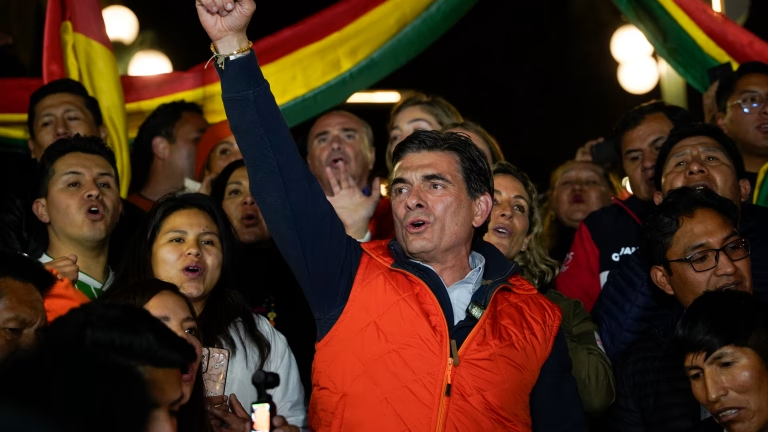
Bolivia’s August 17, 2025, presidential election has brought a dramatic political shift, ending nearly 20 years of leftist rule under the Movimiento al Socialismo (MAS) party. For the first time in the country’s history, no candidate won outright in the first round, forcing a runoff scheduled for October 19 between centrist Senator Rodrigo Paz Pereira and former right-wing president Jorge “Tuto” Quiroga.

Rodrigo Paz Pereira surprised many observers by finishing first with about 32% of the vote. His campaign leaned on themes of anti-corruption, grassroots outreach, and a vision of “capitalism for all,” which appealed to voters weary of economic struggles marked by high inflation, fuel shortages, and declining trust in institutions.

Quiroga, who took second place with around 27%, presented himself as a pro-business conservative favoring privatization, fiscal austerity, and renewed ties with global financial institutions.

The once-dominant MAS party suffered a severe collapse. Its candidate Eduardo del Castillo barely surpassed 3% of the vote, while another leftist figure, Andrónico Rodríguez, managed only about 8%. This fragmentation underscored the decline of a political force that had defined Bolivia for two decades.

Former president Evo Morales, barred from running, called on his followers to nullify their ballots in protest. That appeal led to a record 19% of votes being invalidated, surpassing the totals received by many candidates. Analysts see this as evidence of MAS’s weakening influence and internal divisions.

The election outcome signals widespread frustration with the political establishment and a demand for new leadership. The upcoming runoff between Paz and Quiroga represents not only a clash of two competing visions for Bolivia but also a historic break from the country’s long era of leftist dominance.

AfCFTA Can Drive Growth By Empowering Women-Led Businesses – Oye

1

The Immediate Past Chairman of the Organised Private Sector of Nigeria and former President of the Nigerian Association of Chambers of Commerce, Industry, Mines and Agriculture (NACCIMA), Dele Kelvin Oye, has said that the African Continental Free Trade Area (AfCFTA) holds vast potential to boost Africa’s economy if women-led enterprises are fully empowered.

Oye made this known at a forum hosted by Zenforte and the United Nations Development Programme (UNDP) in Abuja. He noted that women-owned businesses, which make up about 40 per cent of enterprises across the continent, remain an untapped source of innovation, growth, and job creation.

He explained that AfCFTA can provide women entrepreneurs with access to larger markets, enhance competitiveness, and improve economic outcomes by removing trade barriers and fostering deeper regional integration.

“Women-led enterprises are not just vital to the continent’s economy, they also represent an immense opportunity for growth and innovation,” Oye said.

Despite the opportunities, he identified persistent challenges faced by women-led businesses, including poor access to finance, difficulties in entering new markets, and the need for stronger skills and capacity development to navigate trade regulations.

Oye further raised concerns about the Central Bank of Nigeria’s refusal to honour $2.4 billion forwards, warning that the decision was already creating litigations and financial pressure on businesses. He stressed that robust policies and collaboration between government and private sector stakeholders were critical to supporting women-led businesses and achieving the wider goals of AfCFTA.

“To amplify the impact of women-led enterprises, we must collaborate across several fronts, expand access to finance, open up markets, and invest in capacity building,” he said.

Putin And Zelensky Poised For Peace Summit Following Trump’s Talks

1

Russian President Vladimir Putin and Ukrainian President Volodymyr Zelensky are preparing for a potential peace summit, their first face-to-face encounter since the war began over three years ago. The development follows a series of high-level meetings in Washington, where Donald Trump hosted European leaders to discuss long-term security guarantees for Ukraine.

Trump, fresh from his meeting with Putin in Alaska, described his White House talks with European officials and Zelensky as “very good.” He revealed that he reached out to Putin afterward to begin arranging a direct meeting between the two leaders, though the timing and location are yet to be finalized.

Zelensky, speaking outside the White House, confirmed his readiness for such a dialogue. The Kremlin also indicated that Putin was open to direct talks. While the war remains largely stalled, with Russia making limited advances, the recent Trump-Putin discussions failed to secure an immediate ceasefire.

The White House gathering was notable for its strong European presence, with leaders from Britain, France, Germany, Italy, Finland, the European Commission, and NATO showing a united front. Zelensky described his Oval Office meeting with Trump as “the best” they’ve had, contrasting with their tense and publicly hostile encounter earlier this year.

A key focus of the talks was how to guarantee Ukraine’s security. Trump said European nations would coordinate with the U.S. to provide these assurances, but Kyiv would have to abandon its long-standing ambition of joining NATO. NATO Secretary General Mark Rutte called the meeting “very successful,” highlighting Trump’s role in breaking previous deadlocks. Detailed negotiations are expected in the coming days.

Reports suggest Ukraine may agree to purchase around $100 billion worth of U.S. weapons, financed by European partners, in exchange for American security guarantees. Zelensky later mentioned a $90 billion figure and noted that the framework for these guarantees should be finalized within ten days.

Despite the momentum, caution remains among European leaders. French President Emmanuel Macron urged tighter sanctions if Putin fails to show genuine commitment to peace. Finland’s President Alexander Stubb warned that Putin cannot be trusted, while German Chancellor Friedrich Merz insisted Ukraine should not be pressured into giving up territory, comparing it to the U.S. being asked to surrender Florida.

Babangida At 84: Five Key Facts You Didn’t Know About Nigeria’s Former Military Head Of State

2

On August 17, 2025, former Nigerian military president, General Ibrahim Badamasi Babangida (IBB), marked his 84th birthday. Born in Minna, Niger State, in 1941, Babangida rose through the Nigerian Army to become one of the country’s most influential and controversial leaders. His rule, from 1985 to 1993, was marked by bold reforms, iconic infrastructure projects, and political upheavals that continue to shape Nigeria today.

Here are five key facts you may not know about the man Nigerians fondly call “IBB”:

1. He Was The First Nigerian Leader To Introduce Wide-Ranging Economic Reforms

One of Babangida’s most enduring legacies was the introduction of the Structural Adjustment Program (SAP) in 1986. Though controversial, the program liberalised the economy, encouraged private sector growth, and reduced dependence on oil revenue. Supporters hailed it as forward-thinking, while critics say it deepened poverty.

2. He Built Some Of Nigeria’s Iconic Infrastructure

IBB’s administration left behind physical projects that still define Nigeria’s landscape. These include the Third Mainland Bridge in Lagos, the Lagos-Ibadan Expressway, and the Ajaokuta Steel Complex. His investments in roads, telecommunications, and urban development demonstrated a vision for a modern Nigeria.

3. He Founded Nigeria’s Modern Intelligence Agencies

Babangida strengthened Nigeria’s security structure by creating two of the country’s most important intelligence bodies: the State Security Service (SSS) and the National Intelligence Agency (NIA). These agencies remain central to Nigeria’s security framework today.

4. He Was At The Centre Of The June 12 Crisis

The annulment of the June 12, 1993, presidential election, widely believed to have been won by Moshood Abiola, remains the most controversial decision of Babangida’s leadership. The annulment sparked nationwide protests and remains one of the darkest chapters in Nigeria’s democratic journey. Despite this, Babangida argued that his decision was aimed at preventing chaos and bloodshed.

5. He Still Commands National And International Influence

Even in retirement, Babangida remains a respected voice in Nigerian politics. His recent book launch and presidential library fundraising in Minna attracted top figures, including President Bola Tinubu, former Presidents Goodluck Jonathan, Yakubu Gowon, and Abdulsalami Abubakar, as well as international dignitaries. Billionaire businessmen Aliko Dangote, Abdulsamad Rabiu, and Theophilus Danjuma pledged billions in donations to support the library project, cementing Babangida’s stature as one of Nigeria’s most enduring leaders.

General Ibrahim Babangida remains a figure whose leadership left lasting marks on Nigeria’s journey. From economic reforms to landmark projects and his influence in governance, his years in power shaped the nation in ways that still matter today.

At 84, his story continues to be remembered as part of Nigeria’s political and developmental history.