
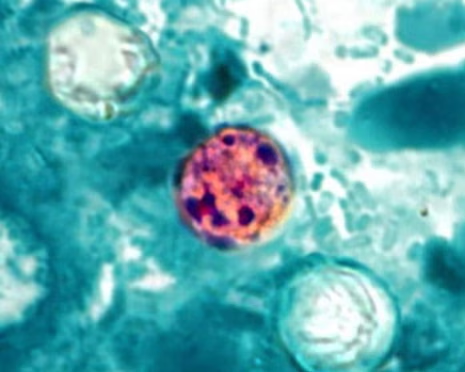
Health authorities in the United States are monitoring a growing outbreak of cyclosporiasis, a parasitic intestinal infection that has sickened thousands of people across several states in recent weeks.
The illness, caused by the microscopic parasite Cyclospora, is known for triggering severe and frequent watery diarrhoea, often described as “explosive diarrhoea.” People typically become infected after consuming food or water contaminated with the parasite.
The outbreak has now spread across more than a dozen states, with Michigan reporting nearly 1,000 infections within a two-week period alone. Despite the rising number of cases, no deaths linked to the current outbreak have been recorded.
Although investigators have yet to identify the exact source of contamination, previous outbreaks have commonly been associated with raw fresh produce.
According to the US Centers for Disease Control and Prevention (CDC), 145 cases of cyclosporiasis were reported nationwide between May 1 and June 16, the latest period covered by publicly available federal data.
During that time, no fatalities were reported, while 20 infected individuals required hospital treatment.
The CDC said outbreaks have been recorded across 17 states since early May, including Illinois, New York and Texas.
State health departments have continued to report rising infection numbers.
As of July 8, Michigan health officials confirmed nearly 1,000 cases had been identified within just two weeks.
Illinois health authorities reported 141 infections on July 7, describing the figure as “higher-than-average.”
Ohio has also confirmed 177 cases of the illness.
Health experts believe the actual number of infections is likely much higher because many people recover without seeking medical care or undergoing laboratory testing.
Cyclosporiasis is an intestinal disease caused by the microscopic Cyclospora parasite, according to the CDC.
People become infected after consuming contaminated food or drinking contaminated water.
Although the illness is generally not life-threatening, it is less common than foodborne infections such as salmonella and E. coli.
Some infected individuals may not develop symptoms. However, those who do commonly experience diarrhoea “with frequent and sometimes explosive bowel movements,” according to the CDC.
If left untreated, symptoms can persist for several days or even more than a month, with some patients experiencing recurring illness after initially improving.
The incubation period is typically about one week after exposure.
Dr Caitlin Rivers of the Johns Hopkins Center for Health Security noted that person-to-person transmission does not occur.
The epidemiologist wrote in a July 8 newsletter that transmission occurs exclusively through the faecal-oral route by consuming contaminated food or water.
Health officials have not yet identified a specific food product, grower or supplier responsible for the current outbreak.
According to Dr Rivers, “Contamination typically occurs at the farm or irrigation level, making traceback investigations difficult.”
Previous outbreaks in both the United States and Canada have been linked to bagged salad mixes, fresh cilantro, basil, raspberries, snow peas and green onions.
In response to the growing number of infections, Michigan health officials have advised restaurants, food service providers and households to thoroughly wash fresh produce, cook raspberries and leafy vegetables where possible, and remove the outer layers of lettuce and green onions before consumption.
While the US Food and Drug Administration notes that rinsing produce alone may not completely eliminate the parasite, the CDC continues to recommend washing fruits and vegetables before eating them.
Health authorities also advise anyone experiencing persistent diarrhoea to seek medical attention and discuss the possibility of a cyclospora infection with their healthcare provider.
Discover more from LN247
Subscribe to get the latest posts sent to your email.

