Home Blog Page 10

Driving Growth: Insights From Nigeria’s Automotive Sector

0

Nigeria’s Senate Committee on Industries has renewed its call for decisive legislative and policy action to revive the country’s struggling automotive industry.

Speaking at a stakeholders’ roundtable in Abuja, the committee stressed that the sector holds enormous potential for job creation, industrial expansion, and economic diversification, if the right reforms are implemented.

On LN247’s morning show, automotive and public affairs analyst Obum Osigwe offered a clear accessment of the industry’s current state, outlining the structural challenges that continue to hinder growth. His insights underscored the need for stronger policy alignment, better infrastructure, and sustained investment to unlock the full promise of Nigeria’s automotive sector.

Nigeria’s 15% Fuel Import Duty U-Turn: What It Means For The Economy

0

Nigeria’s suspension of the 15% import duty on petrol and diesel has sparked discussions around affordability, energy security, and the future of domestic refining.

The policy was originally introduced to encourage reliance on local refineries such as Dangote and emerging modular refineries by making imported fuel less attractive. With the duty now suspended, the government clearly prioritizes short-term relief for consumers and businesses facing rising costs.

But this shift raises deeper questions about long-term strategy. The move creates a trade-off between immediate affordability and the broader goal of strengthening local refining capacity. It underscores a complex tension between economic pressures, investor confidence, and the country’s ambition to become less dependent on fuel imports.

Nigeria Set To Host 2025 West Africa Trophy In Abuja

0

The Nigeria Cricket Federation (NCF) has announced that the second edition of the West Africa Trophy will be staged in Abuja from December 4 to 14, 2025. The tournament will be held at the Cricket Oval, Package B of the MKO Abiola National Stadium.

This year’s edition will feature Rwanda, Sierra Leone, and Zambia, who will join hosts Nigeria in what organisers describe as one of the most competitive regional cricket events to date. The championship is designed to boost the development of cricket across Africa, offering both emerging and established teams an important platform for international exposure.

According to the Federation, preparations are underway to ensure a seamless event, with a strong emphasis on raising the standard of the game and delivering an “unforgettable tournament experience.” Fans are expected to witness high-intensity clashes, tactical matchups, and standout performances from rising talents and seasoned players.

Organisers also expressed appreciation for the continued support from technical teams, regional partners, volunteers, and sponsors, noting that their contributions have been instrumental to the growth of the tournament.

Match fixtures, accreditation details, and broadcast information will be released in the coming days as Nigeria gets set to host ten days of competitive cricket in the nation’s capital.

Why Atiku Rejects Xpress Payment As TSA Collecting Agent

0

Former Vice President Atiku Abubakar has publicly opposed the Federal Inland Revenue Service’s (FIRS) recent appointment of Xpress Payment Solutions Limited as a new collecting agent under the Treasury Single Account (TSA) framework. The move, announced by FIRS on November 20, has sparked a heated debate over transparency, privatization, and the role of private intermediaries in Nigeria’s revenue collection system.

FIRS integrated Xpress Payment Solutions into its TaxPro Max portal, allowing taxpayers to generate a Payment Reference Number (PRN) and remit taxes such as Company Income Tax (CIT), Value Added Tax (VAT), and Withholding Tax (WHT) through XpressPay’s online gateway or its e-Cashier at bank branches.

Xpress Payment, incorporated in 2016, is licensed as a Payment Terminal Service Provider (PTSP) and handles electronic collections, bill payments, and disbursements for financial institutions.

FIRS Acting Managing Director Wale Olayisade emphasized that the infrastructure was fully deployed to manage sensitive federal collections.

The agency clarified that Xpress joins existing platforms like Remita and e-Tranzact, which focus on multi-channel payment collection and electronic invoicing respectively, enhancing efficiency and user choice within a competitive ecosystem of Payment Solution Service Providers (PSSPs).

Despite this, Atiku described the appointment as a “quiet” policy shift, carried out without public consultation, legislative oversight, or stakeholder engagement.

He demanded the immediate suspension of the appointment, a public inquiry, disclosure of contractual terms, and a comprehensive audit of TSA operations.

The History on Alpha Beta

Alpha Beta Consulting LLP was established in 1999 as a private tax consultant for Lagos State under then-Governor Bola Tinubu, with the mandate to modernize revenue collection using technology.

At the time, Lagos’s Internally Generated Revenue (IGR) was around N10 billion annually, hindered by inefficiencies and leakages. Alpha Beta’s electronic systems reportedly raised collections to over N50 billion by 2010, earning the firm a 10–13% commission, totaling more than N150 billion in fees by 2020, according to a former managing director.

The success, however, was marred by scandal. In 2017, ex-MD Oladapo Apara petitioned the Economic and Financial Crimes Commission (EFCC), alleging that Alpha Beta evaded N30 billion in taxes and accusing Tinubu of diverting $44.3 million through shell companies.

Bank records later revealed billions transferred to entities linked to TVC Communications, owned by Tinubu’s family, raising money-laundering concerns.

Critics, including PDP chieftain Olabode George, condemned the arrangement as a “sacrilegious” privatization, turning public revenue into a private tollbooth.

Despite lawsuits seeking Tinubu’s testimony and ongoing investigations, Alpha Beta’s contract continued until 2022, when Lagos adopted a new system.

Apara, who had endorsed Tinubu in 2023 after withdrawing his complaints, later reignited the controversy. The episode remains a cautionary tale of opaque revenue deals, with analysts warning that its “ghost” continues to influence federal tax reforms.

Why Atiku is Comparing Xpress Payment and Alpha Beta

Atiku draws a direct parallel between Xpress Payments and Alpha Beta, warning that the FIRS decision risks reviving what he calls the “Alpha Beta revenue cartel” that dominated Lagos during and after Tinubu’s tenure.

He criticizes the move for attempting to nationalize a “Lagos-style” model, inserting private intermediaries as a kind of “toll gate” around public revenue, potentially channeling funds to vested interests and weakening state oversight.

Opacity is central to his concern. Both Xpress Payments and Alpha Beta were reportedly appointed in a rushed, non-transparent manner, bypassing competitive bidding and stakeholder consultation.

Atiku also questions whether Xpress adds any real value compared with existing platforms like Remita, echoing past criticisms that Alpha Beta created an unnecessary monopoly despite boosting revenue.

He frames the arrangement as “state capture disguised as digital innovation,” suggesting a small circle, likely connected to Tinubu’s allies that could control federal revenue inflows, just as Lagos’s IGR gains allegedly enriched insiders.

Through this comparison, Atiku highlights a pattern of elite continuity, warning that Nigeria risks functioning more like a private holding company than a public republic.

His critique goes beyond partisan politics, relying on Alpha Beta’s documented controversies to underscore potential conflicts of interest in the selection of Xpress Payments.

Why Atiku Thinks It Will Not Work

Atiku argues that the Xpress Payments model is fundamentally flawed because it elevates private intermediaries over institutional reform, creating opportunities for corruption in an already fragile economy.

He highlights that the lack of transparency, no disclosed fees or selection criteria, mirrors Alpha Beta’s opaque system, which allegedly allowed revenue diversions.

The timing, he notes, is particularly troubling. With insecurity rising and public trust strained, government focus should be on security and citizen welfare, not expanding private revenue channels.

Atiku warns this move represents “creeping privatization,” risking the diversion of resources from essential services and politicizing tax collection at a moment when broad-based reform and stakeholder engagement are crucial.

He calls for legal measures to ban such intermediaries, advocating for strong, FIRS-led systems grounded in constitutional principles rather than quick fixes that invite cartels.

Without suspension and thorough scrutiny, he predicts public trust will erode, and fiscal modernization will stall.

The clash between Atiku and FIRS highlights a critical tension in Nigeria’s revenue administration: balancing digital innovation and efficiency with transparency, accountability, and the prevention of elite capture.

Whether this dispute will lead to formal investigations or fade as political noise remains uncertain, but it underscores the challenges of modernizing public finance in a highly scrutinized and politically charged environment.

Northern Nigeria Closes Schools Amid Escalating Security Threats

0

As of November 24, 2025, Nigeria faces one of the largest coordinated school shutdowns in recent history, prompted by a surge in security threats and mass abductions targeting educational institutions in the northern and north-central regions.

In response, both the federal government and several state authorities have ordered the closure of thousands of schools across primary, secondary, and tertiary levels, with measures primarily affecting boarding schools. Reopening remains contingent on security assessments.

Federal Government Measures
The Federal Ministry of Education issued a directive on November 21, 2025, mandating the immediate closure of 41 Federal Unity Colleges (FUCs) nationwide. These prestigious boarding secondary schools, mostly in northern and north-central states, typically accommodate 1,000–2,000 students each. The directive, signed by Director Binta Abdulkadir, applies immediately, with southern schools exempt unless local security concerns arise. Schools have transitioned to remote learning where feasible. Among the affected Unity Schools are:
• FGGC Minjibir, Kano; FGA Suleja, Niger; FTC Ganduje, Kano
• FGGC Zaria, Kaduna; FTC Kafanchan, Kaduna; FGGC Bakori, Katsina
• FGC Daura, Katsina; FGGC Tambuwal, Sokoto; FSC Sokoto
• FTC Wurno, Sokoto; FGC Gusau, Zamfara; FGGC Gwandu, Kebbi
• FGC Birnin Yauri, Kebbi; FTC Zuru, Kebbi; FGGC Kazaure, Jigawa
• FGC Kiyawa, Jigawa; FTC Hadejia, Jigawa; FGGC Bida, Niger
• FGC New Bussa, Niger; FTC Kuta-Shiroro, Niger; FGC Ilorin, Kwara
• FGGC Omu-Aran, Kwara; FGC Ugwolawo, Kogi; FGGC Kabba, Kogi
• FTC Ogugu, Benue; FGGC Bwari, FCT Abuja; FGC Rubochi, FCT Abuja
• FGGC Abaji, FCT Abuja; FGGC Potiskum, Yobe; FGC Buni Yadi, Yobe
• FTC Gashua, Yobe; FTC Michika, Adamawa; FGC Ganye, Adamawa
• FGC Azare, Bauchi; FTC Misau, Bauchi; FGGC Bajoga, Gombe
• FGC Billiri, Gombe; FTC Zambuk, Gombe

These schools, which typically house 1,000–2,000 students each, have shifted to remote learning where possible, with reopening tied to security clearances.

State-Level Closures

Bauchi State
All primary, secondary, and tertiary institutions both public, federal-owned, and private were closed with immediate effect following consultations on November 22, 2025. This encompasses over 5,000 schools statewide, affecting an estimated 2 million students. No specific exemptions; tertiary includes universities like Abubakar Tafawa Balewa University affiliates in vulnerable areas.

Katsina State
All public primary and secondary schools, including boarding facilities, shut down immediately on November 21, 2025. The directive from Commissioner Yusuf Suleman Jibia covers public, private, and community schools, impacting around 3,000 institutions. Duration: Until security stabilizes for safe resumption.

Kebbi State
All public and private secondary schools, plus most tertiary institutions, closed on November 22, 2025. Exemptions apply to the College of Nursing Sciences and Midwifery, Birnin Kebbi. Affected tertiaries include:

  • Kebbi State Polytechnic, Dakingari
  • Abdullahi Fodio University of Science and Technology, Aliero
  • College of Health Sciences and Technology, Jega
  • Adamu Augie College of Education, Argungu
  • School of Remedial Studies, Yauri
    This affects over 1,500 secondary schools and key higher education centers.

Kwara State
Schools in four local government areas: Isin, Irepodun, Ifelodun, and Ekiti were closed on November 19, 2025, per instructions from the Ministry of Education and Human Capital Development. Covers all primary and secondary levels, public and private, in Kwara South, impacting approximately 500 schools. Announced via the Nigeria Union of Teachers (NUT) branch.

Niger State
All public and private primary and secondary schools closed on November 22, 2025, including missionary, Islamic, and federal colleges like FGC Minna. Tertiary institutions are unaffected except in vulnerable Niger North and East senatorial districts. This statewide measure covers over 4,000 schools.

Taraba State
All public and private secondary schools with boarding facilities deboarded students immediately on November 22, 2025, shifting to day-school operations. Approved by Governor Agbu Kefas after a security review; affects boarding sections across the state, sparing day schools.

Yobe State
All boarding secondary schools closed immediately in mid-November 2025 as a proactive measure. Includes federal institutions like those in the Unity Schools list above; state-run boardings also impacted, totaling around 200 facilities.

Adamawa State
Boarding secondary schools closed in mid-November 2025, focusing on high-risk areas. Specifics align with federal Unity Schools in the state, such as FTC Michika and FGC Ganye; no full primary/tertiary shutdown.

Plateau State (North-Central Addition)
All Government Junior Model Secondary Schools closed effective November 22, 2025; primary and day schools effective November 24, 2025. Covers public institutions primarily, with private schools encouraged to follow suit.

These closures disrupt education for millions, prompting federal coordination for alternative learning via radio and digital platforms. State education ministries continue monitoring, with reopenings contingent on joint security evaluations. For the latest updates, check official ministry announcements.

Guinea-Bissau’s Embaló Faces Tight Contest As Vote Counting Continues

0

Vote counting is underway in Guinea-Bissau following Sunday’s presidential and legislative elections, with President Umaro Sissoco Embaló locked in a closely fought race as he seeks a second term. If successful, he would become the country’s first leader in 30 years to secure consecutive mandates in a nation long marked by political instability.

Embaló, 53, a former army general, is competing against 11 challengers. His strongest opponent is Fernando Dias da Costa, 47, a rising political figure supported by former prime minister Domingos Simões Pereira. Dias da Costa is also backed by the African Party for the Independence of Guinea and Cape Verde (PAIGC), the country’s historic liberation movement.

This election is particularly contentious as PAIGC was barred from presenting its own candidates for the first time, after being deemed to have submitted required documents too late. The exclusion has fuelled criticism and heightened tensions around the vote.

Analysts expect a narrow contest between Embaló and Dias da Costa. A runoff will be necessary unless one candidate secures more than 50% of the vote in the first round.

Nearly half of the country’s 2.2 million population registered to vote, with turnout surpassing 65%. The national electoral body said provisional results are expected on Thursday.

Observers say the political climate has become increasingly divisive. Analysts argue that the current environment reflects a system shaped heavily by individual influence rather than institutional norms.

Guinea-Bissau remains one of the world’s poorest countries, with about half of its population living in poverty. The country has also become a significant transit point for drug trafficking routes connecting Latin America and Europe.

Since gaining independence from Portugal in 1974, the coastal nation has endured repeated coups—nine before Embaló took office in 2020. The president says he has survived three more attempts since then, though opponents argue he exaggerates instability to justify political crackdowns, an accusation he rejects.

38 Eruku Worshippers Free, 51 Students’ Release: The Untold Rescue

0

Nigeria witnessed one of its most alarming security crises in recent memory between November 18 and 21, 2025.

On November 18, gunmen struck Christ Apostolic Church, Oke-Isegun in Eruku, Kwara State, leaving three worshippers dead and abducting 38 others during a church service.

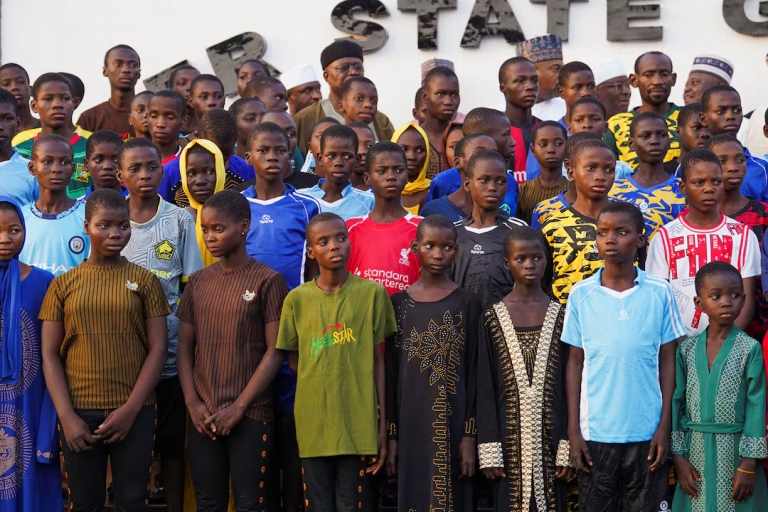
Just days later, on November 21, St. Mary’s Catholic Primary and Secondary School in Papiri, Niger State, was overrun by heavily armed kidnappers. Reports suggest roughly 303 students and 12 teachers were seized, marking one of the largest school abductions in Nigeria’s history.

By November 23–24, authorities and families reported the return of 50 students who had escaped, while state and federal officials declared all 38 churchgoers “rescued.”

Rescued, released, or ransomed? What really happened?

President Bola Ahmed Tinubu framed the developments as a security success. In a November 23 statement, he announced he had canceled a planned G20 trip to South Africa to coordinate security efforts and celebrated the “rescue” of the Kwara church worshippers and the recovery of 51 Niger school students.

But how were these rescues achieved? Were ransom payments involved, or were the captives freed through military action or their own daring escape?

Local accounts complicate the official narrative: for the Niger school, many pupils reportedly “escaped” during the chaos rather than being extracted by security forces.

In Eruku, relatives allege kidnappers demanded up to N100 million per victim, though discussions reportedly reduced the figure. So, were these lives saved by negotiation, paid ransom, or tactical intervention — and if money changed hands, why is the government silent about it?

What Tinubu Said and What It Means

“My fellow Nigerians, thanks to the efforts of our security forces over the last few days, all the 38 worshippers abducted in Eruku, Kwara State, have been rescued. I am equally happy that 51 out of the missing students of the Catholic School in Niger State have been recovered,” Tinubu declared.

He emphasized that his canceled G20 trip allowed him to coordinate efforts at home, while pledging continued vigilance: “Every Nigerian, in every state, has the right to safety — and under my watch, we will secure this nation and protect our people.”

Yet, the statement leaves critical questions unanswered: how were the captives recovered? Were the kidnappers confronted, neutralized, or quietly negotiated with? Did ransom payments fuel this release, and if not, what operational successes enabled it?

Social media erupted as Nigerians challenged the official narrative. Users questioned the absence of operational details, highlighting the lack of arrests, weapons seizures, or evidence of direct military engagement.

Many demanded proof, asking for video evidence of the rescued students and other victims, questioning how the rescue occurred without arrests or shootouts, and seeking clarity on whether ransom payments were involved.

With an X user, @sho1shaw, saying “Show us the video evidence of these rescued students and the other victims. Until we see some proof, we don’t believe you.”
Another user @Ugochukwu_Zilla: “Rescued? No arrest, no shootout. Tell us how much you have paid.”

This reaction illustrates a national sentiment: without transparency, the term “rescue” risks being interpreted as political theater rather than a tangible security success.

The Bigger Picture of what is happening

Ransom payments are illegal in Nigeria, yet they remain the practical currency of the kidnapping industry. In Eruku, reports suggest initial demands were reduced after negotiation, while Niger’s abduction shows kidnappers prioritizing rapid transfers over confrontation. Paying ransom saves lives short-term but fuels criminal networks; refusing to pay without arrests or neutralization risks perpetuating insecurity. Transparency is strategic — without it, the state signals incapacity or unwillingness to disrupt the kidnapping economy.

Investigative efforts by local reporters and youth journalists have pieced together partial details. In Eruku, victims were held in forest corridors known for criminal activity. Many Niger school pupils were found weak, dehydrated, and disoriented, consistent with escape rather than a coordinated extraction. Several recovered students returned after interventions that remain unclear to the public. However, verification of ransom payments, the tracking of kidnappers, or any concrete law enforcement follow-up remains elusive. Until authorities provide clarity, each “rescue” risks being seen as a temporary relief with long-term consequences left unaddressed.

What Nigerians should watch for next

To move beyond public relations, the government must provide tangible proof of success, such as presenting arrested suspects, displaying recovered weapons, sharing forensic findings, and pursuing prosecutions.

Families of victims, civil society groups, and the international community are closely observing these efforts. Without such concrete actions, the story will likely be remembered as a temporary relief overshadowed by the failure to dismantle the criminal networks behind the kidnappings.

Nigerians face a harsh reality: while some captives are now safe, the threat of future abductions remains.

Tinubu’s canceled G20 trip and triumphant statements may offer temporary reassurance, but without transparency, accountability, and decisive law enforcement, this week’s “rescues” could simply pave the way for next week’s kidnappings.

It is important to celebrate the return of survivors, but the public also deserves proof, clear accountability, and a concrete plan to dismantle the kidnapping networks. Relief alone is politically convenient, but without action, it leaves the country vulnerable and strategically exposed.

Israeli Strike In Beirut Kills Senior Hezbollah Commander

0

Israel carried out an airstrike in Beirut’s southern suburbs on Sunday, targeting one of Hezbollah’s most senior military figures in what marks a significant escalation nearly a year after a ceasefire paused months of cross-border clashes.

Hours after the strike, the Israeli military announced that Haytham Ali Tabatabai, widely regarded as Hezbollah’s chief of staff, had been killed. Lebanese health officials reported at least five deaths and 28 injuries, saying multiple missiles hit a building in the Haret Hreik district, a densely populated Hezbollah stronghold.

Hezbollah later confirmed the death of Tabatabai, describing him as a “great commander,” while avoiding specific details about his role. Footage circulating online showed heavy damage, shattered buildings, and emergency teams working at the scene.

The strike follows a surge in Israeli attacks across southern Lebanon this month. Israel says the operations are aimed at preventing Hezbollah from rebuilding its military capabilities near the border and pressuring Lebanese authorities to speed up steps required under last year’s ceasefire, including curbing the group’s weaponry.

Before the attack, Israel’s prime minister said the country would continue acting against groups it views as threats, vowing to prevent Hezbollah from regaining strength. After the strike, his office stated that Israeli forces had targeted a key figure responsible for the group’s military expansion.

Despite the operation, Israeli officials insisted they remain committed to the ceasefire agreement.

US officials said Israel did not provide advance notice of the strike. They said Washington was informed shortly afterward, though they had been aware that Israel intended to intensify operations in Lebanon.

Tabatabai, 58, joined Hezbollah shortly after its formation in the 1980s and survived a previous Israeli assassination attempt in 2015. He later became a central commander for Hezbollah’s foreign operations, playing roles in Syria alongside forces loyal to Bashar al-Assad and in Yemen, where he was involved in training Houthi fighters. The US previously sanctioned him and offered a multimillion-dollar reward for information on his activities.

He was among the few senior commanders who avoided Israel’s sweeping campaign against Hezbollah leadership during the 2023–24 conflict that erupted after Hamas launched its October 7 attack in southern Israel. By the end of that war, most of Hezbollah’s top military figures had been killed, including its leader Hassan Nasrallah.

Lebanese authorities condemned Sunday’s strike and urged stronger international intervention to halt Israeli military actions. The president said Lebanon expected the global community to “act decisively” to protect civilians and prevent further escalation.

Regional analysts have warned in recent weeks that Lebanon has become the most vulnerable point in the broader conflict, with several commentators predicting the likelihood of a major escalation involving Hezbollah.

Bollywood Legend Actor Dharmendra Dies At 89

0

Veteran Bollywood actor Dharmendra, one of India’s most beloved and enduring film stars, has died in Mumbai at the age of 89. His death marks the passing of a performer whose charm, versatility, and longevity left an unmistakable imprint on Indian cinema.

India’s Prime Minister, Narendra Modi, described his death as the “end of an era,” paying tribute to a figure who inspired generations of moviegoers.

Dharmendra, often referred to as the “original He-Man of Bollywood,” enjoyed a career spanning more than six decades, appearing in over 300 films. Though widely admired for his rugged looks, he often insisted that he was “a simple man,” and credited any praise about his appearance to his parents and good fortune.

He achieved iconic status with his role as Veeru in the 1975 blockbuster Sholay, a film that became a cultural landmark. His portrayal of the mischievous yet courageous outlaw remains one of the most celebrated performances in Hindi cinema. Despite acting in numerous box-office hits across romance, action, comedy, and suspense, he frequently said that no role surpassed Veeru.

Born Dharam Singh Deol on 8 December 1935 in Punjab’s Ludhiana district, Dharmendra grew up in a middle-class Jatt-Sikh family. He was drawn to films as a teenager and dreamt of becoming an actor, even as his family urged him to focus on academics. His life changed after he won a national talent competition, which brought him to Mumbai and launched his film career.

He made his debut in 1960 and quickly rose to prominence with acclaimed performances, including a standout role in the 1963 classic Bandini. In the years that followed, he established himself as a romantic lead opposite some of the biggest actresses of the time, before transitioning into a celebrated action star with films like Phool Aur Patthar and Mera Gaon Mera Desh. Known for performing many of his own stunts, he earned a reputation for athleticism and screen presence.

Dharmendra’s on-screen partnership with actress Hema Malini became one of the most successful in Bollywood history. Their romance off-screen drew intense media attention, particularly because he was already married with children. The pair married in 1980, despite significant public scrutiny, and went on to become one of the industry’s most recognisable couples.

He briefly ventured into politics, serving one term as a member of parliament, though he later admitted that public office was not suited to his temperament. He continued working in films well into his later years and maintained a strong connection with fans through public appearances and social media.

Throughout his career, Dharmendra received several honours, including a Lifetime Achievement Award for his contribution to cinema and one of India’s highest civilian awards, the Padma Bhushan. Yet he often said that awards mattered less to him than the affection of his audience.

“I came here for the love,” he once said. “All I ever wanted was people’s love, and I’m grateful that I received it.”

Tributes poured in after news of his passing. Actors, directors, and fans described him as an irreplaceable force in Indian cinema. Many credited him with shaping modern Bollywood and inspiring generations of performers.

Dharmendra leaves behind a legacy defined not only by his films, but by the warmth, humility, and charisma that endeared him to millions across India and beyond.

Why Tinubu Ordered The Withdrawal Of VIP Police Guards

0

President Bola Tinubu has directed the immediate withdrawal of police officers attached to Very Important Persons (VIPs) nationwide, instructing that these officers be reassigned to essential policing responsibilities.

The order followed a security meeting the President held on Sunday in Abuja with the service chiefs and the Director-General of the Department of State Services.

According to a statement issued by the President’s Special Adviser on Information and Strategy, Bayo Onanuga, VIPs who require security will now receive protection from armed personnel of the Nigeria Security and Civil Defence Corps rather than the police.

“Many parts of Nigeria, especially remote areas, have few policemen at the stations, thus making the task of protecting and defending the people difficult.

“In view of the current security challenges facing the country, President Tinubu is desirous of boosting police presence in all communities,” the statement read.

Onanuga further revealed that the President has approved the recruitment of 30,000 new police officers and that the Federal Government is collaborating with states to modernize police training facilities across the country.

Sunday’s meeting was attended by the Chief of Army Staff, Lt Gen Waidi Shaibu; the Chief of Air Staff, Air Marshal Sunday Kelvin Aneke; the Inspector-General of Police, Kayode Egbetokun; and the Director-General of the DSS, Tosin Adeola Ajayi.

List Of VIP’s With Police Guards

There is no single public “official” list of every VIP who has police guards in Nigeria.

Broad categories such as “politicians, businessmen and other VIPs” are repeatedly named by EU and Nigerian reports as the main beneficiaries of police details.

The IGP’s own escort and related expenses,
governors, ex-governors, ministers and business moguls.

Why VIP Police Guards Were Withdrawn

This decision to withdraw police escorts from VIPs comes amid persistent concerns that Nigeria’s police force is overstretched, with reports indicating that more than 100,000 officers are deployed to politicians, business figures, and other VIPs instead of serving in core policing roles.

It also forms part of a broader strategy to clamp down on terrorist activities and restore security across the country.

Although multiple Inspectors-General of Police have repeatedly pledged to end the widespread use of officers as orderlies, the implementation has never materialised.

A report published in November 2025 by the European Union Agency for Asylum highlighted that the Nigeria Police Force has an estimated 371,800 officers serving a population of roughly 236.7 million people.

The report noted that the nation’s policing challenges are compounded by the heavy deployment of officers to VIP protection rather than frontline community policing and crime prevention.

It stated, “Both recent sources and sources dating back as far as 2007 claimed that the NPF had an estimated strength of 371,800, serving a total population estimated in 2024 at 236,747,130. Many parts of Nigeria, especially remote areas, have few policemen at the stations, thus making the task of protecting and defending the people difficult.’’

What Does The Law Say About VIP Police Guards

The Nigeria Police Act outlines the core responsibilities of the police: preventing and detecting crime, maintaining law and order, protecting life and property, and enforcing laws. These duties are designed for public service, not private protection. The Act contains no provision that authorises police officers to function as personal bodyguards for private individuals.

While certain public officials and diplomatic personnel receive protection under formal state security protocols, this falls under official government functions, not private security arrangements. Legal analysts consistently emphasise that diverting frontline police officers into VIP escort roles undermines general policing capacity and strains public safety efforts.

In practice, police officers are not legally empowered to serve as private bodyguards, and the use of state-funded officers for personal protection has repeatedly attracted criticism as well as calls for reform. As one legal commentary explains:

“In the first place, nowhere in the Constitution or the new Police Act (or even under the old one) is the IG, or any other official, empowered to deploy armed policemen to escort or guard specific private individuals or premises on a 24/7 basis as is currently the case.

Rather, the Act, along with the constitution speaks of the duty of the police to protect lives and property generally, enforce the law and apprehend criminals. Indeed, the only reference the Act makes to protecting specific property is when it makes provision for the IG to deploy unarmed supernumerary (auxiliary) officers at the request of the individuals owning such property.