Home Blog Page 102

UN Officials Collapse From Starvation Amid Gaza Humanitarian Crisis

A deepening humanitarian catastrophe is unfolding in Gaza, where relief workers, doctors, and U.N. agency staff are reportedly collapsing on duty from extreme hunger and physical exhaustion.

The United Nations agency responsible for Palestinian refugees confirmed that it had received numerous distress alerts from its personnel in Gaza, painting a dire picture of unbearable working conditions amidst the ongoing conflict that began between Israel and Hamas in October 2023.

“No one is spared: caretakers in Gaza are also in need of care. Doctors, nurses, journalists and humanitarians are hungry,” said UNRWA Commissioner-General Philippe Lazzarini in a message delivered through his media aide at a Geneva press event.
“Many are now fainting due to hunger and exhaustion while performing their duties: reporting atrocities or alleviating some of the suffering.”

Lazzarini also took a strong stance against an alternative aid delivery program spearheaded by the Gaza Humanitarian Foundation (GHF), an initiative that began operations in late May after Israel allowed limited access following nearly three months of restricted entry.

“The so-called ‘GHF’ distribution scheme is a sadistic death trap. Snipers open fire randomly on crowds as if they are given a licence to kill,” he declared.

This independent effort employs U.S. private security contractors and largely avoids coordination with the main U.N. system. Israeli authorities have expressed concerns that some of the U.N.’s previous aid efforts were exploited by Hamas, though the group firmly denies such accusations.

Lazzarini indicated that over 1,000 civilians have reportedly died while attempting to obtain food aid since late May, a figure attributed to the ongoing chaos at distribution points.

Meanwhile, the GHF responded with its own statement, claiming:
“U.N. has enough aid sitting in Gaza that they refuse to deliver and that could help end the desperation and help reduce or eliminate the violence around all aid distribution efforts if they would collaborate with us.”

Despite the escalating criticism, U.N. humanitarian office representative Jens Laerke dismissed claims of halted operations, stating on Tuesday that such suggestions are “manifestly incorrect.”

The GHF has further alleged that the “deadliest attacks” on aid handouts have occurred near or during U.N.-organized convoys.

According to Gaza’s health ministry, 67 Palestinians were killed by Israeli gunfire over the weekend while waiting near U.N. relief trucks in the northern region of the territory. This occurred shortly before Israeli forces ordered fresh evacuations in zones already densely populated by displaced persons.

The U.N. also disclosed on July 15 that a total of 875 people have been killed in recent weeks during aid-related incidents. Most of those deaths were linked to areas managed by the GHF, with the remainder occurring along routes used by other humanitarian convoys.

Officials from Israel’s Ministry of Foreign Affairs and the military agency overseeing aid coordination had not issued any response at the time this report was compiled.

The Power Of Storytelling In Gospel Music

1

Storytelling has always been a powerful tool in gospel music, and Pere Jason, a classically trained countertenor, vocal coach, and winner of The Voice Nigeria 2023, is a clear example of how it continues to shape the genre.

Pere has carved a distinct space for himself by blending his rich vocals with biblical storytelling, creating music that is both spiritually uplifting and artistically refined. His love for hymns and classical crossover music defines his unique sound, he remains committed to nurturing gospel artists who carry both spiritual depth and creative excellence.

Through his brand, The Gospel According to Pere Jason, he is building more than just music, he is driving a movement rooted in faith, truth, and creativity. His growing influence continues to shape the gospel music scene in Nigeria and beyond, showing how faith and storytelling can inspire, teach, and minister in a way that resonates across generations. His work highlights the deeper purpose of gospel music: to connect people to God through both message and melody.

Military Jet Crash In Bangladesh Kills Dozens Of School Children

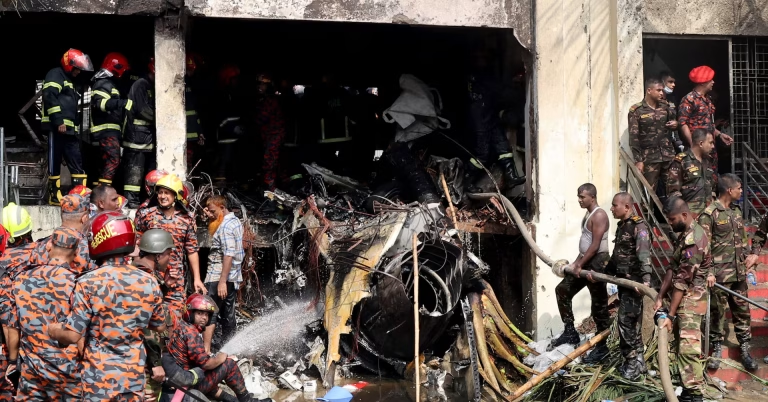
What began as a day of mourning quickly spiraled into mass protests across Bangladesh, after a military aircraft slammed into a school in Dhaka, claiming 31 lives, most of them young students. The tragic incident has deepened public unrest in an already volatile political climate.

The crash occurred on Monday when a Bangladesh Air Force fighter jet, a Chinese-built F-7 BGI, lost control and collided with Milestone School and College just as students were preparing to leave for the day. The impact and resulting fire left devastation in its wake, killing at least 25 children, many below age 12.

In the aftermath, furious students gathered at the crash site, confronting government officials with cries of “Why did our brothers die? We demand answers!” The outrage spread across the capital, with crowds storming key government premises and clashing with police, who were seen using batons to disperse the demonstrators.

Emergency crews remained on the scene well into Tuesday, combing through the burned-out structures. Locals, overcome with grief, gathered nearby, some hoping for word on missing relatives, others to mourn.

“I took her to school yesterday morning like every day. I had no idea it would be the last time I would be seeing her,” said Abul Hossain, unable to contain his emotions while speaking about his daughter, nine-year-old Nusrat Jahan Anika, who was buried that same night.

Another parent, Rubina Akter, recounted her son’s narrow escape. “He sprinted to the ground floor and jumped on the grass to douse it,” she said. “He tore his shirt and vest inside which saved him from severe burns.”

The military confirmed that the aircraft was on a routine flight from a nearby base when it experienced technical issues. Despite the pilot’s efforts to divert the aircraft, he and others on the ground were killed when the jet struck the school premises.

By Tuesday, authorities confirmed that the death toll had reached 31, with 165 individuals hospitalized. The health ministry reported that 70 remained under medical care.

To honor the victims, a national mourning day was declared. Flags flew at half-staff, and prayers were held across various religious centers.

Students demanded that the full list of victims be made public, and called for compensation from the air force for bereaved families. They also insisted on grounding outdated aircraft and a complete overhaul of flight training protocols over populated zones.

A release from the press team of interim administrator Muhammad Yunus stated that coordination was ongoing between the military, educational, and healthcare institutions to publish the list of those affected. The statement also assured that military training flights would no longer occur over civilian areas.

The F-7 BGI is considered the final upgraded version of China’s Chengdu J-7 series, itself derived from a Soviet-era MiG-21 model. Bangladesh acquired 16 of these jets starting in 2011, with all delivered by 2013.

This crash occurs at a time when neighboring India is still recovering from a catastrophic aviation disaster, the deadliest in the last ten years where an Air India aircraft crashed into a college dormitory in Ahmedabad, killing over 260 people including many on the ground.

Bangladesh itself remains on edge following political upheaval last year, when Sheikh Hasina left office amidst deadly student-led demonstrations. Nobel Peace Prize winner Muhammad Yunus, now heading the interim administration, has pledged to hold national elections next year, although opposition voices are calling for an earlier date.

ICAD 2025: “Africa Trades More With The External World Than With Itself,” Ex-Kenyan PM, Raila Odinga

6

Odinga made the remark while delivering a special address at the ongoing International Conference on Africa’s Democracy (ICAD) 2025, taking place at the NAF Conference Centre in Abuja, Nigeria.

Speaking on the theme “Building a Governance System That Works in Africa for Africans,” Odinga emphasized the urgent need for an Afrocentric governance framework that fosters regional integration, homegrown economic policies, and pan-African collaboration.

He noted that Africa’s fragmented markets and overdependence on external partners have limited its economic potential. “We must reimagine governance in a way that breaks structural dependency and empowers our people to trade, innovate, and thrive together,” he said.

The two-day ICAD 2025 conference, organized by a team led by Ambassador Chris Iyama, aims to explore solutions to Africa’s governance challenges, including constitutional reforms, economic sovereignty, and democratic consolidation.

Beyond Survival: Building Sustainable NGOs That Last

1

People create NGOs to solve real problems from poverty to education, healthcare, and social justice. However, building a sustainable NGO requires more than passion; it demands a clear long-term vision and proper structures to ensure lasting impact. The question remains: how do non-profits move beyond short-term projects to deliver meaningful, lasting change?

Funding and partnerships are key to sustainability. Consistent funding through grants, private donors, and corporate sponsorships is vital, while partnerships with governments, agencies, and other NGOs help expand reach. Crowdfunding also offers opportunities for new NGOs to build community support and raise funds. Anyone building an NGO must embrace transparency, accountability, and innovation to ensure their mission endures.

Ibrahim Kashim, Ex-Bauchi SSG Resigns From PDP

0

Ibrahim Kashim, former Secretary to the Bauchi State Government and the 2023 governorship candidate of the Peoples Democratic Party (PDP), has officially resigned from the party, effective July 21, 2025.

In a resignation letter obtained on Monday, Kashim thanked the PDP for the opportunity to serve and for entrusting him with the party’s gubernatorial ticket in the last election cycle. He notably stepped down from the race in 2023 to back Governor Bala Mohammed’s re-election bid, supporting the governor’s campaign across Bauchi Local Government despite the typical hurdles faced by second-term hopefuls.

“After careful reflection, I have decided to resign my membership of the PDP. I remain committed to serving our people with integrity, sincerity, and the fear of Allah,” Kashim stated.

He had earlier left his position as SSG in January 2025, following what sources described as a directive from Governor Mohammed.

Although Kashim has not yet disclosed his next political move, there is growing speculation that he may seek the Bauchi governorship again in 2027 under a new political platform.

NNPC Declares N905bn Profit In June, Remits N6.96tn

The Nigerian National Petroleum Company Limited (NNPC Ltd.) has announced a profit after tax of N905 billion for June 2025, according to its latest Monthly Financial and Operations Report. This figure reflects a drop from the N1.054 trillion profit posted in May.

Despite the dip in monthly profit, the report confirms a total statutory remittance of N6.96 trillion to the Federation Account between January and May 2025. This marks an increase from the N5.58 trillion remitted within the first four months of the year.

The report also shows a gradual rebound in upstream oil and gas operations. Crude oil and condensate production rose to 1.68 million barrels per day (bpd) in June, the highest since January up from 1.629 million bpd in May. Natural gas output also climbed to 7.581 billion standard cubic feet per day (scf/d), compared to 7.352 billion scf/d the previous month.

In terms of revenue, NNPC Ltd. earned N4.57 trillion in June, down from N6 trillion in May. This fluctuation was attributed to changing dynamics in the global oil market.

The company also reported improvement in fuel supply across the country, with petrol availability at its retail outlets rising to 71 per cent in June, compared to 62 per cent in May.

Key gas infrastructure projects recorded progress as well. The Ajaokuta–Kaduna–Kano (AKK) gas pipeline reached 83 per cent completion, up from 81 per cent the previous month. However, the OB3 pipeline remained at 96 per cent completion. Upstream pipeline availability slightly declined from 98 per cent in May to 97 per cent in June.

Significant technical milestones were also achieved, including the successful crossing of the River Niger segment of the AKK pipeline, a development seen as critical to the project’s overall completion. A similar review has commenced on the OB3 River Niger crossing to leverage lessons from the AKK project.

Meanwhile, rehabilitation efforts at the Port Harcourt, Warri, and Kaduna refineries are still ongoing.

On the corporate social responsibility front, NNPC disclosed that it trained over 67,000 members of the National Youth Service Corps (NYSC) in financial literacy during June. This brings the total number of NYSC members trained under the initiative to 870,383.

NNPC Ltd. emphasized that all financial and production data remain provisional and are subject to reconciliation with stakeholders.

The report underlines the company’s sustained importance as a key revenue-generating arm of the government amid Nigeria’s broader economic reforms and fiscal challenges.

Senate Public Hearings: Controversy Trails Nigeria’s Constitutional Review

1

The Senate Committee on the Review of the 1999 Constitution recently concluded a two-day zonal public hearing across Nigeria’s six geopolitical zones, aimed at capturing the voices of citizens on key governance issues. Led by Deputy Senate President Barau Jibrin, the hearings took place simultaneously in Lagos, Enugu, Ikot Ekpene, Jos, Maiduguri, and Kano.

However, despite this wide consultation, many stakeholders have raised concerns that this exercise could end up like previous ones gathering dust without real change, as seen with past constitutional reviews.

Nigeria’s 1999 Constitution, a legacy of military rule, has faced criticism for fostering a centralized federal system that alienates citizens and stifles innovation. While it has been amended four times in 2000, 2003, 2010, and 2017 additional amendment efforts by past Assemblies have often stalled.

Current debates by the 10th Assembly continue to focus on issues like state police, power devolution, and electoral reform, but skepticism remains over whether these proposals will lead to meaningful, lasting reforms.

Cockpit Exchange Triggers Fresh Scrutiny In Air India Crash Investigation

Following the release of the initial findings into the Air India Flight 171 disaster which resulted in the deaths of 260 individuals in June many anticipated clarity.

However, the 15-page summary only intensified ongoing debate. Despite its restrained language, one point continues to unsettle experts, investigators, and the public.

Just after lift-off, both fuel-control switches on the Boeing 787, 12 years in service unexpectedly shifted to the “cut-off” setting, instantly cutting engine power. Typically, this switch-off is only executed once the aircraft lands.

The voice recording from the cockpit reveals a conversation in which one pilot asks the other why he “did the cut-off”, and receives a denial. The voices remain unidentified. The co-pilot was handling the controls during take-off while the captain observed.

After a brief moment, the switches were restored to normal, initiating an automatic attempt to restart the engines. By the time the crash occurred, one engine had begun regaining power and the other had restarted but had not yet built sufficient thrust. The aircraft was in the air for under a minute before plunging into a residential area in Ahmedabad, western India.

Numerous theories have been circulating since this early report though the conclusive report is still expected within the next year.

Some media reports have indicated that “new details in the probe of last month’s Air India crash are shifting the focus to the senior pilot in the cockpit”.

Other outlets suggested, based on unnamed sources, that the first officer allegedly kept questioning the captain as to why he “shut off the engines”.

The pilots—Sumeet Sabharwal, 56, and Clive Kunder, 32 had more than 19,000 hours of flight experience combined, nearly half of which was on the 787. Both passed routine pre-flight medical evaluations.

The leaks and unofficial commentary surrounding the incident have unsettled investigators and drawn backlash from the flying community in India.

Recently, India’s air accident investigation authority issued a statement criticizing what it called “certain sections of the international media” for pushing conclusions based on “selective and unverified reporting”. These portrayals were called “irresponsible” and inappropriate given that the full probe remains underway.

The chair of the U.S. transportation board assisting the probe shared on X that the reports were “premature and speculative” and stressed that “investigations of this magnitude take time”.

Meanwhile, a union representing Indian commercial pilots described the finger-pointing at crew members as “reckless” and “deeply insensitive”. They urged patience until the final analysis is released.

Sam Thomas, who heads a national pilots’ association, expressed concern over media narratives overtaking evidence-based conclusions. He highlighted the importance of assessing technical documentation and voice recordings alongside maintenance records.

At the core of the public debate is the short snippet from the cockpit recorder shared in the initial report. The full transcript, expected in the final document, may reveal more.

An anonymous aviation safety expert based in Canada observed that the brief voice exchange presented in the report opens multiple scenarios.

They explained that if “pilot ‘B’ was the one who operated the switches – and did so unwittingly or unconsciously – it’s understandable that they would later deny having done it.” On the other hand, if “pilot ‘A’ operated the switches deliberately and with intent,” then asking a question aloud could have been a diversionary tactic knowing the audio would be analyzed.

Ultimately, the expert noted, even pinpointing who spoke may not conclusively identify who manipulated the controls.

Another source familiar with the investigation emphasized that although current evidence points toward the switches being manually flipped, every angle must remain open to examination.

Some pilots have proposed that a system malfunction could under very rare circumstances automatically shut down the engines if it mistakenly detected irregular signals from onboard sensors.

However, if the recorded line “why did you cut-off [the fuel]?” occurred after the switches had already moved to cut-off mode, it could undermine the malfunction hypothesis. The final report is expected to clarify this with precise timing and technical data.

What’s feeding much of the speculation is not so much what was said, but what remains unrevealed.

The preliminary document shared only a fraction of the voice recorder dialogue, offering just one critical exchange from the flight’s final seconds.

This limited disclosure has left room for multiple interpretations. Some wonder if investigators are certain about who spoke but chose not to reveal it yet. Others suspect that identification of the voices is still pending.

A former U.S. aviation regulator believes the full voice recording with pilots’ voices clearly matched should be made available.

He noted that if the plane experienced malfunctions during take-off, such abnormalities would appear in the flight data logs and trigger cockpit alerts, which the pilots would likely have discussed.

Experts warn against drawing firm conclusions too early.

One experienced aviation investigator and university expert said it’s risky to instantly interpret the switch movement as intentional whether due to mistake, mental state, or sabotage especially without full context.

Meanwhile, alternate ideas continue to circulate.

Local press in India previously mentioned a potential electrical issue near the aircraft’s tail. But the official early report confirms: the engines went down after the fuel switches were manually disengaged, a fact backed by flight recorders. If any fire at the rear occurred, it likely resulted from the crash itself.

The lead official overseeing the probe stated that the report’s goal was to explain “WHAT” happened, not to assign blame prematurely.

He emphasized that the final conclusions will outline root causes and recommend steps for future safety. He also committed to transparency about ongoing technical findings.

To summarize, experts say the incident likely boils down to one of three causes intentional action, unintentional error, or an automation problem.

The report avoids placing blame on any crew member or suggesting definitive motive; rather, it reflects how complex aviation accidents often are.

Ultimately, the search for answers continues and it’s possible that some questions may never be fully resolved.

Appeal Court Orders CAC To Remove KPMG Professional Services From Register

The Court of Appeal sitting in Lagos has ordered the Corporate Affairs Commission (CAC) to remove the business name “KPMG Professional Services” from its register, ruling that the name is too similar to that of the established audit, tax, and consulting firm, KPMG Nigeria. 

Justice Abdullahi Mahmud Bayero, who delivered the unanimous verdict on behalf of the panel, also issued a perpetual injunction restraining “KPMG Professional Services” from conducting any business under that name going forward.

The appellate court ruled that the registration of the second respondent’s business name was “improper and misleading”in violation of Section 662(1)(d) of the Companies and Allied Matters Act (CAMA) 1990, now known as Section 852 of CAMA 2020. KPMG Nigeria, which encompasses its audit, tax, and consulting divisions, had filed an originating summons in 2002, challenging the CAC’s registration of “KPMG Professional Services” on the grounds that the name was deceptively similar to its long-established corporate identity.

However, in 2005, the Federal High Court dismissed KPMG Nigeria’s suit, reasoning that an alleged merger between KPMG Nigeria and Akintola Williams Deloitte meant that the plaintiff no longer retained rights to the disputed name. The lower court further upheld the second respondent’s counterclaim and ordered that KPMG Nigeria’s name be struck off the CAC register.

The Court of Appeal, however, rejected this ruling, describing the evidence of the alleged merger as “inadequate and unsubstantiated.” The appellate court noted that the newspaper articles relied upon by the lower court were insufficient proof of a legal merger and did not establish that KPMG Nigeria had ceased to exist or forfeited its rights.

Justice Bayero clarified, “It is only a merger agreement that can determine the nature and scope of the purported merger. What exists here, at best, is a functional collaboration or partial merger of only a component, KPMG Audit, and even that is not proven by binding legal documents.”

The appellate court further held that KPMG Nigeria was the first to register its various business entities, including KPMG Audit (1969), KPMG Tax Consultants (1990), and KPMG Consulting, and faulted the CAC for acting contrary to CAMA by registering a similar name without first removing the earlier existing registrations.

“The Registrar cannot assign a business name already held by another entity. One cannot give what one does not have, nemo dat quod non habet,” stated the court.