
Home Blog Page 135

‎”I Have Fulfilled My Mandate” — EFCC Chairman

0

‎‎‎In a recent interview, Economic and Financial Crimes Commission (EFCC) Chairman Ola Olukoyede reiterated his dedication to prosecuting former Kogi State Governor Yahaya Bello, emphasizing that the commission has fulfilled its investigative and prosecutorial roles.

‎With Bello facing multiple high-profile charges, the cases continue to unfold in Nigerian courts, drawing public scrutiny and debates over accountability in governance.

‎Latest Developments

‎As of January 13, 2026, Yahaya Bello’s legal battles remain active, with the EFCC maintaining that the trials are proceeding according to judicial processes.
‎
‎The commission’s Director of Public Affairs, Wilson Uwujaren, recently stated that Bello’s renewed political activities, including his December 2025 announcement of a senatorial bid within the All Progressives Congress (APC), will not impact the ongoing prosecutions.
‎
‎Uwujaren emphasized the EFCC’s focus on evidence presentation, independent of party affairs, and noted that Bello is presumed innocent until proven guilty.
‎
‎Court proceedings have seen adjournments, with one trial rescheduled to January 29, 2026, following rulings on interim forfeiture orders related to Bello’s alleged properties.
‎
‎ Bello remains on bail, allowing him to engage in political activities while the EFCC insists on pursuing the charges diligently.

‎Why Yahaya Bello Faces Prosecution

‎The prosecution of Yahaya Bello stems from allegations of financial misconduct during his tenure as Kogi State Governor.
‎
‎Central to the case is the claim that Bello transferred $720,000 from state government accounts to a bureau de change as an advance payment for his child’s school fees, anticipating his exit from office.
‎
‎ Olukoyede described this as a blatant misuse of public funds in a economically challenged state like Kogi, questioning attempts to dismiss the investigations as politically motivated.
‎
‎The EFCC declared Bello wanted in April 2024 over suspected financial crimes totaling around N80 billion, sparking a nationwide manhunt and political controversy.
‎
‎Investigations revealed patterns of fraud, money laundering, and property acquisition allegedly funded by illicit means, prompting the commission to file charges to hold him accountable and deter similar abuses of power.
‎
‎
‎The Charges Against Him
‎
‎Yahaya Bello faces two major sets of charges in separate courts. In one case before the Federal Capital Territory (FCT) High Court, he is arraigned on a 19-count charge involving fraud and money laundering amounting to N80.2 billion.
‎
‎This includes accusations of diverting state funds for personal use, such as the aforementioned school fee payment.
‎
‎Additionally, Bello is on trial alongside Umar Oricha and Abdulsalami Hudu on a 16-count charge related to property fraud valued at N110 billion.
‎
‎These allegations involve the unlawful acquisition and concealment of assets. The EFCC has presented witnesses and evidence in ongoing hearings, with the cases emphasizing breaches of financial regulations and anti-corruption laws.
‎
‎* EFCC Chairman previous statement*
‎
‎EFCC Chairman Ola Olukoyede has been vocal about the Bello case since assuming office.
‎
‎In April 2024, he publicly vowed to resign if he failed to oversee the completion of the investigation and prosecution, stating, “If I do not personally oversee the completion of the investigation regarding Yahaya Bello, I will tender my resignation as the chairman of the EFCC.”
‎
‎In a recent interview, Olukoyede defended his stance, asserting that he has fulfilled his promise by investigating Bello, filing charges, and advancing the cases to court.
‎
‎”Have I not made good that promise of commitment? Is Yahaya Bello not being prosecuted? The case is still in court,” he said.
‎
‎He clarified that the EFCC’s role ends at prosecution, leaving convictions to the judiciary, and urged Nigerians to support the agency while allowing the legal process to unfold.
‎
‎ Olukoyede also highlighted three active cases against Bello, emphasizing his mandate’s completion despite public impatience.
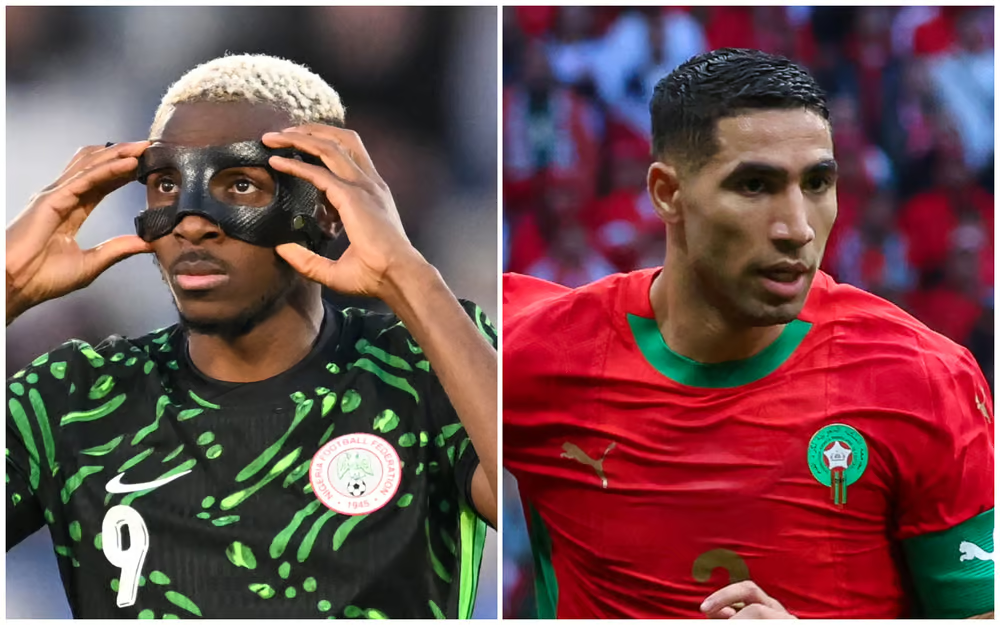
AFCON 2025 Semi-Final: Can The Super Eagles Break Morocco?

0

Nigeria and Morocco lock horns in Rabat on Wednesday, with a place in the 2025 Africa Cup of Nations final at stake in what promises to be one of the tournament’s defining nights.

The Super Eagles arrive with momentum firmly on their side. A composed 2–0 victory over Algeria in the quarter-finals preserved their perfect record at this year’s AFCON, making Nigeria the only team to have won all of their matches so far. With 14 goals scored, they are the competition’s most potent attack and now stand on the brink of history one more multi-goal outing would make them the first team to score two or more goals in six consecutive matches in a single AFCON edition.

Such a return would also carry Nigeria into a ninth AFCON final, and potentially back-to-back finals for only the second time in their history. Still, history urges caution. Nigeria have lost three of their last four AFCON meetings with hosts Morocco, a reminder that pedigree alone guarantees nothing at this stage.

Morocco, meanwhile, continues to look every bit like a host nation growing into the tournament. A commanding 2–0 win over Cameroon in the last eight marked their third successive clean-sheet victory, a run they have never extended to four matches at AFCON. Achieving that here would send the Atlas Lions into just their third final, following appearances in 1976 and 2004, as they chase an end to a 50-year wait for continental glory.

Goals have rarely been an issue for Walid Regragui’s side. Morocco have failed to score in only one of their last 18 AFCON matches, underlining their consistency in the final third and their readiness for another step toward the trophy.

Head-to-Head

This will be Nigeria and Morocco’s first AFCON meeting since 2004. Across five previous tournament encounters, Morocco holds the edge with three wins to Nigeria’s two.

Key Stats

* Nigeria has scored two or more goals in just one of their last seven AFCON semi-finals.

* The Super Eagles are averaging 16.8 shots per game, the highest figure at this tournament.

* Morocco has failed to score in three of their last four AFCON semi-finals.

Players to Watch & Absentees

Nigeria’s Ademola Lookman has been directly involved in 11 goals in 11 AFCON appearances (six goals, five assists), more than any player across the last two editions. For Morocco, Brahim Díaz has scored in all five matches at this tournament and could make history by finding the net in six different games in a single AFCON.

Nigeria will be without suspended captain Wilfred Ndidi, while Morocco continue to monitor Azzedine Ounahi, who remains sidelined with a calf injury.

All signs point to a fierce and finely balanced contest as two of the tournament’s most dangerous attacking sides collide. A semi-final in name, but very much a final-quality encounter.

Royal Supremacy Dispute Between Alaafin And Olubadan Escalates in Oyo State

0

The perceived supremacy rift between two foremost traditional rulers in Oyo State, the Alaafin of Oyo, Oba Abimbola Owoade, and the Olubadan of Ibadanland, Oba Rashidi Adewolu Ladoja, has resurfaced following a tense public incident at a government event.

The latest development occurred on Monday during the 2026 Inter-Faith Service organised for civil servants at the Oyo State Secretariat, Ibadan.

Tension reportedly filled the venue when the Alaafin, seated among other monarchs, extended his hand in what appeared to be a gesture of courtesy to greet the Olubadan.

Eyewitnesses said the Olubadan, who had arrived shortly after Governor Seyi Makinde, ignored the outstretched hand, proceeded to exchange pleasantries with the governor and other dignitaries, and then took his seat, leaving the Alaafin visibly unsettled.

The incident triggered murmurs among attendees and has since sparked widespread public debate within and outside the state.

Observers said the atmosphere around the seating area of the monarchs remained tense throughout the event. Opinions have since been divided over the incident.

While some argue that it was improper for the Alaafin to attempt to greet the Olubadan while seated, citing age and traditional etiquette, others insist that the Alaafin stool is historically superior and must be accorded due respect regardless of the incumbent’s age.

Sources familiar with palace affairs claimed the disagreement is rooted in an unresolved supremacy tussle between the two royal stools.

The public display of tension is not the first involving both monarchs. A similar situation reportedly played out on December 15, 2025, during the unveiling of the Oyo@50 logo at the same venue.

On that occasion, the Alaafin was represented by one of his chiefs. Trouble began when the Olubadan objected to being seated beside the Alaafin’s representative, whose chair was placed ahead of his despite the Alaafin’s absence.

The disagreement reportedly caused anxiety among top government officials and politicians present, who intervened to pacify the Olubadan. Eventually, his seat was relocated to a position ahead of the Alaafin’s, resolving the immediate tension.

The recurring incidents have raised questions about earlier efforts by the state government to foster harmony between the monarchs. On December 22, 2025, Governor Makinde held a brief closed-door meeting with both the Alaafin and the Olubadan shortly after signing the 2026 Appropriation Bill at the Governor’s Office in Agodi, Ibadan.

The unscheduled meeting, which lasted about 15 minutes, was believed by observers to be aimed at promoting unity and peaceful coexistence between the two first-class monarchs, though details were not made public.

Despite that intervention, the latest episode has reignited public discourse around hierarchy, tradition and mutual respect among Yoruba traditional rulers.

Cultural enthusiasts, historians and residents have taken to social media to express divergent views, with some faulting the Alaafin’s action and others condemning the public nature of the Olubadan’s response.

However, calls have continued from various quarters for calm, dialogue and reconciliation to preserve the dignity, unity and stability of the revered traditional institution in Oyo State.

Iran Protests Turn Deadly As Student Named Among Hundreds Killed

0

A sports referee and a university student are among the hundreds of people reportedly killed amid widespread anti-government protests across Iran, according to human rights groups and media reports.

Twenty-six-year-old coach and referee Amir Mohammad Koohkan was shot with live ammunition on 3 January during demonstrations in the town of Neyriz, a close friend told BBC Persian.

“Everyone knew him for his kindness,” the friend said, adding that Koohkan’s family is grieving and “angry because he was killed by the regime.”

Five days later, 23-year-old student Rubina Aminian was fatally shot during a protest in Tehran, according to multiple rights organisations. “She fought for things she knew were right,” her uncle told CNN.

A US-based human rights group estimates that nearly 500 protesters and 48 members of the security forces have been killed within two weeks of unrest. Sources inside Iran have told the BBC that the actual death toll may be higher.

The demonstrations began on 28 December in Tehran over economic grievances and quickly spread nationwide. According to the Human Rights Activist News Agency (HRANA), protests have taken place in 186 cities across all 31 provinces.

What started as economic protests has evolved into the largest wave of unrest Iran has seen in years, with demonstrators calling for an end to the Islamic Republic and the rule of Supreme Leader Ayatollah Ali Khamenei.

Authorities have responded with a sweeping crackdown. HRANA reports that at least 10,600 people have been arrested and 496 protesters killed so far.

Medical workers have described hospitals overwhelmed with casualties. BBC Persian verified that 70 bodies were delivered to Poursina Hospital in Rasht on 9 January, while footage from a morgue near Tehran showed at least 180 body bags believed to have been filmed the same night.

Independent reporting has been hampered by an internet shutdown imposed by Iranian authorities since Thursday, along with restrictions on foreign media access.

Koohkan, an indoor futsal coach and referee, was killed in Neyriz in Iran’s Fars Province. His friend, who cited eyewitness accounts, said he was known for his compassion and concern for others.

“It was far too soon for him, really far too soon. He was so young,” the friend said.

Having known Koohkan for a decade, the friend described him as “someone who didn’t like to see people in this state… in this misery.”

“Everyone knew him for his kindness and good nature. The whole town loved him,” the friend added. “The family are both grieving and angry. Grieving because they lost their son, angry because he was killed by the regime.”

Aminian, a Kurdish student, was also among those killed. Rights groups including Norway-based Iran Human Rights (IHRNGO) and Kurdish organisation Hengaw said she was shot in the head, while the Kurdistan Human Rights Network reported she was shot in the back. Both Kurdish groups alleged she was shot by government forces. The BBC has not been able to independently verify the circumstances.

The 23-year-old, whose name has also been spelled Robina or Roubina, was studying textile and fashion design at Shariati Technical and Vocational College in Tehran, according to IHRNGO.

“She was a strong girl, a courageous girl, and she was not someone you could control and make decisions for,” her uncle told CNN. “She fought for things she knew were right and fought hard.”

He added that she was “thirsty for freedom, thirsty for women’s rights.”

“Overall, she was a girl who was alive, who lived.”

Family members travelled from their hometown of Kermanshah in western Iran to Tehran to identify her body, a source close to the family told IHRNGO. According to the source, they were forced to search through hundreds of bodies near her college.

“It wasn’t just my daughter; I saw hundreds of bodies with my own eyes,” Aminian’s mother said, according to the source.

The family alleged that authorities initially refused to release Aminian’s body and later barred burial and mourning ceremonies in her hometown. She was reportedly buried along the road between Kermanshah and Kamyaran.

Iran’s Supreme Leader Ayatollah Ali Khamenei has dismissed protesters as “troublemakers,” while US President Donald Trump has warned of possible intervention, saying the US military is considering “very strong options.”

Iranian officials have accused protesters of being supported by the United States and Israel.

The unrest marks the most extensive protests since the 2022 uprising triggered by the death in custody of Mahsa Amini, a young Kurdish woman detained by Iran’s morality police for allegedly violating hijab rules. That wave of protests left more than 550 people dead and 20,000 detained, according to human rights organisations.

Federal Government And ASUU Set To Reveal New Agreement On January 14

0

The Federal Government and the Academic Staff Union of Universities (ASUU) will on Wednesday, January 14, formalise a fresh agreement aimed at improving the quality of university education and promoting stability in the sector.

The Ministry of Education, in a statement released on Sunday, said the event will hold at the Tertiary Education Trust Fund (TETFund) Conference Hall in Maitama, Abuja.

The agreement signing will be overseen by the Minister of Education, Dr. Maruf Alausa, and the Minister of State for Education, Prof. Suwaiba Ahmad.

The move follows a recent 14 day ultimatum issued by ASUU.

However, the planned strike was suspended before it began after overnight negotiations between the union and the Federal Government.

In an update, the ministry said the new agreement reflects the government’s resolve to engage key stakeholders constructively and resolve industrial disputes through dialogue, mutual respect, and cooperation.

The statement, signed by the Director of Press and Public Relations at the Ministry of Education, Folasade Boriowo, explained that the agreement is the result of years of discussions between the Federal Government and ASUU over industrial relations.

The ministry noted that the agreement aligns with President Bola Tinubu’s Renewed Hope Agenda, which places education at the centre of national development, human capital development, and socio economic progress.

It is expected to promote industrial peace, provide a more conducive learning environment, and restore confidence among students, university workers, and the wider public.

According to the ministry, the unveiling ceremony will be attended by senior government officials, ASUU representatives, heads of tertiary institutions, development partners, and members of the media.

The disagreement between the Federal Government and ASUU has remained a long standing issue in Nigeria’s higher education system, often revolving around funding, conditions of service, and the implementation of past agreements.

Over the years, ASUU has embarked on several strikes in pursuit of better funding for public universities, improved staff welfare, and the full implementation of earlier accords, including outstanding aspects of the 2009 agreement.

The most recent significant industrial action occurred in October 2025, when ASUU began a two week nationwide strike.

These strike actions have repeatedly disrupted academic calendars, sometimes lasting months and resulting in lost study time, delayed graduations, and increased movement of students to private or foreign universities.

FG Unveils ₦40bn CCTV Control Centre For Third Mainland Bridge

0

The Federal Government has officially opened a ₦40 billion closed-circuit television (CCTV) control centre for Lagos’s Third Mainland Bridge.

At the inauguration on Sunday, Minister of Works David Umahi explained that the project came after extensive rehabilitation work was carried out on the bridge since the current administration assumed office in 2023.

Umahi stated that the CCTV system, initially announced in 2025, aims to curb reckless driving, prevent suicide attempts, and enhance security.

He added that security personnel would monitor live footage from the control centre and enforce speed limits across the bridge.

“When we came on board in 2023, we met a very terrible Third Mainland Bridge,” Umahi said, noting that the structure, along with Carter and Iddo bridges, required thorough inspections and repairs both above and below the water.

He mentioned that President Bola Tinubu approved the total rehabilitation of the bridge, including the replacement of expansion joints.

Umahi highlighted that the completed works have improved driving conditions and extended the bridge’s lifespan.

The minister also pointed out that the contract covers a surveillance boat and two Hilux vans, which will be handed over to the police to aid monitoring and rapid response.

“The idea is that we can see everything that is happening on the bridge,” Umahi said, stressing concerns about speeding and urging motorists to adhere to traffic rules.

Niger State Starts Gradual Reopening of Schools

0

Schools in select safe areas of Niger State resumed academic activities on Monday, January 12, 2026, following a government directive aimed at balancing education continuity with heightened security risks.

The partial reopening comes weeks after mass student abductions in November 2025 prompted a statewide shutdown, affecting thousands of learners.

The Niger State Ministry of Basic and Secondary Education announced that only public and private schools, including boarding facilities, in secure zones would reopen.

Specifically, the initiative covers four local government areas (LGAs): Bida, Suleja, Chanchaga, and parts of Bosso, out of the state’s 25 LGAs.

Commissioner Dr. Hadiza Asabe Mohammed emphasized that this is part of a phased approach, with schools in unsafe areas remaining closed until cleared by security agencies.

Governor Mohammed Umaru Bago approved the move after extensive consultations with security stakeholders, underscoring the administration’s commitment to safeguarding lives.

Out of 45 boarding schools statewide, only 18 in the approved LGAs have been cleared for resumption, primarily those in urban centers rather than outskirts vulnerable to banditry.

The decision follows a joint assessment by the ministry, local authorities, and security forces, with a detailed list of approved schools released for transparency.

Dr. Mohammed stated, “We cannot reopen all schools at once due to the security challenges facing Niger State. We will continue in phases, starting with these cleared areas.”

Parents and educators have welcomed the resumption but expressed mixed feelings about overall safety. In interviews, some Minna residents voiced concerns over potential risks, urging enhanced patrols around school premises.

Education experts highlighted the need for ongoing monitoring to prevent disruptions.

The abductions last year, which saw over 100 students kidnapped in Niger and neighboring states, exposed vulnerabilities in rural education infrastructure.

Officials say the phased strategy will allow for adaptive measures, with future reopenings dependent on improved security.

As classes resume in the designated areas, the government has called on communities to report suspicious activities, aiming to restore normalcy while prioritizing student welfare in one of Nigeria’s most insecurity-plagued regions.

Rivers State Saga: Will Governor Fubara Be Impeached?

0

A fresh wave of political uncertainty has emerged in Rivers State following the decision of the State House of Assembly to begin impeachment proceedings against Governor Siminalayi Fubara and his deputy, Ngozi Odu.

The move, based on allegations of gross misconduct, has reopened deep political divisions in the state and intensified the long-running power struggle between Fubara and his predecessor, Nyesom Wike, now Minister of the Federal Capital Territory (FCT).

The development has sparked widespread concern across the country, with civil society groups, legal bodies and political stakeholders warning that the crisis could undermine democratic governance and further destabilise the oil-rich state.

Background to the Rivers Political Crisis

The current crisis is the result of a breakdown in the political relationship between Governor Fubara and Nyesom Wike, who played a decisive role in Fubara’s emergence as governor in 2023 under the Peoples Democratic Party (PDP).

Wike’s political structure was instrumental in securing the election victory, and his camp expected continued influence over the affairs of government.

Tensions surfaced soon after Fubara assumed office, as he began asserting independence in governance.

The disagreement quickly escalated into a full-blown institutional conflict, leading to a split in the Rivers State House of Assembly, largely along loyalty lines.

By late 2023, impeachment threats became frequent, and the crisis reached a dramatic point when the assembly complex was set ablaze during the height of the standoff.

Although President Bola Tinubu intervened to broker peace, the truce was short-lived.

In March 2025, the situation deteriorated to the point that a six-month state of emergency was declared, suspending democratic institutions and placing the state under a sole administrator until September 2025.

The political landscape shifted again in late 2025 when Fubara defected to the All Progressives Congress (APC), effectively transforming the dispute from an internal PDP struggle into a national political issue within the ruling party.

The immediate trigger for the latest confrontation was disagreement over state finances.

Lawmakers aligned with Wike proposed a supplementary appropriation to revise the ₦1.48 trillion 2025 budget approved during emergency rule.

Governor Fubara rejected the proposal, insisting the budget was sufficient, and declined to present the 2026 budget, accusing the assembly of deliberate obstruction.

The lawmakers responded by accusing the governor of constitutional breaches, including failure to submit key fiscal documents and alleged unauthorized spending.

Wike’s Local Government Tours: What Changed?

The crisis took a sharper turn following Nyesom Wike’s recent “Thank You” tour across Rivers State’s local government areas.

The tour, which ended on January 11, 2026, at the Captain Elechi Amadi Polytechnic in Rumuola, was officially described as an appreciation of political support during the 2023 elections.

However, political observers say the tour served as a rallying point for Wike’s supporters and a show of strength. During the events, Wike dismissed speculation about his removal as FCT minister, stating that only President Tinubu had the authority to sack him.

He reaffirmed his loyalty to the president and pledged full support for Tinubu’s re-election bid in 2027, citing federal appointments given to Rivers indigenes as evidence of political reward.

Wike also used the platform to make political statements against opposition figures and to reassert his influence in Rivers politics.

Following the tour, pro-Wike lawmakers in the state assembly appeared emboldened, with impeachment proceedings against Governor Fubara gaining momentum.

Speaker of the House, Martin Amaewhule, publicly aligned himself with Wike and President Tinubu, reinforcing perceptions that the assembly is deeply divided along factional lines.

The situation was further inflamed by Fubara’s decision to remove several officials seen as loyal to Wike from his cabinet.

Rivers Assembly’s Allegation

On January 8, 2026, the Rivers State House of Assembly formally initiated impeachment proceedings against Governor Fubara and Deputy Governor Ngozi Odu.

The motion, moved by Deputy Speaker Dumle Maol, called for an investigation into alleged financial and administrative misconduct.

Notices of gross misconduct were served on both officials on January 9, giving them seven days to respond, in line with Section 188 of the 1999 Constitution.

The allegations include failure to present the Mid-Term Expenditure Framework, refusal to submit budget proposals, and alleged unauthorized expenditure of public funds.

The assembly also claimed it had intelligence reports suggesting attempts to frustrate the impeachment process through court orders obtained outside the state. Lawmakers insisted they would proceed strictly in accordance with constitutional provisions.

The process has, however, drawn sharp criticism. The Rivers Elders and Leadership Forum described the allegations as weak and politically motivated, while civil rights groups warned that the tension could distort due process.

The Nigerian Law Society called on President Tinubu to intervene by invoking constitutional provisions that would allow the National Assembly to assume the functions of the state assembly, citing concerns about bias and lack of neutrality.

What This Means for Governor Fubara

For Governor Fubara, the impeachment move represents a serious political threat with far-reaching consequences.

His first public response was measured, as he appealed for calm during a church service marking the 2026 Armed Forces Remembrance Day, assuring residents that the situation was under control. Deputy Governor Ngozi Odu also urged prayers and restraint.

Under the constitution, impeachment requires a two-thirds majority of the House, the appointment of a seven-member investigative panel by the chief judge, and adherence to due process.

While Wike-aligned lawmakers appear to have numerical advantage, political analysts note that Fubara’s incumbency, party backing at the federal level, and grassroots support could complicate the process.

Beyond politics, the crisis is already affecting governance and the economy. Government projects have slowed, contractors face delays, and uncertainty continues to affect business confidence.

There are also fears that a prolonged standoff could lead to another emergency rule, with significant economic costs for the state.

At the national level, President Tinubu faces a difficult choice: balancing loyalty to a powerful ally in Wike against the political cost of losing an APC governor ahead of the 2027 elections.

As the situation unfolds, Rivers State once again finds itself caught in a familiar political struggle where elite rivalries threaten governance and stability.

Whether Governor Fubara survives the impeachment process remains uncertain, but the coming days are likely to be decisive for the state’s political future.

Resident Doctors Suspend Planned Nationwide Strike

0

The National Association of Resident Doctors (NARD) has suspended its planned nationwide strike after recording what it described as significant progress on its demands following sustained engagements with the Federal Government and other key stakeholders.

The decision was reached during a virtual Emergency National Executive Council (E-NEC) meeting held on January 11, 2026, where the association reviewed recent developments and assessed the status of its demands.

NARD said the suspension followed direct presidential intervention led by Vice President Kashim Shettima on behalf of President Bola Ahmed Tinubu.

According to the Secretary-General of the association, Dr. Shuaibu Ibrahim, the suspension is strategic and conditional, allowing the NEC to review tangible progress at its next meeting scheduled to commence on January 25, 2026.

“The NEC unanimously resolved to suspend the resumption of TICS 2.0 based on firm commitments from critical stakeholders and the direct presidential intervention led by the Vice President, Senator Kashim Shettima, acting on behalf of President Bola Ahmed Tinubu,” the statement read in part.

The association expressed appreciation to its members and stakeholders for their support, adding that it remains confident that the Vice President’s intervention would lead to a lasting resolution of long-standing challenges in Nigeria’s health sector.

On the lingering crisis at the Federal Teaching Hospital (FTH), Lokoja, NARD disclosed that an earlier committee report had been implemented, while a new reconciliation committee has been constituted to ensure peace and harmony among medical professionals at the facility.

NARD also reported progress on the payment of outstanding Consolidated Medical Salary Structure (CONMESS) arrears, accoutrement allowances, promotion and salary arrears, as well as steps toward resolving issues relating to entry-level placement, locum practice, specialist allowances and the welfare of house officers.

The association had earlier stated that more than 2,000 of its members were yet to be paid arrears of the 25–35 per cent CONMESS adjustment, despite claims by the Federal Government that the outstanding payments had been settled.

Responding to the government’s assertion that seven out of its 19 demands had been statutorily addressed, including the full payment of seven months’ CONMESS arrears, NARD insisted that many doctors were still unpaid.

“On the seven months’ arrears of 25–35 per cent, we still have over 2,000, almost 3,000 of our members who are yet to be paid those arrears,” a representative of the association said.

Meanwhile, to avert a shutdown of the health sector, the National Industrial Court of Nigeria last Friday issued an interim order restraining resident doctors from commencing the planned “TICS 2.0” strike scheduled for January 12, 2026.

Justice Emmanuel Subilim made the order while ruling on a motion ex parte filed by the Federal Government of Nigeria and the Attorney General of the Federation, following rising tensions over unresolved welfare and professional concerns.

FA Cup Third Round Classics: Manchester United’s Nightmare at Old Trafford

0

In one of the shock headlines of the day, Manchester United were eliminated 2–1 by Brighton & Hove Albion, their first FA Cup exit at the third round in decades. Brighton struck early through Brajan Gruda and were doubled up by former United forward Danny Welbeck. United grabbed a late consolation via Benjamin Sesko, but teenager Shea Lacey was sent off, sealing United’s misfortune.

Turning point:
United enjoyed the lion’s share of possession but failed to convert the chances, while Brighton’s clinical edge and tactical discipline won the day. This defeat compounds a difficult season for the Red Devils and adds fresh scrutiny on the interim manager.

Arsenal Comeback with Martinelli Magic

At Fratton Park, Arsenal survived an early scare against Championship side Portsmouth before asserting their quality in a 4–1 victory. Portsmouth stunned the visitors inside the opening three minutes through Colby Bishop, but Arsenal quickly regrouped. An own goal levelled matters, and Gabriel Martinelli delivered a stunning hat-trick, showcasing his lethal finishing—including two goals from set pieces—to sink the hosts and keep Arsenal cruising into the fourth round.

Why it mattered:

  • A statement from Arsenal’s squad depth and attacking firepower
  • Portsmouth earned plaudits for a spirited showing before being overwhelmed

Leeds Edge Derby in Tight Encounter

Leeds United claimed a 3–1 victory over Derby County in a match where they came from behind to assert control. Goals from Gnonto, Tanaka and Justin turned the tie on its head, marking a strong cup performance and highlighting Leeds’ attacking depth.

Cup Underdogs Steal the Spotlight

Mansfield Town’s Thrilling Upset

One of the day’s most exciting results saw Mansfield Town (League Two) defeat Sheffield United 4–3 in a seven-goal classic. This result underlined why the FA Cup is football’s great leveler—Championship opposition couldn’t contain Mansfield’s fearless attacking approach.

Penalty Action & Gritty Progressions

Elsewhere in cup action:

  • Hull City beat Blackburn on penalties after a stalemate in normal time.
  • West Bromwich Albion saw off Swansea in a tense shootout.
  • West Ham United advanced with a 2–1 extra time win over QPR.

A few ties were played with high drama, showcasing resilient defending and nerve-shredding finishes—classic FA Cup narratives.

Norwich Dominate, but Tragedy Overshadows Victory

Norwich City cruised to a 5–1 thrashing of Walsall, with striker Jovon Makama starring with a hat-trick in an impressive performance at Carrow Road. However, the joyful night was clouded by a fan’s tragic medical emergency during the match, prompting tributes and support from both clubs.

As teams prepare for the Fourth Round draw, the football calendar shifts momentum into an exciting phase of knockout football—with giant killers rising and established clubs fighting to safeguard glory.
