The Edo State Polytechnic, Usen, has temporarily halted its policy requiring students to provide proof of fee payment before writing examinations, specifically for those applying for student loans through the Nigeria Education Loan Fund (NELFUND).
The institution’s Rector, Engr. Sylvester Omoruyi, made this announcement during a sensitization program organized by NELFUND at the polytechnic’s main campus in Usen, Edo State.
Meanwhile, the Managing Director/Chief Executive Officer of NELFUND, Akintunde Sawyerr, raised concerns over the polytechnic’s delay in submitting student data, which is essential to kickstart the registration process for loan applications.
Represented by the Director of Loan Allocation and Distribution, Lami Suwaid, Sawyerr encouraged the institution to leverage the new registration cycle for the 2024/2025 academic session to ensure more students enroll in the scheme.
He further revealed that NELFUND had enrolled 259 institutions in the 2023/2024 academic year, disbursing billions of naira in student loans. However, he noted that institutions in the South-South and South-East regions recorded the lowest registration rates and called for increased participation.
Every year on International Women’s Day, we pause to celebrate the achievements of women worldwide who have defied expectations, broken barriers, and redefined leadership. In Nigeria, a nation of vibrant cultures and diverse voices, many women have risen above challenges, inspiring a new generation to dream boldly and act fearlessly.
1. Ngozi Okonjo-Iweala — Breaking Barriers in Global Trade
As the first woman and the first African to lead the World Trade Organization (WTO), Dr. Ngozi Okonjo-Iweala is a living testament to resilience and brilliance. With a career spanning over 25 years at the World Bank, where she served as Managing Director, and her pivotal role as Nigeria’s Finance Minister, Ngozi’s legacy is one of transformative leadership.
Her bold economic reforms helped stabilize Nigeria’s economy and secured billions in debt relief. At the WTO, she champions equitable trade policies that support developing nations, breaking long-standing biases in global finance. Her story is a powerful reminder that women can excel at the highest levels of international leadership.
2. Chimamanda Ngozi Adichie — Redefining African Literature and Feminism
Chimamanda Ngozi Adichie has not just written books; she has penned revolutions. With bestsellers like Half of a Yellow Sun and Americanah, Chimamanda has given the world authentic African stories that challenge stereotypes.
Her TED Talk, We Should All Be Feminists, sparked a global movement, leading to its adaptation as a book and a symbol of modern feminism. By fearlessly addressing issues of gender, identity, and power, Chimamanda has redefined what it means to be a feminist in today’s world. Her impact extends beyond literature—she is a cultural force.
3. Amina J. Mohammed — Championing Sustainable Development
In the corridors of the United Nations, Amina J. Mohammed is a name that resonates with power and purpose. As the Deputy Secretary-General, she has been instrumental in advancing the Sustainable Development Goals (SDGs), a global blueprint for achieving a better future.
Her journey from Environmental Minister in Nigeria to the UN’s second-highest position is one of unyielding dedication to climate action and gender equality. Amina’s leadership continues to inspire young African women to pursue careers in governance and international diplomacy.
4. Arunma Oteh — Transforming Finance in Africa
When Arunma Oteh took over as the Director-General of Nigeria’s Securities and Exchange Commission (SEC), she inherited a market marred by corruption and distrust. Through strategic reforms, she restored investor confidence and brought transparency to Nigeria’s capital market.
Later, as the Treasurer and Vice President of the World Bank, Arunma managed billions of dollars, proving that women can lead in finance with integrity and vision. Her advocacy for accountability in governance and finance continues to pave the way for more women in leadership roles.
5. Ibukun Awosika — Trailblazer in Business Leadership
Ibukun Awosika’s journey is one of firsts. As the first female Chairperson of First Bank of Nigeria, she broke a 126-year-old glass ceiling. Her business acumen is reflected in the success of The Chair Centre Group, a company she founded, which has grown into a conglomerate spanning manufacturing, retail, and financial services.
Beyond her boardroom achievements, Ibukun’s mentorship programs and advocacy for women in business have empowered countless young women to pursue entrepreneurship. Her courage and commitment to integrity in business make her a true trailblazer.
The stories of these five women are not just tales of personal triumph—they are blueprints for a future where gender is no barrier to success. As we celebrate International Women’s Day, let us be inspired by their journeys and commit to supporting women and girls in breaking even more barriers.
May their stories remind us that the glass ceiling is not just meant to be cracked—it is meant to be shattered.
On March 6, 2025, the Senate suspended Senator Natasha Akpoti-Uduaghan for six months after she filed a petition accusing Senate President Godswill Akpabio of sexual harassment. Akpoti-Uduaghan initially made these allegations in an interview last Friday, drawing attention to one of Nigeria’s most prominent politicians.
Following the dismissal of her petition on procedural grounds, the ethics committee recommended her suspension, asserting that her actions had brought ridicule to the upper chamber of the National Assembly. While some senators proposed reducing the suspension to three months, the majority voted in favor of the six-month suspension suggested by the ethics committee.
Women’s rights activist Hadiza Ado referred to the suspension as a “sad day for Nigerian women.” In response, Senator Uduaghan called the decision “an injustice that will not be sustained,” emphasizing her determination to continue her “pursuit for justice.”
The accusations have remained a hot topic of conversation in Nigeria since the initial claims were made. Several influential individuals and groups have demanded a transparent investigation. On Wednesday, two groups of protesters gathered in Abuja, one supporting Akpabio and the other advocating for Uduaghan, chanting, “Akpabio must go.”
Hadiza Ado, founder of the Women and Children Initiative, remarked: “We’ve been following events at the Assembly keenly and hoping that investigation into Natasha’s allegations would follow.” She added, “All we can say is that today is a sad day for Nigerian women fighting for emancipation. Out of 109 senators, only four are women, and one is now suspended.”
Numerous women on social media expressed their frustration, with some labeling the suspension as “oppression.” As part of the suspension, Uduaghan’s salary and security details were revoked, and she was barred from accessing the National Assembly. Additionally, her office was locked.
The Senate has previously suspended various lawmakers for misconduct and other violations of legislative protocols. Here are other senators who faced suspension and the reasons behind their sanctions:
Femi Okurounmu (Ogun Central) – 1999
Senator Okurounmu was suspended in 1999 after he claimed that fellow senators were plotting to impeach President Olusegun Obasanjo. He was reinstated after apologizing to the Senate.
Joseph Waku (Benue) – 2000
In 2000, Senator Waku was suspended for suggesting that a military coup would be preferable to allowing President Obasanjo to rule as a dictator.
Arthur Nzeribe (Imo, Orlu Constituency) – 2002
Senator Nzeribe was indefinitely suspended in November 2002 due to a ₦22 million fraud allegation.
Isah Mohammed (Niger Central) – 2004
Senator Mohammed was suspended for two weeks in 2004 after physically assaulting Senator Iyabo Anisulowo outside the National Assembly in a dispute over committee funds.
Ali Ndume (Borno South) – 2017
In 2017, Senator Ndume was suspended for six months after calling for an investigation into allegations involving Senate President Bukola Saraki and Senator Dino Melaye.
Ovie Omo-Agege (Delta Central) – 2018
In 2018, Senator Omo-Agege was suspended for opposing the election reordering bill. After apologizing for his stance, he sought a court order to prevent his suspension, which ultimately led to his suspension.
Abdul Ningi (Bauchi Central) – 2024
Senator Ningi was suspended for three months in 2024 after claiming that the National Assembly had inflated the 2024 budget by ₦3 trillion.
Was Natasha Akpoti-UduaghanSuspension Legal?
LN247 spoke with legal practitioner Yinka Adegboye to shed light on the legality of the suspension and whether Senator Akpoti-Uduaghan can seek reprieve from the court. Adegboye explained in detail:
“In Nigeria, no organization or body, including the Senate, can enact laws to punish individuals without following due process. The principles of fair hearing are crucial, and Senator Natasha Akpoti-Uduaghan was not given a chance to defend herself against the allegations of misconduct. This lack of due process, combined with the conflict of interest in the Senate president’s involvement, raises serious legal concerns.”
Adegboye continued, addressing the broader issue: “The Senate’s actions are fundamentally flawed. There is no law supporting the suspension, and I believe that any court would set it aside. The principle of fair hearing, enshrined in our constitution, was violated. The Senate failed to follow the legal procedures, and in light of this, Senator Akpoti-Uduaghan has every right to challenge the suspension in court.”
Furthermore, Adegboye emphasized that the case is not unique. “There have been instances in the past where senators successfully challenged disciplinary measures. Senators like Ali Ndume and Dino Melaiye have previously contested their suspensions in court, and I believe Senator Akpoti-Uduaghan has strong grounds to do the same.”
Adegboye also noted an alarming issue: “The Senate ignored a court order restraining them from imposing any penalty on Senator Akpoti-Uduaghan. Despite the fact that the order was served on them, they proceeded with the suspension. This act of defiance toward the court undermines the rule of law.”
On the severity of the suspension, Adegboye concluded, “Suspending a senator for six months, especially one who was elected to represent her constituents, is a harsh punishment. There’s a Supreme Court ruling that states a senator cannot be suspended for more than 14 days. The Senate has acted beyond its legal authority.”
As the legal process unfolds, many are questioning the Senate’s actions, calling for justice to be served. Adegboye’s final thoughts were clear: “The Senate, as the law-making body in Nigeria, has embarrassed itself by violating the very laws it is supposed to uphold. The world is watching, and it is imperative that they retrace their steps and address this issue with the seriousness it deserves.”
The matter continues to be one of great public interest, with many watching closely to see how the courts will rule on this controversial issue.
The National Identity Management Commission (NIMC) has entered into a Memorandum of Understanding (MoU) with the Nigerian Education Loan Fund (NELFUND) to facilitate the rollout of multi-purpose Government-to-People (G2P) cards for students. This initiative aims to improve access to loans and streamline administration processes.
The MoU was signed at NELFUND’s headquarters in Abuja by Akintunde Sawyerr, Managing Director of NELFUND; Engr. Abisoye Coker-Odusote, Director-General of NIMC; and Mr. Femi Akande, Managing Director of Data Mining Company.
According to an official statement, the NIN-enabled G2P cards will support payments, allowing students to directly access their upkeep loans without the need to wait for bank processes. The cards will also enable students to perform various electronic transactions, including point of sale (POS) payments, ATM withdrawals, and online payments.
In his remarks, Akintunde Sawyerr described the MoU as a groundbreaking step towards advancing financial inclusion and promoting transparency and accountability through the G2P cards. He reaffirmed NELFUND’s commitment to the project, emphasizing that the biometric-enabled cards will allow students to access loans seamlessly through multiple wallets.
Sawyerr also acknowledged the critical support provided by NIMC in ensuring efficient loan administration and disbursement by offering essential identity verification services.
Engr. Abisoye Coker-Odusote, the Director-General of NIMC, explained that the biometric-enabled cards are part of NIMC’s broader strategy to drive both digital and financial inclusion. He highlighted that these cards will ensure that every student benefiting from government services, such as loans, has a verifiable identity.
Additionally, Coker-Odusote noted that the biometric-enabled cards feature multiple wallets, enabling students to access loans and other services both online and offline.
A group of 140 Nigerians, long stranded in Sudan, has managed to return home with help from the International Organization for Migration under its Voluntary Humanitarian Return initiative. IOM confirmed this development in a statement released on Friday.
According to the announcement, a chartered flight—the first since the crisis in Sudan began—landed at Mallam Aminu Kano International Airport on February 27, where Nigerian government officials greeted the returnees.
The returning group included 64 women, 36 children, and four infants under 12 months old, along with migrants facing various health challenges.
“Following their return, each of the migrants received post-arrival assistance including counselling, medical attention – mental health and psychosocial support where necessary, as well as assistance for onward transportation to their final destinations. IOM and partners will also ensure their reintegration through additional support based on individual needs,” IOM stated.
“After the war, we found ourselves out in the open with no accommodation and no food. Things kept getting tougher, and the problem was that there was no hope because the war kept going on,” said Bashir, one of the returnees. “We are grateful to be back home”, he added.
The international organization also emphasized that the conflict, which erupted in Sudan in 2023, has forced over 12 million people to leave their homes, either relocating within the country or seeking refuge in neighboring states.
“A considerable number of them were migrants, including third-country nationals who were circular workers, students and professionals who had made Sudan their home.
“As the war rages, IOM has worked closely with embassies and consular offices from various countries to coordinate protection, assistance and access to services for stranded migrants,” it added.
It was also pointed out that IOM’s Voluntary Humanitarian Return programme offers a critical lifeline to those migrants caught in desperate circumstances, providing them a secure way back to their home countries when no alternatives exist.
The international organization noted that the VHR charter flight was executed in close coordination with both Sudanese and Nigerian authorities, including the Nigerian Embassy in Sudan, the Sudanese Ministry of Interior, Nigeria’s National Commission for Refugees, Migrants, and Internally Displaced Persons, Nigeria Immigration Services, and several local entities in Kano.
“We are happy to see the positive results of partnerships and cooperation in saving lives”, said Ms. Paola Pace, Chief of Mission a.i. for IOM Nigeria. “IOM remains committed and will continue to work tirelessly to extend support to all migrants and ensure no one is left behind”, she added.
Additionally, the statement also mentioned that the VHR charter was made possible with the support of the European Union through the Migrant Protection, Return and Reintegration Programme for Sub-Saharan Africa
The Nigerian naira has recently shown signs of resilience against the US dollar, supported by a mix of factors, including improved foreign investor sentiment, higher yields on Nigerian bonds, and a more predictable forex market. However, a deeper analysis reveals a two-speed recovery, with the official market performing better than the parallel market.
In February, the naira depreciated by 1.69% in the official market but appreciated by 7.33% in the parallel market, resulting in a year-to-date gain of 2.48% and 9.67% in the official and parallel markets, respectively. This divergence is largely due to the Central Bank of Nigeria’s (CBN) sustained forex interventions, which have eased pressure on forex demand and improved dollar liquidity in the official market.
Despite these positive developments, concerns linger about the sustainability of the naira’s strength. The CBN’s interventions have come at a cost, with Nigeria’s gross external reserves declining to $39.10 billion. Additionally, Brent crude oil prices, a major source of Nigeria’s forex earnings, dropped to $75.02 per barrel, raising questions about future forex inflows.
In an interview with LN247, financial analyst Mr. Muktar Mohammad explained that the naira’s recent gains were driven by CBN’s interventions in the retail market. However, he cautioned that these gains might not be sustainable without fundamental economic improvements.
“The naira has been gaining over the dollar this week, but this gain has slowed down. The reason for this gain is the CBN’s intervention, especially in the retail segment of the market,” he said.
Mr. Mohammad further highlighted that low oil prices, high debt servicing costs, and significant government spending could impede the naira’s momentum. For sustained strength, he suggested that Nigeria must boost forex liquidity through higher oil prices and increased foreign direct investment (FDI).
“With low oil prices, high debt servicing, and large government spending, I don’t think the current momentum can be sustained. To keep the naira strong, we need to attract more FDI and ensure a steady inflow of dollars,” he added.
Analysts remain cautiously optimistic about the naira’s prospects in 2025, pointing to improved market confidence and potential inflows from autonomous sources. However, they emphasize the need for consistent economic reforms and a stable forex management approach to ensure long-term stability.
“If the naira is to sustain its strength against the dollar in 2025, there must be increased liquidity in the forex market, especially in the retail segment, either through Bureau de Change or CBN’s planned recapitalization,” Mr. Mohammad stated.
While the naira’s recent performance offers a glimmer of hope, its long-term strength depends on addressing fundamental economic challenges and maintaining a balanced forex policy.
Why Did the Naira Depreciate Against the Dollar?
The Nigerian naira weakened against the US dollar on Wednesday, hitting a high of N1,505 due to increased demand for dollars. Traders attributed the pressure to businesses and individuals seeking USD for imports, foreign investments, and hedging against further depreciation. Despite the Central Bank of Nigeria’s (CBN) efforts to manage the naira, the rising demand underscores ongoing challenges. Enhancing local production and reducing import dependency remain crucial for stabilizing the naira and fostering economic growth.
Why Is Demand for the US Dollar Increasing?
Import Needs: Businesses reliant on imported goods and services face higher costs due to global inflation and supply chain disruptions. To secure these essential supplies, they require more dollars, putting additional pressure on the naira.
Foreign Investment: Although Nigeria has attracted some foreign investment, particularly in the oil and gas sector, investors are increasingly repatriating their profits, leading to an outflow of dollars and further weakening the naira.
Hedging: With the naira’s value under pressure, individuals and businesses are converting their naira holdings into dollars as a protective measure. This hedging strategy, while understandable, exacerbates the demand for dollars and accelerates the naira’s depreciation.
The rising demand for dollars—driven by import needs, foreign investment outflows, and hedging against further depreciation—continues to challenge the naira’s stability. The CBN’s efforts to manage the situation highlight the complexities involved in stabilizing the currency in the face of multiple economic pressures.
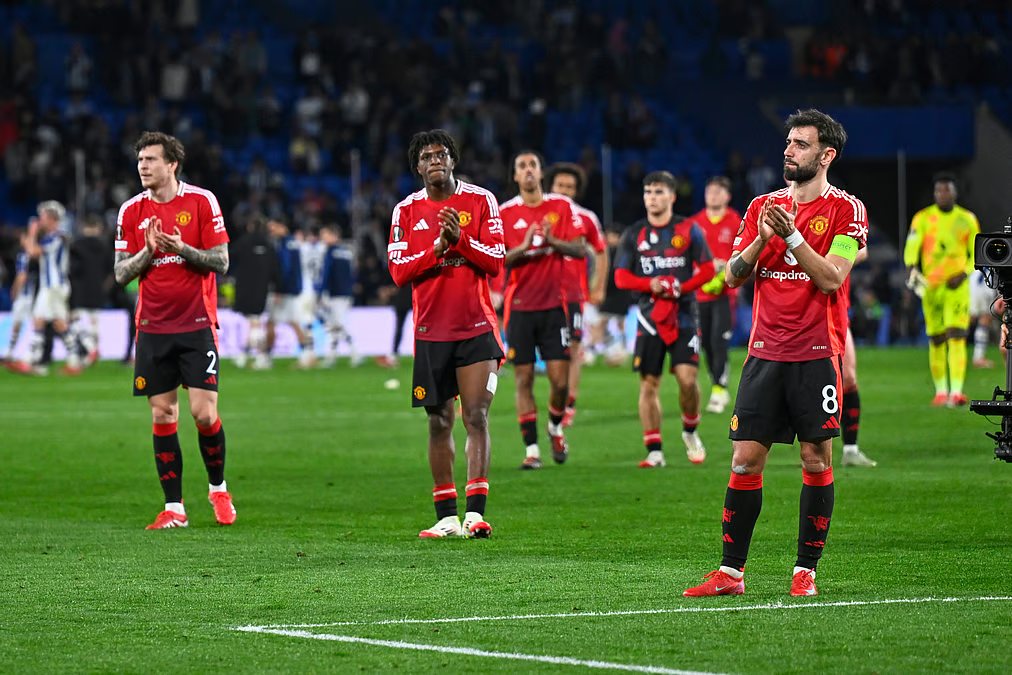
Mikel Oyarzabal’s composed penalty secured a 1-1 draw for Real Sociedad against Manchester United in the first leg of their Europa League last-16 clash on Thursday.
The Red Devils, struggling in a disappointing season, view the competition as their most realistic path to Champions League qualification. However, they failed to maintain their lead at the Reale Arena in San Sebastián.
Dutch forward Joshua Zirkzee ended a five-game goal drought by scoring just before the hour mark, giving Ruben Amorim’s side a 1-0 advantage. However, a handball by Bruno Fernandes led to a penalty, which Oyarzabal converted in the 70th minute to level the match.
The hosts came close to a late winner, but Orri Oskarsson squandered two clear chances, leaving the tie delicately balanced ahead of the return leg at Old Trafford next Thursday.
Reflecting on the match, Oyarzabal said, “It’s a shame about those chances we missed at the end, but the tie is open. We’re going there alive, with a lot of desire.” He acknowledged the challenge of creating opportunities but felt the team held firm defensively.
Ruben Amorim, dealing with an injury crisis that limited him to 18 players, saw key figures like Harry Maguire and Manuel Ugarte join Amad Diallo, Kobbie Mainoo, and Luke Shaw on the sidelines. Upfront, Rasmus Højlund’s goal drought extended to 19 matches, while Zirkzee’s strike marked only his second goal in 17 games.
Amorim admitted that winning the Europa League is not “crucial” but sees it as a potential lifeline for a disastrous season, with United sitting 14th in the Premier League and out of all domestic cup competitions.
The first half was uneventful, with neither side attacking convincingly, though United created the better chances. Real Sociedad’s Aritz Elustondo made vital blocks to deny Fernandes and Zirkzee, helping the hosts stay level at halftime.
Real Sociedad, currently ninth in La Liga, are determined to lift the trophy at San Mamés, the home of their rivals, Athletic Bilbao. Imanol Alguacil’s side, boosted by the returns of Takefusa Kubo, Oyarzabal, and Luka Sučić, struggled in midfield due to the absence of Martín Zubimendi.
Manchester United showed greater urgency after the break, with Fernandes sending a free-kick wide and Alejandro Garnacho hitting the side-netting. Zirkzee finally broke the deadlock in the 58th minute, converting Garnacho’s cross despite goalkeeper Álex Remiro’s efforts.
Real Sociedad responded midway through the second half, winning a penalty when Fernandes was penalised for a handball while attempting to clear a corner. Oyarzabal, who scored Spain’s winner in the Euro 2024 final, confidently converted the spot-kick, sending United’s goalkeeper André Onana the wrong way.
Onana produced a brilliant save to deny Brais Méndez’s curling effort as the hosts grew in confidence. However, Oskarsson’s late misses spared United from a damaging defeat.
The winner of this tie will face either French side Lyon or Romanian club FCSB in the quarter-finals, keeping the stakes high for the return leg at Old Trafford.
Chelsea took a significant step towards the UEFA Conference League quarter-finals with a 2-1 win over Copenhagen in the first leg of their last-16 tie on Thursday. Meanwhile, Panathinaikos and Fiorentina delivered a five-goal thriller in their encounter.
Reece James and Enzo Fernández scored in the second half to give Chelsea control of the tie, despite Gabriel Pereira’s late goal for the hosts. Under the guidance of Enzo Maresca, Chelsea managed to hold on to their advantage in the Danish capital.
After a lackluster first half, Chelsea captain Reece James broke the deadlock just a minute into the second half, finishing off Marc Cucurella’s deep cut-back with a precise low shot into the near post. The goal revitalized the game, and Copenhagen nearly responded immediately, but Viktor Claesson’s one-on-one effort struck the inside of Robert Sánchez’s post and bounced back safely.
Substitute Enzo Fernández doubled Chelsea’s lead in the 65th minute with a powerful finish following impressive work by teenager Tyrique George. However, Copenhagen pulled one back in the 79th minute when Gabriel Pereira headed home unmarked from a set-piece, keeping their hopes alive for the second leg.
In other matches, last season’s runners-up Fiorentina fell to a 3-2 defeat against Greek side Panathinaikos. The hosts surged to a 2-0 lead within 19 minutes through Karol Świderski and Nemanja Maksimović. Fiorentina quickly responded with goals from Lucas Beltrán and Nicolò Fagioli to level the score, but Tete’s 55th-minute strike secured a narrow win for Panathinaikos.
Meanwhile, Molde survived a late scare to edge Legia Warsaw 3-2 in Norway. Eirik Hestad, Kristian Eriksen, and Fredrik Gulbrandsen scored for Molde, while Legia’s Kacper Chodyna and Luquinhas struck twice in quick succession to make for a nervy finish.
In Spain, Real Betis were held to a 2-2 draw at home by Portuguese side Vitória Guimarães. Cédric Bakambu and Isco scored for Betis, but João Saraiva and Nélson Oliveira’s goals ensured the tie remains evenly poised.
Later fixtures include Austria’s Rapid Vienna visiting Borac Banja Luka of Bosnia and Herzegovina, while Swiss side Lugano travel to Slovenia to face Celje.
Dr. Doyin Okupe, a renowned Nigerian physician, influential politician, and former presidential aide, has died at the age of 72. He was just weeks away from celebrating his 73rd birthday on March 22.
According to family sources, Dr. Okupe had been critically ill in the weeks preceding his death, raising concerns among his loved ones and supporters about his deteriorating health.
His long battle with cancer was a defining part of his life. Diagnosed with prostate cancer 16 years ago, Dr. Okupe later developed sarcoma in his right shoulder. His condition worsened significantly in recent months, leading to multiple hospitalizations and a trip to Israel for advanced treatment. Sadly, despite efforts by his family and medical team, his health did not improve.
Born on March 22, 1950, in Ogun State, Nigeria, Dr. Okupe earned a degree in Medicine and Surgery from the University of Ibadan. He built a successful medical career and made substantial contributions to Nigeria’s healthcare system. His medical expertise fueled his advocacy for improved health policies and practices nationwide.
Dr. Okupe also made a significant impact in Nigerian politics, serving as a special assistant to former Nigerian presidents. Known for his eloquence and passion for governance, he held several key positions and championed progressive change and social reforms.
As a prominent member of the People’s Democratic Party (PDP), Dr. Okupe played an active role in political discourse and policy-making, focusing on areas such as health, education, and economic reforms. His advocacy earned him widespread respect and recognition.
His death marks the end of a prolonged struggle with illness and the loss of a notable figure in Nigerian medicine and politics. Dr. Doyin Okupe’s legacy will be remembered for his contributions to healthcare, governance, and his unwavering dedication to the well-being of Nigerians.
The Federal Ministry of Education has officially confirmed the appointment of Professor Christopher B.N. Ogbogbo as the substantive Vice-Chancellor of Admiralty University of Nigeria (ADUN), Ibuzor, Delta State. This clarification comes in response to recent misleading reports questioning the credibility of the selection process.
In a statement released by Folasade Boriowo, Director of Press and Public Relations, the Ministry emphasized that a thorough investigation and review of the selection procedure revealed that due process was meticulously followed. The Ministry’s intervention reaffirmed that Professor Ogbogbo emerged as the most eligible candidate based on merit and fairness, aligning with the Federal Government’s commitment to these principles.
The Ministry also highlighted the declassification of the Council’s 21st Extraordinary Meeting Report held on 26th and 27th February 2025, describing it as a step towards promoting full transparency in the administration of the University.
Furthermore, the Federal Ministry of Education reiterated its commitment to upholding due process, fairness, and merit in its supervisory responsibilities. It affirmed that the appointment of Professor Ogbogbo is in full compliance with the provisions of the Admiralty University of Nigeria (Establishment) Act 2022 and other relevant regulations governing the institution’s affairs.
The statement concluded by urging the public to disregard any contrary reports and assured that the Ministry would continue to ensure transparency and accountability in the administration of federal institutions.
To provide the best experiences, we use technologies like cookies to store and/or access device information. Consenting to these technologies will allow us to process data such as browsing behaviour or unique IDs on this site. Not consenting or withdrawing consent, may adversely affect certain features and functions.
Functional
Always active
The technical storage or access is strictly necessary for the legitimate purpose of enabling the use of a specific service explicitly requested by the subscriber or user, or for the sole purpose of carrying out the transmission of a communication over an electronic communications network.
Preferences
The technical storage or access is necessary for the legitimate purpose of storing preferences that are not requested by the subscriber or user.
Statistics
The technical storage or access that is used exclusively for statistical purposes.The technical storage or access that is used exclusively for anonymous statistical purposes. Without a subpoena, voluntary compliance on the part of your Internet Service Provider, or additional records from a third party, information stored or retrieved for this purpose alone cannot usually be used to identify you.
Marketing
The technical storage or access is required to create user profiles to send advertising, or to track the user on a website or across several websites for similar marketing purposes.