Home Blog Page 37

What Dangote Refinery 1.4m Barrels Per Day Expansion Means For Nigeria And Africa

5

‎In a bold declaration of industrial ambition, Africa’s richest man, Aliko Dangote, has announced plans to expand the Dangote Petroleum Refinery from its current 650,000 barrels per day (bpd) capacity to an unprecedented 1.4 million bpd within three years.

The $20 billion Lagos-based facility, already the largest in Africa, will surpass India’s Jamnagar Refinery (1.24 million bpd) to become the world’s biggest oil processing complex.

‎Speaking at a press briefing in Lagos, Dangote described the move as “a vote of confidence in Africa’s future,” emphasizing that the expansion is not merely about capacity but about “confidence in our people, our country, and our continent.”

The project will be financed through internal cash flows, a planned public listing on the Nigerian Exchange in 2026, and potential strategic investors, with estimated annual revenue projected to exceed $55 billion.

‎The announcement comes amid operational hiccups and fuel price hikes. Still, Dangote assured Nigerians that the refinery would maintain stable supplies during the festive period, crediting government interventions and improved logistics.

What It Means for Nigeria

‎For Nigeria, this expansion represents an economic and industrial turning point. It will significantly reduce the country’s dependency on imported fuel, saving an estimated $10–15 billion in foreign exchange each year.

This will help stabilize the naira, lower inflation, and strengthen Nigeria’s balance of trade.

‎The refinery’s upgraded capacity will also boost local production of essential by-products such as polypropylene and base oils, fostering the growth of downstream industries like manufacturing, detergent production, and lubricants.

‎It is also expected to create over 65,000 direct and indirect jobs, the majority of which will be filled by Nigerians, while also offering opportunities for skills transfer and technical training.

‎With power generation at the site set to double to 1,000 megawatts, the refinery will further enhance industrial productivity and energy security.

‎The adoption of Euro VI fuel standards means cleaner emissions and better environmental outcomes.

‎Altogether, the expansion will make Nigeria a key energy hub, align with President Bola Tinubu’s “Nigeria First” policy, and attract more private sector investments into the country’s industrial sector.

‎Key benefits for Nigeria include a stronger currency, reduced import bills, more employment, cleaner fuel, and improved infrastructure, all of which will enhance economic stability and citizens’ quality of life.

What It Means for Africa

‎For Africa, the Dangote Refinery’s expansion is more than a national success story; it’s a continental milestone.

‎The continent, which possesses abundant energy resources but imports about 80% of its refined fuels, stands to gain from a major shift toward self-sufficiency. The increased refining capacity can meet domestic demand while exporting surplus products to neighboring countries such as Ghana, Senegal, and South Africa.

‎This will make fuel more affordable, reduce dependency on European imports, and improve the regional trade balance under the African Continental Free Trade Area (AfCFTA).

‎The refinery’s adherence to Euro VI standards also positions Africa as a cleaner, more competitive exporter in the global market.

‎The project will create new opportunities for cross-border trade, logistics, and industrial partnerships, while driving energy affordability and availability across sub-Saharan Africa. Financial institutions like Afreximbank’s proposed $5 billion credit line reflect growing confidence in Africa’s industrial future.

‎Ultimately, the refinery’s expansion symbolizes Africa’s shift from raw resource exports to value-added production, a leap toward economic independence and sustainable growth.

What Next

‎Construction on the expansion has already begun, with technology licensing agreements signed and groundwork underway.

Polypropylene output will rise from 900,000 to 2.4 million metric tonnes annually, and 4,000 Compressed Natural Gas (CNG) trucks will be deployed nationwide by mid-2026 to lower logistics costs and ensure efficient fuel distribution.

‎However, the road ahead is not without challenges. The refinery must secure consistent crude oil supplies amid OPEC restrictions and navigate short-term market fluctuations.

‎Yet, Dangote remains optimistic, framing the project as a mission to redefine Africa’s place in the global energy market.

‎As he stated, “Africans should be proud that one of them is freeing them from economic slavery.” The refinery’s expansion is more than an engineering feat — it’s a symbol of resilience, ambition, and transformation.

‎The Dangote Refinery is not just refining oil; it is redefining Nigeria’s and Africa’s future. Driving growth, creating opportunities, and shaping a path toward lasting energy independence.

Mali Closes Schools As Fuel Blockade By Jihadists Worsens

4

Mali’s government has ordered the closure of all schools and universities across the country amid a worsening fuel shortage triggered by a jihadist blockade on fuel imports.

Education Minister Amadou Sy Savane announced the nationwide suspension on state television, explaining that the movement of teachers and students had been severely disrupted. He said all educational institutions would remain closed until 9 November, assuring that authorities were working to resolve the crisis so classes could resume the following day.

The shortage, which has gripped the capital Bamako and other parts of the country for weeks, stems from a blockade imposed by militants linked to al-Qaeda. The insurgents have reportedly targeted fuel tankers along key supply routes, effectively cutting off imports.

As a landlocked nation, Mali relies heavily on fuel deliveries by road from neighbours such as Senegal and Ivory Coast. The attacks have left long queues at petrol stations and turned Bamako’s usually bustling streets unusually quiet.

Although the military government initially dismissed the shortage as a temporary disruption, the situation has steadily worsened.

Last week, the US Embassy in Bamako ordered the evacuation of non-essential staff and their families, warning that the fuel crisis had disrupted electricity supply and could “unpredictably affect the overall security situation.”

Mali, currently under the rule of Gen. Assimi Goïta following a 2021 coup, has faced years of instability. The junta came to power promising to end the insecurity caused by a Tuareg separatist rebellion that was later overtaken by Islamist extremists.

International efforts to contain the insurgency — including UN peacekeepers and French troops — have since withdrawn. In their place, the junta has turned to Russian mercenaries for support.

Despite these efforts, large areas of the north and east remain under jihadist control, and the ongoing blockade has now compounded both Mali’s economic and humanitarian challenges.

India, China Resume Direct Flights As Diplomatic Ties Improve

2

India and China have resumed direct passenger flights after nearly five years, signalling a gradual improvement in relations between the two Asian giants.

An IndiGo aircraft, flight 6E 1703, arrived in Guangzhou from Kolkata on Monday carrying about 180 passengers — marking the first direct connection since flights were suspended in early 2020 due to the Covid-19 pandemic and subsequent border tensions.

The flight relaunch follows a steady thaw in diplomatic ties that had been strained since a deadly border clash in the Himalayan region. Both countries have since taken steps to rebuild confidence, including a landmark border patrol agreement reached last year.

According to India’s government, the resumption of flights is aimed at enhancing people-to-people contact and supporting the gradual normalisation of bilateral exchanges.

In a symbolic gesture, staff at the Kolkata airport lit traditional brass lamps on Sunday evening as passengers checked in for the historic flight.

At the terminal, Qin Yong, a senior Chinese consular official, described the moment as “a very important day for the India-China relationship.”

Passengers also expressed relief that travel times between the two countries would now be shorter. Business traveller Krishna Goyal told local media that the direct connection would strengthen trade and economic relations, noting that travellers previously had to make two or three flight connections, often transiting through Singapore.

The revival of air links is one of several diplomatic moves this year pointing to improved ties. In August, Indian Prime Minister Narendra Modi met Chinese President Xi Jinping on the sidelines of the Shanghai Cooperation Organisation summit in China — his first visit to the country in seven years. A month earlier, Chinese Foreign Minister Wang Yi had travelled to New Delhi for talks on border management and de-escalation.

India also resumed issuing tourist visas for Chinese nationals in July.

Before the pandemic, India and China operated around 2,588 scheduled flights in 2019, according to travel data firm OAG.

The air connection is set to expand further, with China Eastern Airlines announcing plans to launch a Shanghai–Delhi route from 9 November, operating three times weekly, the Chinese embassy in India confirmed on X.

Kaduna Courts Closed As Judiciary Workers Begin Indefinite Strike

0

Courts across Kaduna State were shut on Monday as members of the Judiciary Staff Union of Nigeria (JUSUN) commenced an indefinite strike to demand the implementation of financial autonomy for the judiciary and other pending entitlements.

According to the News Agency of Nigeria (NAN), operations were halted at the Federal and State High Courts, Upper Shari’a Court, Customary Court, and Magistrates’ Courts. Banners bearing the inscription, “JUSUN Kaduna State Chapter Embarks on Strike,” were displayed at court entrances.

At the Shari’a Court in Magajin Gari, the situation was the same, with courtrooms locked, though some staff members were seen attending to clients outside the premises for affidavit services.

The strike notice, issued on October 23 and signed by the union’s secretary, Nasiru Haruna, stated that the action followed the state government’s failure to address several letters, including a demand dated September 1 and an ultimatum issued on October 9, 2025.

“An indefinite strike action shall begin on Monday. All activities of the Kaduna State Judiciary shall be shut down. All staff are to withdraw their services until further notice,” the statement read in part.

JUSUN listed its demands to include the enforcement of judiciary financial autonomy as enshrined in the 1999 Constitution (as amended), the implementation of consequential salary adjustments, and payment of withheld salaries for April and May 2021.

Other demands include the payment of nine years’ arrears of a 20 percent salary component from 2016, settlement of outstanding leave and transport grants, and payment of outfit allowances for judiciary workers.

The union noted that the decision to embark on the strike was reached at an emergency meeting held on October 13 after all previous attempts to resolve the issues amicably were ignored. It directed all courts and judicial offices across the state to ensure full compliance with the strike directive.

UN Urges Protection And Safe Routes For Civilians Trapped In Sudan’s Embattled City

2

The United Nations has appealed for secure evacuation routes for civilians trapped in the war-ravaged city of el-Fasher after paramilitary forces claimed to have captured the Sudanese army’s main stronghold there.

The Sudanese military has not confirmed losing control of the base, which, if true, would represent a major triumph for the Rapid Support Forces (RSF) amid the ongoing civil conflict.

UN Secretary-General Antonio Guterres described the latest clashes as a “terrible escalation” of the war and said the plight of civilians had become “unbearable.”

El-Fasher, the army’s last remaining position in the Darfur region, has been under siege by RSF forces and allied militias for the past 18 months.

Intense fighting reportedly broke out on Saturday after RSF fighters overran the residence of the North Darfur governor.

Verified footage circulating online shows RSF troops rejoicing after taking over the army’s headquarters in el-Fasher.

The RSF claims to have gained full control of the city, but local forces loyal to the army insist that clashes are still raging in several areas.

The paramilitary group has been accused of deliberately attacking civilians and encircling nearly 250,000 residents with barricades of sand and debris, cutting off food supplies and pushing many to the brink of famine.

El-Fasher has become one of the deadliest fronts in Sudan’s civil war, prompting the UN to describe it as an “epicentre of suffering.”

The UN’s humanitarian chief, Tom Fletcher, said he was “deeply alarmed” by reports of mass civilian casualties.

“With fighters pushing further into the city and escape routes cut off, hundreds of thousands of civilians are trapped and terrified – shelled, starving, and without access to food, healthcare, or safety,” Fletcher said in a statement.

“Civilians must be allowed safe passage and be able to access aid,” he added.

The United States has also urged that civilians be granted safe passage and is reportedly engaging in efforts to broker a ceasefire between the warring sides.

A full RSF takeover of el-Fasher would represent a significant rebound for the group following earlier setbacks in Khartoum. However, it also signals that the war is far from over.

Sudan has been engulfed in conflict since 2023, when tensions between the RSF and the national army’s top commanders erupted into a full-blown struggle for power.

The fighting has killed more than 150,000 people and displaced roughly 12 million others, making it one of the gravest humanitarian disasters in the world.

While the army continues to hold much of northern and eastern Sudan, el-Fasher had been the last major urban centre under its control in Darfur.

The RSF now dominates nearly all of Darfur and large sections of the neighbouring Kordofan region.

The group has previously declared its intention to establish a rival administration in el-Fasher once it consolidates complete authority over the city.

JAMB Approves Admission For 85 Underage Candidates

5

The Joint Admissions and Matriculation Board (JAMB) has announced that 85 underage candidates have successfully completed its special screening process for exceptional admission into tertiary institutions across Nigeria.

In a statement issued on Monday by its Head of Media, Dr. Fabian Benjamin, JAMB revealed that the candidates, all younger than 16 years as of September 2025, were approved after passing a meticulous, multi-stage evaluation exercise.

“After meticulous evaluation, 85 candidates who are adjudged to be qualified have been duly notified to proceed to their respective institutions to complete the admission process and print their individual JAMB admission letters.
“This policy of exceptional admission is consistent with global best practices, where such cases are treated as rare exceptions rather than the norm,” the statement read.

The Board disclosed that out of 2,031,133 applicants who sat for the 2025 Unified Tertiary Matriculation Examination (UTME), a total of 41,027 requested special consideration under this category. Of these, 599 scored at least 80 percent in the exam and were subjected to further review of their school certificates and post-UTME results, leading to 182 finalists.

“After due verification, interviews, and screening, 85 candidates were found to have met the criteria and have consequently been cleared for admission,” JAMB added.

The Board advised any finalist who missed the last interview to submit a formal request via the JAMB Support Ticketing System under the category ‘2025 Underage Complaint.’
“Such complaints will be reviewed individually, and decisions will be made strictly on their own merits,” it stated.

It further noted that “candidates who scored 320 and above in UTME but failed to upload O-Level results and were subsequently disqualified from proceeding are now given a chance to upload within two days (not later than Wednesday, 29th October, 2025) and notify the Board through the ticketing platform.”

JAMB reiterated its commitment to transparency, fairness, and academic integrity in Nigeria’s tertiary admission process.

This development follows a recent controversy surrounding the minimum admission age. JAMB had earlier announced that only candidates who would be 16 years old by August 2025 would be eligible for admission — a directive that drew public criticism and led to a legal challenge by former Nigerian Bar Association chairman, John Aikpokpo-Martins. Following a court order, JAMB introduced this special screening process to consider exceptional underage candidates.

When Love Meets Education, Miracles Happen

A behind-the-scenes look at Christ Embassy’s Inner City Mission and the children who were told they’d never learn

There’s a moment every teacher dreads—the moment when a child’s eyes go blank. When they stop trying. When they’ve heard “you’re behind” or “you can’t keep up” so many times that they’ve started to believe it.

For eight-year-old Chidi*, that moment came early. By the time he was six, he’d already been labeled. Slow learner. Disruptive. Unteachable.

His parents, struggling to make ends meet in Lagos, watched their bright-eyed boy shrink into himself. The public school said he needed “special attention” they couldn’t provide. Private schools were financially out of reach. The options seemed to narrow until there were none left.

Then they heard about a program. A bridge, they called it.

More Than a Curriculum

“We have a program called the Bridge Program,” explains the director of Inner City Mission, her voice carrying the conviction of someone who’s seen the impossible become routine. “We bridge that gap that children had before they came to us. And I call it a catalyst, because in no time you have children that at one time couldn’t be taught.”

In no time.

It sounds like hyperbole until you see it. Until you watch children who couldn’t recognize their own names in September confidently reading chapter books by December. Until you hear testimonies from parents who wept—not because their child was finally “normal,” but because they watched their child rediscover joy.

“Three months,” the director continues, “six months—the high fliers. That’s what they become.”

But how? What makes the difference between a child who struggles indefinitely and one who transforms in a single season?

The answer, she says, is simpler and more profound than most education theories: Love.

“It’s more than the curriculum. The environment is charged up with God’s love so much that God’s love conquers, breaks down barriers of illiteracy.”

The Problem With Fixing Only the Child

Here’s what most educational interventions miss: You can transform a child’s mind, but if you send them back to an unchanged home, you’ve built a house on sand.

Chidi could learn to read at school. But if he went home to parents who couldn’t help with homework, to an environment where survival overshadowed studying, to a mindset that said poverty was permanent—what then?

Inner City Mission understood this from the beginning.

“We don’t want the children, after being with us for a long period of time, to go home to the same condition they left,” the director explains. “So we begin to teach the parents. We have parent forums. We have parent-teacher meetings.”

It’s a radical approach: Don’t just educate the child. Transform the family.

“We carry the families, and the families make up communities.”

The ripple effect is intentional. Parents learn skills—vocational training that creates income opportunities. They learn financial management—not just how to earn, but how to break the mindset of poverty that keeps families trapped in generational cycles.

“It’s not just teaching them skills,” she emphasizes. “You have to recondition the mindset of poverty.”

Faith That Works

There’s a passage in James that haunts comfortable Christianity: “If you see someone hungry and say ‘be fed and be warm’ but don’t give them food or clothing, what good is that?”

The director quotes it from memory, her point clear: Faith without action is dead. Preaching without meeting needs is noise.

“When you see someone hungry, you can’t just say ‘go and be fed.’ When you see someone naked, you can’t just say ‘be clothed’ and pass by without doing something.”

This is why Inner City Mission exists. It’s not education or evangelism. It’s both, inseparably woven together.

“While we’re preaching Christ, we’re building community. We’re building foundations. Education is a tool for nation building. The gospel is a tool for nation building.”

The school isn’t just a building where learning happens. It’s a ministry hub. A demonstration of what Jesus would do if He walked through those neighborhoods today.

“The school is just a home for us to carry on ministry,” she says simply.

Excellence Without a Price Tag

Here’s where the story gets even more remarkable: All of this—the quality education, the family programs, the skills training, the resources—comes at zero cost to the families who need it most.

“We deliver quality education, what is not cheap or free, at no cost to every beneficiary,” the director explains with evident pride.

Not cheap education made free. Not basic education for the poor.

Quality education. World-class teaching. Excellent facilities. Comprehensive support.

Free.

“How is this possible?” the interviewer asks, voicing what everyone wonders.

The answer reveals the heart of the mission: “The gospel is free.”

This isn’t charity that diminishes. It’s not handouts that create dependency. It’s a demonstration of the kingdom—where the best is available to all, where excellence doesn’t require wealth, where dignity is restored through generosity.

The Community That Didn’t Have to Ask

Perhaps the most striking aspect of Inner City Mission’s work is how it transforms not just individuals or families, but entire communities—often without those communities even lobbying for it.

“Which community leader isn’t happy to have such an edifice in the community?” the director asks. “You didn’t pay a dime for it. You didn’t even need to lobby for it. God just saw His children and said, ‘I want to be there.'”

Suddenly, a neighborhood has a beautiful building. A facility serving generations. A hub of transformation.

“And you just have this beautiful edifice for your children, for generations to come.”

The community leaders didn’t campaign for it. They didn’t have to convince anyone or compete for resources. The mission simply appeared—a gift, a grace, a tangible expression of God’s heart for the forgotten places.

Chidi’s Story Continues

Remember Chidi? The eight-year-old labeled “unteachable”?

Six months after entering the Bridge Program, his mother stood in a parent forum, tears streaming down her face as she shared her testimony. Her son wasn’t just reading now—he was reading to her. Teaching her what he’d learned.

The shame she’d carried, the weight of watching her child struggle while feeling powerless to help, had lifted. She’d learned skills in the program. She’d started a small business. The family’s trajectory had changed.

But more than that, hope had returned.

“I thought he would never learn,” she told the room full of other parents. “I thought we would always be stuck. But this place… it’s not just a school. It’s where God showed us we matter.”

That’s the testimony the director speaks of. Not singular. Not rare. Multiplied.

“We have testimonies and inspiring stories of many children—a lot of them—that have been impacted with this program. Children who once came and couldn’t read or write, who had poor social skills.”

Each one, a miracle. Each family, transformed. Each community, strengthened.

The Invitation

As I watched this interview, I kept thinking about the neighborhoods that need this. The children dismissed as “behind.” The families trapped in cycles they didn’t create and can’t seem to break.

And I thought about what the director said: “Education is a door opener.”

Not just a door to better grades or even better jobs—though it’s that too. But a door to dignity. To hope. To futures that looked impossible.

Inner City Mission isn’t solving education. They’re demonstrating the kingdom.

They’re showing what happens when you combine excellent teaching with sacrificial love. When you refuse to separate spiritual truth from practical needs. When you believe that every child—every single child—has a God-given capacity to learn, to grow, to become a “high flier.”

The Bridge Program didn’t just bridge Chidi’s academic gap. It bridged the chasm between where he was and who he was created to be.

And they’re doing it again. And again. And again.

Three months. Six months. One transformed child, one restored family, one strengthened community at a time.

“That is what excites me about the education program,” the director concludes, her joy evident.

And honestly? It should excite us all.


Want to learn more about how Inner City Mission is transforming communities through education? Watch the full interview above.

Questions for Reflection:

  • What “unteachable” children in your community need a bridge?
  • How might your church or organization bring holistic transformation—not just programs?
  • Where is God calling you to demonstrate the gospel through action?

“Name changed to protect privacy

About Christ Embassy Inner City Mission: Inner City Mission is a member agency of Christ Embassy, committed to demonstrating God’s love through education, community development, and holistic family transformation. Through programs like the Bridge Program, they provide free, quality education and comprehensive family support to underserved communities across Nigeria.


Share this story if you believe every child deserves a bridge to their potential.

#InnerCityMission #EducationForAll #TransformationStory #BridgeProgram #HopeRestored

Pastor Chris Oyakhilome stunned viewers during the Healing Streams Live event by revealing a simple toilet posture adjustment that could end constipation, straining, and digestive discomfort — and gastroenterologists agree

Pastor Chris Reveals the Proper Way to Use the Toilet — Backed by Medical Science

During Day 2 of the ongoing Healing Streams Live Healing Services, the President of Loveworld Inc., Pastor Chris Oyakhilome, DSc., DSc., DD, delivered an unexpected yet enlightening health insight — the proper way to defecate.

In his teaching, Pastor Chris drew attention to a simple but often overlooked aspect of everyday life: the body’s position during bowel movement. He explained that many common digestive discomforts are linked to how we sit on the toilet.

According to him, the function of a small but important muscle — the puborectalis muscle — determines how easily the body releases waste. In the modern sitting position used on most toilets, this muscle remains partially contracted, creating a bend in the recto-anal angle. This bend can make defecation more difficult, leading to straining, constipation, and other bowel-related issues.

However, when the body assumes a squatting posture, that angle straightens naturally, allowing for smoother and more complete bowel movements. Pastor Chris noted that this squatting position is, in fact, the body’s natural design for proper waste elimination.

To simulate the effect of squatting even when using a regular toilet, he suggested placing a small stool or raised support under the feet while sitting — a simple adjustment that aligns the body for easier passage of stool.

Medical science supports this advice. Studies published in the Journal of Gastroenterology and Hepatology and other medical journals have confirmed that squatting reduces strain and promotes healthier bowel function. Gastroenterologists explain that the posture relaxes the puborectalis muscle, straightens the rectum, and allows the bowels to empty more completely.

Health experts also emphasize that chronic straining due to poor posture can contribute to hemorrhoids, fissures, and other colon-related problems — all of which can be minimized by adopting a squatting position or its modified form.

Pastor Chris concluded his teaching by encouraging listeners to care for their bodies with wisdom and understanding, emphasizing that divine insight applies to all aspects of life — even the most ordinary routines.

This enlightening message bridges faith and science, showing that sometimes, the key to better health lies in the smallest, most practical details of daily living.

President Tinubu Dismisses Chief Of Defence Staff, Names New Military Leaders

91

‎President Bola Tinubu has restructured the leadership of the Service Chiefs to advance the Federal Government of Nigeria’s drive to reinforce the nation’s security framework.

‎He dismissed multiple high-ranking military officers in a sweeping overhaul intended to fortify Nigeria’s national security system. This information was outlined in a statement released by Sunday Dare, the President’s Special Adviser on Media and Public Communication. The new appointments take effect right away.

‎General Olufemi Oluyede has been designated the new Chief of Defence Staff, taking over from General Christopher Musa. Major-General W. Shaibu has been appointed Chief of Army Staff, Air Vice Marshal S.K. Aneke becomes the new Chief of Air Staff, and Rear Admiral I. Abbas assumes command as Chief of Naval Staff. Major-General E.A.P. Undiendeye remains in his role as Chief of Defence Intelligence.

‎“President Bola Tinubu has made changes in the hierarchy of the Service Chiefs in furtherance of the efforts of the Federal Government of Nigeria to strengthen the national security architecture.

‎“The President appointed General Olufemi Oluyede to replace General Christopher Musa as the new Chief of Defence Staff.

‎“The new Chief of Army Staff is Major-General W. Shaibu. Air Vice Marshall S.K Aneke is Chief of Air Staff while Rear Admiral I. Abbas is the new Chief of Naval Staff. Chief of Defence Intelligence Major-General E.A.P Undiendeye retains his position,” the statement read in part.

‎President Tinubu extended his heartfelt thanks to the departing Chief of Defence Staff and the other service chiefs for their steadfast service and guidance.

‎He urged the newly appointed leaders to honor the trust reposed in them by fostering professionalism, readiness, and unity within the armed forces.

Trump Halts Trade Discussions With Canada

0

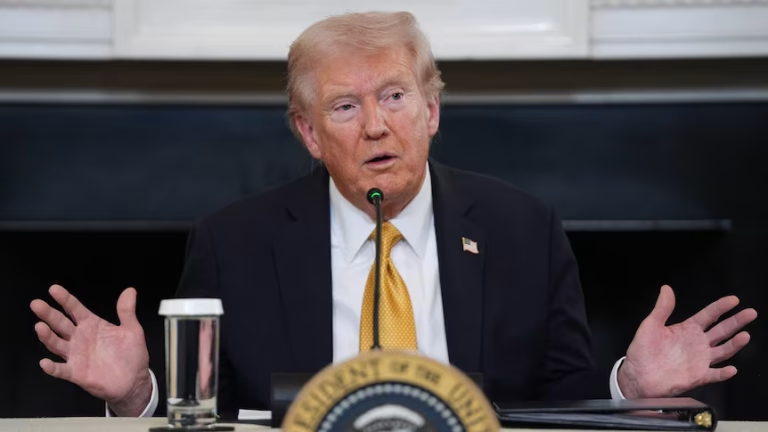
President Donald Trump announced that the United States has suspended all ongoing trade negotiations with Canada, citing what he described as a fraudulent television advertisement featuring former President Ronald Reagan speaking critically about tariffs.

“The Ronald Reagan Foundation has just announced that Canada has fraudulently used an advertisement, which is FAKE, featuring Ronald Reagan speaking negatively about Tariffs,” Trump wrote on his Truth Social platform late on Thursday.

“The ad was for $75,000. They only did this to interfere with the decision of the US Supreme Court, and other courts,” Trump wrote.

“Based on their egregious behavior, ALL TRADE NEGOTIATIONS WITH CANADA ARE HEREBY TERMINATED,” Trump added.

Earlier that day, the Ronald Reagan Presidential Foundation & Institute posted a statement online saying that a television commercial produced by the government of Ontario in Canada “misrepresents the ‘Presidential Radio Address to the Nation on Free and Fair Trade’ dated April 25, 1987.”

The foundation further clarified that Ontario had not been granted authorization “to use and edit the remarks” of the former U.S. president.

It also confirmed that it was “reviewing legal options in this matter” and encouraged the public to view the original, unaltered recording of Reagan’s address.

Ontario’s Premier Doug Ford acknowledged earlier in the week that the ad — which showed Reagan condemning tariffs on imports and warning they could spark trade wars and job losses — had drawn Trump’s attention.

“I heard that the president heard our ad. I’m sure he wasn’t too happy,” Ford said on Tuesday.

In a separate social media post, Ford shared the ad alongside the message: “Using every tool we have, we’ll never stop making the case against American tariffs on Canada. The way to prosperity is by working together,” he said.

Trump’s decision to end the trade talks came shortly after Canadian Prime Minister Mark Carney reiterated his government’s goal to expand exports beyond the U.S. market in response to the economic risks posed by new U.S. tariffs.

Carney also emphasized that Canada would resist granting the U.S. preferential market access if current negotiations failed to reach a fair outcome.

The two countries had been negotiating a potential agreement for several weeks following Trump’s earlier imposition of tariffs on Canadian steel, aluminum, and automobiles — measures that prompted Canada to impose retaliatory duties.

Officials from the Canadian prime minister’s office have not yet issued a public statement in response to Trump’s announcement that all trade discussions have been terminated due to the disputed advertisement.

Currently, more than 75% of Canadian exports are directed to the United States, with an estimated 3.6 billion Canadian dollars ($2.7 billion) worth of goods and services exchanged between both nations each day.