Home Blog Page 374

Pension Assets Surge by N4.26tn in One Year – PenCom

0

Nigeria’s contributory pension assets have experienced a significant growth, rising by N4.26 trillion between October 2023 and October 2024. This represents a 24.14% increase, according to data from the National Pension Commission (PenCom).

As of October 2024, the value of pension assets stood at N21.92 trillion, up from N17.66 trillion in the same period in 2023. The growth is attributed to investments in Federal Government securities, which rose from N11.42 trillion to N13.57 trillion.

Asset Composition Breakdown:

Federal Government Securities:_ N13.57 trillion (up from N11.42 trillion)
Corporate Debt Securities:_ N2.29 trillion
Money Market Instruments:_ N2.20 trillion
Mutual Funds: N106.85 billion (down 5.04% from N112.52 billion)

The number of retirement savings accounts also grew by 394,679 to 10,535,608 over the past year. On a month-on-month basis, pension assets increased by N541 billion, from N21.38 trillion in September to N21.92 trillion in October.

PenCom has lifted its suspension on pension fund administrators investing in commercial papers, following the development of draft rules by the Securities and Exchange Commission. This move aims to facilitate capital raising and ensure market stability

Foreign Investments in Nigerian Telecoms Drops by 87% – NBS

42

Foreign investments in Nigeria’s telecommunications sector witnessed a significant decline in the third quarter of 2024, dropping to $14.4 million, according to the National Bureau of Statistics (NBS). This represents an 87% decline from the $113.42 million recorded in the second quarter.

The NBS data revealed that foreign investments in the sector fell by $99.02 million, signaling a substantial downturn for the industry. Capital importation, which refers to the inflow of foreign funds or investments into Nigeria’s telecommunications sector, has been affected by infrastructure deficits and high operating costs.

In contrast, the first quarter of 2024 saw a significant increase in capital importation, reaching $191.5 million, a 769% increase from $22.05 million in Q1 2023. The second quarter also recorded a substantial inflow of $113.42 million, a 339% increase from $25.81 million in Q2 2023.

However, the third-quarter decline has raised concerns about the sector’s sustainability. The telecommunications industry faces persistent challenges, including foreign exchange difficulties, policy uncertainties, and a pressing need for infrastructure development. High operating costs, fueled by rising inflation, have also affected the sector.

Industry stakeholders, including the Association of Licensed Telecom Operators of Nigeria (ALTON) and the Association of Telecommunication Companies of Nigeria (ATCON), have urged the government to address these challenges. They have warned that inaction could jeopardize the sector’s sustainability and have called for a tariff increase to alleviate the pains of high operating costs.

ALTON Chairman, Gbenga Adebayo, emphasized that “current pricing structures are inadequate and unsustainable. Service providers cannot continue to operate under these conditions, especially when the cost of delivering services is far higher than what is being charged.”

The decline in foreign investments and the sector’s challenges have raised concerns about the future of Nigeria’s telecommunications industry.

Ondo Guber: INEC Ad-hoc Staff Protest Unpaid Allowances

0

Over 17,000 ad-hoc staff who worked for the Independent National Electoral Commission (INEC) during the November 16 governorship election in Ondo State have threatened to stage a protest due to unpaid allowances. These staff members were deployed across the state after undergoing training, with INEC promising to pay them under N20,000 for their services on Election Day.

Speaking with reporters in Akure, the affected workers expressed frustration over the delayed payments, with some criticizing the commission for failing to honor its commitment. One of the workers, who served as a Supervisory Presiding Officer (SPO), voiced disappointment, stating that despite weeks passing since the election, INEC has yet to fulfill its promise. “We are still waiting for our allowances,” the SPO said. “INEC has not communicated with us, and many of us are severely impacted.”

Another ad-hoc staff member appealed to Ondo State Governor Lucky Aiyedatiwa and other stakeholders to intervene and urge INEC to settle the outstanding payments. “If we do not receive our allowances by Tuesday, we are prepared to stage a peaceful protest at the INEC office,” they stated, adding that they felt “used and abandoned” by the commission.

In response, Temitope Akanmu, INEC’s spokesperson in Ondo State, assured the public that payments had begun. She explained that most of the payments had been processed, but some ad-hoc staff were experiencing banking issues that had delayed their disbursements. “We are working closely with the affected staff to resolve these issues,” Akanmu said, emphasizing that the delays were due to typical banking challenges and that all outstanding payments would be made soon.

Court Grants Dele Farotimi N50 Million Bail

0

The Federal High Court in Ado-Ekiti, Ekiti State, has granted human rights lawyer and activist, Dele Farotimi, bail in the sum of N50 million. The court’s ruling was shared by Omoyele Sowore, the presidential candidate for the African Action Congress in the 2023 election, via his X (formerly Twitter) account on Monday.

Sowore revealed that Farotimi had been granted bail with a surety of the same amount, with the requirement that the surety owns landed property. The case was adjourned to January 29, 2025.

In a subsequent tweet, Sowore described the trial as a “farcical” one and stated that it would continue the next day (Tuesday) at the Magistrate Court in Ado-Ekiti, over an alleged offence that does not exist in Ekiti State law. He also called on the Attorney-General of Ekiti to halt the proceedings immediately.

Farotimi’s legal troubles began on December 7, 2024, when he was remanded in prison custody after his arrest on 16 counts of criminal defamation. This follows allegations made by Aare Afe Babalola, a prominent Senior Advocate of Nigeria and founder of Afe Babalola University, in his book Nigeria and Its Criminal Justice System. Babalola claims Farotimi defamed him by accusing him of corruption linked to a Supreme Court ruling in a protracted land dispute.

In his petition to the Ekiti State Commissioner of Police, Babalola alleged that Farotimi’s book falsely portrayed him as having “corrupted the Supreme Court” and led it to commit “egregious acts of injustice.” Farotimi was apprehended by officers from the Lagos State Police Command and transported to Ekiti for trial.

Meanwhile, despite the Ekiti State Police Command issuing a ban on public gatherings and protests for security reasons, the Take It Back (TIB) Movement has vowed to continue with planned protests in Ekiti, Lagos, Abuja, London, and Canada in support of Farotimi. TIB National Coordinator Juwon Sanyaolu condemned the police’s actions, asserting that the force had no legal right to prohibit peaceful protests.

Babalola’s legal team has indicated that Farotimi’s release hinges on his ability to substantiate the defamation claims he made in his book.

Dele Farotimi: What You Should Know About The Human Rights Lawyer

278

Dele Farotimi is a prominent Nigerian human rights lawyer, activist, and advocate for social justice. Known for his unwavering stance on transparency and accountability, Farotimi has actively engaged in national debates on governance, human rights, and socio-political reforms. He has written extensively and appeared in public forums addressing issues of corruption, police brutality, and governance failures in Nigeria.

Early Life and Education

Farotimi’s journey into law and activism is rooted in his passion for justice and equity. While details of his early education and upbringing are not widely publicized, his professional career and advocacy work highlight a commitment to the principles of fairness and the rule of law.

Career and Advocacy

Dele Farotimi

As a lawyer, Farotimi has built a reputation for representing marginalized communities and speaking truth to power. He has been a vocal critic of systemic failures in Nigeria and has actively participated in campaigns to promote human rights and governance reforms. His legal expertise and eloquent public commentary have earned him respect within and outside Nigeria.

Arrest and Defamation Allegations

Afe Babalola and Dele FarotimI

Farotimi’s recent arrest on December 3, 2024, at the Zone 2 Police Command in Lagos has drawn significant public attention. The arrest stemmed from a defamation petition filed by Tony Elumelu, Chairman of the United Bank for Africa (UBA) Group, who alleged that Farotimi made defamatory public statements about him.

Farotimi disclosed that he received a police invitation letter on November 11, 2024, and, accompanied by his legal counsel, reported to the police on November 13. He was presented with the petition and addressed the accusations, describing them as baseless. However, the situation escalated, leading to his formal detention.

The incident sparked outrage among human rights advocates and civil society groups. Omoyele Sowore, a fellow activist, criticized the police for allegedly being used to settle personal disputes and demanded Farotimi’s immediate release. The arrest is seen as part of a broader challenge of using state apparatus to suppress dissent and intimidate critics of influential individuals.

Public Reaction and Implications

Farotimi’s arrest has highlighted the ongoing struggle for free speech and the independence of law enforcement in Nigeria. Many view it as an attempt to silence critical voices, raising concerns about the misuse of police powers to settle personal grievances. Calls for his release and a fair judicial process continue to gain momentum among human rights organizations and concerned citizens.

This unfolding event underscores the need for greater protections for activists and a stronger commitment to upholding human rights in Nigeria.

South Korean President Banned From Leaving Country

0

South Korea’s President Yoon Suk Yeol has been banned from leaving the country on Monday, the justice ministry said, less than a week after briefly imposing martial law which plunged the country into chaos.

On the 3rd of December, Yoon sent special forces and helicopters to parliament before lawmakers quickly rejected his martial law decree, forcing him to rescind it.

Despite narrowly surviving an impeachment vote on Saturday, Yoon continues to face mounting legal challenges.

However, his administration is under scrutiny despite remaining in office, with several high-profile figures, including Yoon’s allies, also facing travel bans and a probe for alleged insurrection.

On Monday, The Ministry of Justice confirmed that Yoon had become the first sitting South Korean president to be banned from leaving the country.

A lawmaker was asked at a parliamentary hearing on Monday whether Yoon had been banned from leaving the country. “Yes, that’s right,” Bae Sang-up, an immigration services commissioner at the ministry, replied.

Also under travel bans for their roles in last week’s events are former defence minister Kim Yong-Hyun – currently in detention—and ex-interior minister Lee Sang-min.

General Park An-su, the officer in charge of the martial law operation, and defence counterintelligence commander Yeo In-hyung are also barred from leaving the country. Investigators hauled Park in for further questioning on Monday.

‘Second coup’

The impeachment push failed to pass after members of Yoon’s own People Power Party (PPP) walked out of parliament, preventing a two-thirds majority. In exchange, Yoon reportedly agreed to transfer power to the prime minister and party chief, but this arrangement has sparked fierce opposition.

“This is an unlawful, unconstitutional act of a second insurrection and a second coup,” Democratic Party floor leader Park Chan-dae said on Monday.

Under South Korea’s constitution, the president serves as both the head of government and the commander-in-chief of the military, unless incapacitated, resigns, or steps down. In such cases, power would temporarily shift to the prime minister until elections are held.

Claiming that Yoon can remain in office but has delegated his powers to the prime minister and leader of his ruling PPP—who is not elected—is “a blatant constitutional violation with no legal basis,” Park said.

“Their attitude of placing themselves above the constitution mirrors that of insurrectionist Yoon Suk Yeol,” he said.

Power vacuum?

Despite the political turmoil, the Defence Ministry confirmed that Yoon continues to oversee South Korea’s military, even as a perceived power vacuum looms in a nation still technically at war with North Korea.

“Legally, (control of military forces) currently lies with the commander in chief,” Defence Ministry spokesperson Jeon Ha-Kyou said.
Yoon has apologised for the “anxiety and inconvenience” caused by his declaration of martial law but has not stepped down, saying instead he would entrust decisions about his fate to his party.

He also accepted responsibility for the martial law debacle.

There is no constitutional basis supporting the ruling party’s claim that Yoon can stay in office but hand over his power to unelected party officials, said Kim Hae-won, a constitutional law professor at Pusan National University Law School.

“It seems to resemble an unconstitutional soft coup,” he said.
“If there are issues with the president, there are ways laid out in the constitution, such as suspending the president from his duties, and then move on to proceedings set out in the constitution, such as impeachment,” he said.

The opposition has vowed to attempt another impeachment vote, with opposition leader Lee Jae-Myung announcing a new vote scheduled for Saturday.

Large crowds are expected to gather once again outside the National Assembly building.
According to a new Gallup poll commissioned by local media, Yoon’s approval rating hit 11%, a historic low for the unpopular president.

FG Denies Fake Ambassadorial Nominees List

0

The Ministry of Foreign Affairs has urged Nigerians to ignore a fraudulent list of ambassadorial nominees that has been circulating on social media.

In a press statement released on Sunday, and signed by its spokesperson, Kimiebi Ebienfa, the ministry clarified that no such appointments have been made and emphasized that the appointment of ambassadors is solely the responsibility of the President.

“The Ministry of Foreign Affairs wishes to inform the general public to kindly disregard the fake list of ambassadorial nominees, which is currently in circulation on some social media platforms.

“The ministry wishes to state unequivocally that the appointment of ambassadors is the prerogative of Mr. President and no such appointments have been made in that regard.

“The purported list should, therefore, be discountenanced,” the statement read.
Nigeria has 109 missions, 76 embassies, 22 high commissions, and 11 consulates globally.

On September 2, 2023, President Bola Tinubu recalled all career and non-career ambassadors operating the country’s diplomatic missions, embassies, and consulates globally.

A statement by Nigeria’s Foreign Affairs Ministry confirmed the recall, saying: “Sequel to the inquiries on the letter recalling the Nigerian ambassador to the UK, the Minister of Foreign Affairs, Ambassador Yusuf Tuggar, has clarified that all career ambassadors and non-career ambassadors have been recalled on the instructions of President Bola Tinubu.”

A statement from the Ministry confirmed the recall, following inquiries about the Nigerian ambassador to the UK. According to the statement, both career and non-career ambassadors were directed to return to Nigeria by October 31, 2023. These envoys were part of the 41 non-career and 42 career ambassadors initially appointed by former President Muhammadu Buhari in July 2020.

The envoys were directed to return to the country on or before October 31. They include the 41 non-career ambassadors and 42 career ambassadors appointed by Former President Muhammadu Buhari in July 2020.

However, despite the recall, no new ambassadors have been appointed or assigned to their respective missions over a year later.

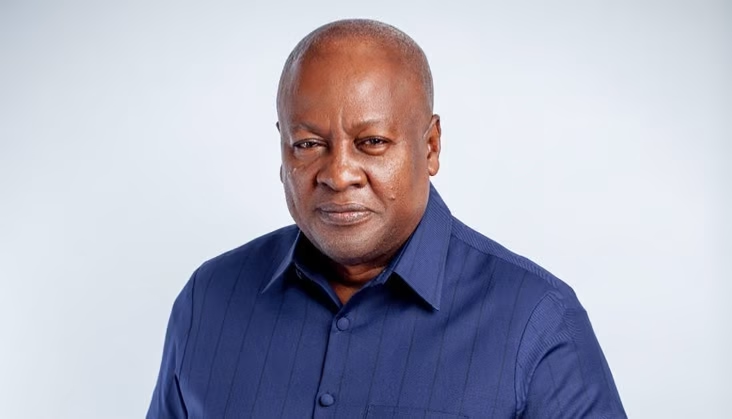
What you need to know about John Dramani Mahama: Ghana’s Former and Incoming President

0

The 2024 presidential election in Ghana has generated attention from across the globe, considering the pedigree of the contesters, especially the major front-runners. Mahama’s contender who is also the Ghana’s Vice President, Muhammadu Bawumia, has since conceded defeat even before the official announcement was made by the country’s Electoral Commission.

As Mahama takes the reigns of power for yet another fresh term, here are things you should know about him.

Who is John Dramani Mahama

John Dramani Mahama was born on November 29, 1958, into a politically active family. His father, Emmanuel Adama Mahama, was a prominent parliamentarian who served as a regional commissioner under Ghana’s first President, Kwame Nkrumah. This early exposure to politics laid the foundation for Mahama’s illustrious career in public service.

Education

Mahama’s academic journey began at Achimota School in Accra and Ghana Secondary School in Tamale for his primary and secondary education, respectively. He pursued higher education at the University of Ghana, earning a bachelor’s degree in History in 1981. He furthered his studies with a postgraduate degree in Communication in 1986. Driven by a thirst for knowledge, Mahama also obtained a postgraduate degree in Social Psychology from the Institute of Social Sciences in Moscow in 1988.

Early Career

After completing his education, Mahama worked as an Information, Culture, and Research Officer at the Japanese Embassy in Accra. In 1995, he joined Plan International’s Ghana office as the Manager of International Relations, Sponsorship, Communication, and Grants. These roles sharpened his leadership and communication skills, preparing him for his foray into politics.

Political Ascent

Mahama entered Ghana’s political landscape in 1996 as a Member of Parliament under the National Democratic Congress (NDC). His tenure in Parliament was marked by dedication and effectiveness, earning him re-election in 2000 and 2004. Between 1998 and 2001, Mahama served as Minister of Communications, showcasing his commitment to national development.

In 2008, Mahama was selected as the running mate to John Evans Atta Mills in the presidential election. Their victory saw him inaugurated as Vice President on January 7, 2009. Following the untimely death of President Mills in 2012, Mahama assumed the presidency and completed the remaining term.

Presidential Tenure

Mahama was elected as Ghana’s President in December 2012, winning 50.7% of the vote against his closest rival, Nana Addo Dankwa Akufo-Addo of the New Patriotic Party (NPP). However, his presidency was not without challenges. Falling global prices on Ghana’s primary exports, rising public debt, and frequent power outages significantly impacted the economy, earning him the unflattering nickname “Mr. Dumsor” (off-on) in reference to the recurrent power cuts.

These economic struggles and public dissatisfaction culminated in his defeat in the 2016 presidential election by Nana Akufo-Addo. Despite the loss, Mahama conceded graciously and handed over power in January 2017.

The Comeback

Unwavering in his political ambitions, Mahama remained active within the NDC and contested the 2020 presidential election but lost to Akufo-Addo. His challenge of the election results in court was dismissed in March 2021. However, Mahama’s persistence paid off when he was once again chosen as the NDC’s flag bearer for the December 2024 presidential election.

Victory in 2024

The 2024 election was closely watched both within Ghana and internationally, given the prominence of the contenders. Mahama’s primary rival was Ghana’s Vice President, Muhammadu Bawumia, who conceded defeat before the Electoral Commission’s official announcement. In his concession speech, Bawumia emphasized the importance of preserving peace and maintaining Ghana’s democratic reputation.

Mahama emerged victorious in a highly competitive race involving 12 other candidates. His victory marked a significant comeback, underscoring his enduring appeal and resilience in Ghanaian politics.

John Dramani Mahama’s political journey is a testament to perseverance and commitment to public service. From his early days in Parliament to his role as President and now President-elect, Mahama’s career has been characterized by determination and a steadfast dedication to Ghana’s development. As he prepares to assume office, Ghanaians and the world will closely watch how he navigates the challenges and opportunities of his new term.

Yuletide: NAFDAC Warns Against Fake Drinks and Unregulated Foods

0

As the holiday season approaches, the National Agency for Food and Drug Administration and Control (NAFDAC) has cautioned Nigerians to avoid counterfeit and adulterated beverages, which are increasingly prevalent during the Yuletide.

The agency’s Director-General, Prof. Moji Adeyeye, issued this advisory during a forum hosted by the News Agency of Nigeria (NAN) in Abuja.

Highlighting the grave dangers posed by counterfeit drinks, food items, and medicines, Adeyeye warned that these fake products can result in severe health complications and, in extreme cases, fatalities.

She strongly discouraged the public from purchasing drugs or other consumables from unregulated sources, such as roadside vendors or hawkers, and advised buying from certified pharmacies and reputable outlets.

“Do not buy medicines from corner stores, kiosks, or hawkers. Always purchase from a certified pharmacy,” she urged.

While acknowledging the financial hardships faced by many Nigerians, the NAFDAC DG emphasized that the potential health risks of consuming unregulated products outweigh the short-term cost savings.

“It might be more expensive to buy from a certified pharmacy, but it is safer. Cheap, counterfeit medicines or drinks can harm your health or even result in death,” she said.

Prof. Adeyeye also noted that the festive season often sees a surge in the circulation of falsified drinks, calling for heightened vigilance.

“Drinks are among the most counterfeited products during festive seasons. Nigerians must be extra cautious,” she added.

To safeguard health, NAFDAC advised consumers to verify the agency’s registration number and expiry date on products before purchase. She further encouraged the public to avoid items that appear suspicious or lack proper labeling.

Warning to Bakeries

NAFDAC also addressed concerns over the use of harmful additives in bread production, cautioning bakeries nationwide against using saccharin and bromate. The agency warned that violators would face severe penalties.

“This is where our post-marketing surveillance becomes crucial. We routinely inspect products and respond to complaints received through our reform office.

“We have shut down several bakeries found using bromate in their production processes,” Adeyeye disclosed.

She stressed that any facility engaged in substandard production practices or operating in unhygienic conditions would be shut down immediately.

“We have closed down numerous water production facilities for failing to meet hygiene and quality standards.

“Our Regulatory Inspection Directorate plays a vital role in ensuring that the products approved at registration maintain the same quality in the market,” she explained.

NAFDAC’s post-marketing surveillance aims to ensure consistency in production standards and uphold consumer safety. Prof. Adeyeye reiterated that deviations from approved processes would not be tolerated, adding that the agency remains committed to protecting public health during and beyond the festive season.

NBSA Urges For More Blood Donations As Nigeria Faces Shortage

0

The National Blood Service Agency (NBSA) has sounded the alarm over Nigeria’s severe blood supply shortage. Less than 30% of the country’s blood needs are currently being met, according to the agency’s Director General, Prof. Saleh Yuguda, during the third National Blood Donor Day celebration at the Family Worship Centre in Abuja.

The event aimed to encourage voluntary blood donation, honor local donors, and engage religious leaders in mobilizing community support for a culture of giving blood. Prof. Yuguda emphasized the urgency of the situation, stating:

“Blood is a very scarce commodity in our society. The World Health Organisation estimates that we can only meet less than 30% of our blood needs in Nigeria. This shortage largely stems from the reluctance of healthy individuals to donate blood.”

He highlighted the life-saving potential of blood donation, noting that a single pint can save up to three lives. Many deaths resulting from road traffic accidents, he said, could be prevented with adequate blood supply.

Yuguda appealed to Nigerians, especially faith-based organizations, to support the cause:

“Community engagement is key to achieving self-sufficiency in blood supply. We call on religious bodies to encourage their congregations to donate blood freely.”

Speaking on behalf of the Senior Pastor of the Family Worship Centre, Serah Omakwu, Pastor Wilson Akubo also underscored the role of religious leaders in this mission. He urged faith communities to champion the life-saving cause, saying:

“For the past 20 years, we have actively supported blood donation. I implore churches, pastors, and imams to inspire their members to donate blood willingly. It is a service to God and humanity.”

The World Health Organisation (WHO) stresses the importance of blood transfusion in saving lives and improving health. However, the disparity in blood availability between low- and high-income countries highlights the need for urgent action in Nigeria.

Nigerians are encouraged to embrace voluntary blood donation as a way to save lives and address the country’s critical blood shortage.