Home Blog Page 99

Mexico Defeats Ghana As World Cup Cohosts Excel Despite FIFA Sanctions

Mexico defeated Ghana 2-0 in a World Cup warm-up match in Puebla as the 2026 FIFA World Cup co-hosts continued preparations despite FIFA sanctions affecting attendance at the stadium.

Goals from Brian Gutiérrez and Guillermo Martínez secured the win for Mexico in front of a reduced crowd at Puebla’s Cuauhtémoc Stadium. FIFA had ordered partial stadium closures because of discriminatory chants by Mexican fans during previous international matches.

The Mexican Football Federation said sections of the stadium were shut in compliance with FIFA disciplinary measures tied to repeated homophobic chants directed at opposing goalkeepers. The federation has launched an anti-discrimination campaign called “Wave yes, chant no” ahead of the World Cup.

Despite the restrictions, the match was viewed as another positive sign for the North American co-hosts less than three weeks before the expanded 48-team tournament begins in the United States, Mexico, and Canada.

Mexico coach Javier Aguirre used the game to assess players competing for final World Cup roster spots, including younger talents and returning Europe-based internationals.

For Ghana, the defeat added to concerns about form and defensive weaknesses heading into the tournament. Reports note the Black Stars have conceded heavily in recent warm-up matches against strong opposition.

Are India And Pakistan Quietly Preparing To Restart Dialogue?

Earlier this month, as Indian television channels and government leaders were celebrating the anniversary of the war against Pakistan in May 2025, one of the most influential ideologues of the political movement that Prime Minister Narendra Modi leads struck a discordant note.

In an interview with an Indian news agency, Dattatreya Hosabale, general secretary of the Rashtriya Swayamsevak Sangh (RSS) – the mothership of the Hindu majoritarian philosophy of Hindutva that guides Modi’s Bharatiya Janata Party –  said New Delhi should explore dialogue with Pakistan.

“We should not close the doors. We should always be ready to engage in dialogue,” he said.

His comments instantly stirred up a political storm in India, with the opposition questioning the RSS position and pointing out how it was in stark contrast to Modi’s.

Indeed, Modi and his government have repeatedly said “terror and talks can’t go together”, arguing against any dialogue with Pakistan, which India accuses of sponsoring and arming fighters that have attacked Indian-administered Kashmir and Indian cities for decades. The four-day 2025 war – which Pakistan and India both insist they “won” – followed an attack by gunmen in the resort town of Pahalgam in Indian-administered Kashmir in which 26 tourists were killed.

Pakistan welcomed Hosabale’s comments, with Foreign Ministry spokesperson Tahir Andrabi saying Islamabad would wait to see whether there was “an official reaction” from India to calls for talks.

More than a week later, the Modi government is yet to formally respond to Hosabale’s call for dialogue, but other prominent voices in India have backed the RSS leader, leading to suggestions that New Delhi might be preparing the ground to restart formal engagement with Pakistan.

Analysts say, however, that while there’s a growing rationale for the neighbours to re-engage diplomatically, and that they have already quietly taken baby steps in this direction, resurrecting a full-fledged dialogue will not be easy.

Coal Mine Explosion In China Kills 90 People, State Media Says

At least 90 people have been killed after a gas explosion tore through a coal mine in northern China’s Shanxi province, according to Chinese state media. The blast happened at the Liushenyu coal mine in Qinyuan county while 247 workers were underground.

Officials said rescue teams managed to bring most miners to the surface, but several people remain missing and more than 100 workers have been hospitalized, many suffering from toxic gas inhalation. Carbon monoxide levels inside the mine reportedly exceeded safety limits.

The disaster is being described as China’s deadliest mining accident in more than 16 years. President Xi Jinping ordered “all-out” rescue operations and demanded a full investigation into the cause of the explosion. Authorities have reportedly detained executives connected to the mine operator.

The Liushenyu mine, operated by Shanxi Tongzhou Group, had previously appeared on official lists of high-risk mines because of elevated gas levels. The tragedy has renewed scrutiny of industrial safety standards in China’s coal sector, which remains one of the world’s largest despite years of efforts to reduce mining accidents.

Wang Yong, an injured miner, told state media that when the incident happened, he did not hear a sound but saw a sudden plume of smoke.

“I smelled sulphur, the same smell you get from blasting. I shouted at people to run. As we were running I could see people collapsing from the fumes. Then I blacked out too,” he said.

“I lay there for about an hour or so before I came round on my own. I woke up the person next to me and we got out together.”

Some of the management team at the mine have reportedly been detained. The cause of the gas explosion has not yet been revealed, but state media reported that the levels of carbon monoxide – a highly toxic, odourless gas – in the mine were found to have “exceeded limits”.

China’s Ministry of Emergency Management has sent 345 personnel from six rescue teams to help with the operation.

Putin Vows Retaliation After Accusing Ukraine Of Hitting Student Dormitory

Russian President Vladimir Putin has vowed retaliation after accusing Ukraine of carrying out a drone strike on a student dormitory in the Russian-controlled city of Starobilsk in the Luhansk region. Russian officials said at least six people were killed, dozens injured, and several others remain missing.

According to Moscow, the attack struck a dormitory connected to a pedagogical university where teenagers aged 14 to 18 were staying. Putin described the strike as a “terrorist attack” and said there were no military facilities nearby, insisting the building was deliberately targeted. He said he had ordered Russia’s military to prepare response options.

Ukraine denied intentionally targeting civilians. Ukrainian military officials said the strike targeted a Russian drone command unit in the area and accused Moscow of manipulating the incident for propaganda purposes.

Ukraine’s military said it hit the headquarters of Russia’s elite Rubicon drone military unit in Starobilsk. It did not say whether it was the same building as the one identified by Russia.

“There are no military facilities, intelligence service facilities, or related services in the vicinity,” Putin said in Moscow.

“Therefore, there is absolutely no basis for claiming that the munitions struck the building as a result of our air defence or electronic warfare systems,” he said at a reception in his Kremlin residence on Friday.

He ordered the Russian military to prepare its “proposals” on how to retaliate.

The Russian leader said the Ukrainian strike had been carried out in three waves using 16 drones.

Russia’s state-run TV showed what it said was one of the injured students, identifying her as Diana Shovkun, aged 19.

She had head injuries after a being hit by a collapsing concrete slab, the TV said report said.

No photos or videos of those who Moscow says were killed were shown.

Later on Friday, Ukraine’s military said its overnight strike targeted Rubikon’s headquarters in Starobilsk. It accused fighters from the special drone unit of regularly striking civilians and civilian infrastructure in Ukraine.

The statement also said that Ukrainian forces “are causing damage to military infrastructure and facilities used for military purposes, strictly adhering to the norms of international humanitarian law, laws and customs of war”.

Trump To Send Additional 5000 Troops To Poland

Trump, in a Truth Social post, cited his relationship with Poland’s conservative nationalist president, Karol Nawrocki, as the reason behind his decision ​to send additional troops.

NATO Secretary-General Mark Rutte has welcomed the United States’ decision to send an additional 5,000 troops to Poland, calling it an important reinforcement of NATO’s eastern flank amid continuing security concerns linked to Russia.

The announcement came after U.S. President Donald Trump said Washington would deploy the troops following talks with Polish President Karol Nawrocki. Around 10,000 American troops are already stationed in Poland.

Rutte said NATO military commanders were working through operational details ahead of a meeting of alliance foreign ministers in Sweden. The move is seen as strengthening NATO’s defenses near the alliance’s border with Russia and Belarus.

The decision follows confusion earlier this week after reports that the Pentagon had delayed or reconsidered some troop deployments in Europe as part of a broader review of U.S. military commitments abroad. Several NATO allies had expressed concern about possible reductions in American forces on the continent.

The White House has signalled in recent weeks that it intends to reduce its overall troop levels in Europe as part of its “America First” agenda.

Rubio is expected to call for increased burden sharing from Washington’s Nato partners at Friday’s talks in Helsingborg.

Speaking to reporters on Friday morning, he said: “The president’s views are frankly disappointment at some of our Nato allies and their response to our operations in the Middle East.

“In the meantime there are other areas where we continue with cooperation,” he added – citing the Poland announcement.

“That said obviously the United States continues to have global commitments that it needs to meet in terms of our force deployment and that constantly requires us to re-examine where we put troops – this is not a punitive thing.”

Ahead of the meeting, the BBC asked Rubio about unconfirmed reports the US could shrink its total troop numbers available in the event of an attack on a Nato country.

He said “some of those issues” will be discussed at the summit, adding Trump remained very upset and disappointed with Nato allies.

Ebola Hospital Tents On Fire in DR Congo

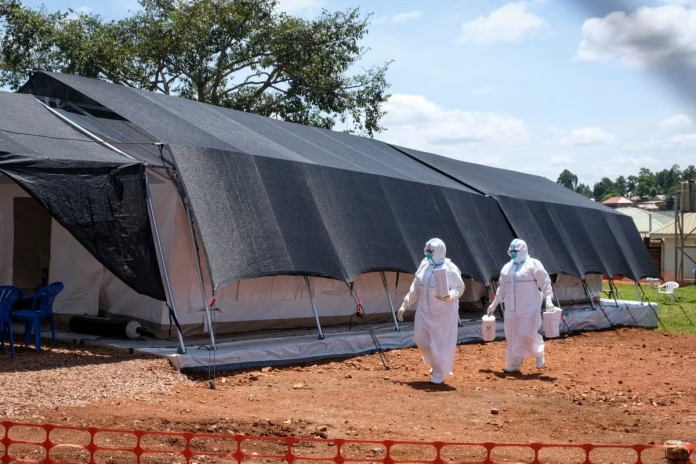
An Ebola treatment center in eastern Democratic Republic of the Congo was set on fire by angry residents amid growing tensions over the handling of Ebola victims’ bodies during the country’s latest outbreak.

The violence happened in Rwampara, near Bunia in Ituri province, where protesters stormed and burned tents used for Ebola isolation and treatment after authorities refused to release the body of a local man for a traditional burial. Health officials suspected the man had died from Ebola, but relatives disputed the diagnosis.

The man who died was a popular figure in the local community and those upset by his death did not “grasp the reality of the disease,” Jean Claude Mukendi, who is co-ordinating the security response to Ebola in Ituri, told the Associated Press.

Witnesses told Reuters the young man was a footballer who had played with several local teams. His mother told the news agency she believed her son had died of typhoid fever, not Ebola.

Witnesses said police fired warning shots and tear gas as crowds clashed with security forces. Some aid workers fled the facility while treatment tents and at least one stored body were reportedly destroyed in the fire.

Malembe said the crowd did not believe the virus, which has so far killed more than 130 in eastern DR Congo, was real.

“People are not properly informed or sensitised about what is happening. For a certain segment of the population, especially in remote areas, Ebola is an invention by outsiders – it does not exist,” the politician said.

“They believe it is the NGOs and hospitals creating this to make money, and this is tragic.”

He said two tents had been burned down, along with a body that had been due to be buried.

The unrest highlights deep mistrust toward Ebola response teams and the difficulty of enforcing strict burial protocols in areas where traditional funeral practices are culturally important. Aid agencies say misinformation and fear are complicating efforts to contain the outbreak.

The current outbreak involves the Bundibugyo strain of Ebola, for which there is no widely approved vaccine or treatment. The World Health Organization has warned that the outbreak may be significantly larger than official figures suggest. Reports indicate hundreds of suspected cases and more than 100 deaths across eastern Congo, with cases also reported in neighboring Uganda.

Mexico Cuts Interest Rates Amid War Fears Driven By US-Israel Conflict

Mexico’s central bank, Banco de México (Banxico), has continued cutting interest rates as policymakers try to support a weakening economy while navigating inflation risks linked to escalating Middle East tensions involving the U.S., Israel, and Iran.

Banxico lowered its benchmark interest rate to 6.5% earlier this month, citing slowing economic activity and softer inflation pressures inside Mexico. However, officials also warned that geopolitical instability and energy-price shocks remain major risks to the outlook.

The broader concern is that prolonged conflict in the Middle East could drive oil prices sharply higher, fueling global inflation and disrupting growth. Analysts say countries like Mexico face a difficult balancing act: stimulate domestic growth with lower borrowing costs while avoiding renewed inflation caused by higher fuel and import prices.

Financial markets worldwide have reacted nervously to the regional conflict. Central banks in several countries have either paused planned rate cuts or warned that energy-driven inflation could force tighter policy again.

Mexico’s economy has shown signs of weakness in recent months, and Banxico indicated that reduced consumer demand and slower growth helped justify the rate cuts despite ongoing global uncertainty.

Minutes from the Bank of Mexico’s May meeting showed a 3-2 decision, with policymakers warning the conflict is pushing up inflation risks.

All five members flagged the war as a source of upward pressure on prices, though most said the direct impact on Mexico remains limited.

Officials pointed to government fuel price controls as a key buffer against rising energy costs linked to the conflict.

Air France, Airbus Found Guilty Of Manslaughter Over 2009 Plane Crash

A French appeals court has found Air France and Airbus guilty of corporate manslaughter over the 2009 crash of Air France Flight 447 crash, which killed all 228 people on board.

The Airbus A330 aircraft was flying from Rio de Janeiro to Paris when it crashed into the Atlantic Ocean during a storm on June 1, 2009. Investigators later concluded that iced-over Pitot tube sensors caused faulty speed readings, contributing to pilot confusion and a fatal aerodynamic stall.

The Paris Court of Appeal ruled on Thursday that both companies were “solely and entirely responsible for the crash of flight AF447”, and ordered a payment of 225,000 euros ($261,720) for each passenger, the maximum fine possible for corporate manslaughter.

Prosecutors argued that Airbus underestimated known risks linked to the airspeed sensors, while Air France failed to provide adequate pilot training for handling such emergencies. Victims’ relatives described the verdict as an important acknowledgment of responsibility, even though the fines are relatively small for companies of that size.

Although the penalties are largely symbolic, they capped an eight-week trial that victims’ families saw as a last chance to find justice two years after a lower court acquitted Airbus and Air France.

Both companies have repeatedly denied all charges.

Following the ruling, Airbus said it would appeal to France’s highest court, saying the latest finding contradicted submissions from prosecutors and the 2023 acquittal.

Prosecutors previously warned that an appeal was likely and denounced the companies’ behaviour throughout the decade-plus legal process.

“Nothing has come of it – not a single word of sincere comfort,” said prosecutor Rodolphe Juy-Birmann as the trial was under way last November. “One word sums up this whole circus: indecency.”

The crash led to a complex recovery operation in a remote part of the Atlantic Ocean, more than 700 miles (1127km) from the coast of South America.

During the initial searches, the French government had been responsible for investigating the crash and Brazilian forces took charge of retrieving the bodies.

In the first 26 days of searches, 51 bodies were recovered, many still buckled into their seats.

One family member who spoke to BBC News Brasil in 2019 said he had only been able to bury his son’s remains over two years after the incident.

His son, 40-year-old engineer Nelson Marinho Filho, nearly missed the flight out of Rio de Janeiro’s Galeão International Airport and was the last person to board, according to Air France staff.

The passengers came from 33 different countries, including 61 French nationals, 58 Brazilians, 26 Germans, two Americans, five Britons and three Irish nationals.

One of the Britons was 11-year-old Alexander Bjoroy from Bristol, who had been returning to the UK via France after spending half-term in Brazil.

Three Irish women – Eithne Walls from County Down, Jane Deasy from County Dublin, and Aisling Butler from Co Tipperary – were also among those killed.

All three were doctors and were returning home from a holiday in Brazil.

Brazilian prince Pedro Luiz de Orleans e Bragança also died in the crash at the age of 26.

Out of the 216 passengers, there were 126 men, 82 women, 7 children and one infant on board.

The 12 members of flight crew were mainly from France, with the exception of one Brazilian.

Israeli Strikes Continue In Lebanon As Regional Tensions Persist

Israeli airstrikes in southern Lebanon have continued despite ongoing ceasefire negotiations, underscoring how fragile the situation remains across the region. Recent strikes reportedly hit areas near Tyre, Baalbek, and several villages in southern Lebanon, while Hezbollah said it responded with rockets, drones, and missile attacks targeting Israeli forces.

Israel said it had killed the Hamas military chief, Izz al-Din al-Haddad, in a targeted strike in Gaza on Friday.

Al-Haddad was described by Israel’s army as one of the senior Hamas military commanders who directed the planning and execution of the Hamas-led attacks on 7 October 2023, which killed about 1,200 people in southern Israel and saw more than 250 taken hostage. A Hamas spokesperson, Hazem Qassem, confirmed the killing on social media.

A U.S.-brokered ceasefire extension between Israel and Lebanon was announced earlier this month, extending the truce by 45 days to allow further talks. However, both sides have accused each other of violations, and clashes have continued almost daily.

Lebanon’s health ministry says the death toll from the renewed fighting has surpassed 3,000 people, with thousands more injured and large-scale displacement continuing in southern parts of the country.

In a further sign that the region could be on the brink of a possible return to full-scale war, reports in the US and Israeli press said Donald Trump had been briefed on his military options in Iran, should he decide to break a five-week-old truce and resume strikes in the hope of forcing concessions at the negotiating table.

Lebanon’s state-run media reported that at least five villages in the south of the country had been hit by strikes, and the Israeli military confirmed on Saturday that it was targeting what it said was “Hezbollah infrastructure” in southern Lebanon.

Lebanese authorities said that an airstrike on Friday had hit a clinic run by the Hezbollah-linked Islamic Health Committee, killing six people, three of them paramedics. An Israeli military statement said it had killed Hezbollah militants preparing to fire rockets at its troops in southern Lebanon.

Al-Haddad’s family confirmed his death in Friday’s strike to the Associated Press. Six other people, including his wife and daughter, were also killed, according to reports. His two sons were killed earlier in the war.

His body was wrapped in Hamas and Palestinian flags as it was carried by mourners at Saturday’s funeral in Gaza City.

Al-Haddad joined Hamas when it was established in the 1980s, and was a member of the Qassam Brigades’ Majd section tasked to go after collaborators with Israel. He was also a member of Hamas’ Military Council, the highest group of commanders that played a key role in the attacks that sparked the war.

Israel’s army chief of staff called his killing a significant operation, and said that Israel would continue pursuing its enemies to hold them accountable.

US Indicts Cuba’s Raul Castro Over 1996 Plane Shootdown

United States federal prosecutors have indicted Cuba’s former President Raul Castro in connection with the 1996 downing of planes operated by the Miami-based exile group Brothers to the Rescue.

The indictment, unsealed on Wednesday, marks one of the sharpest escalations in tensions between Washington and Havana in years.

The US Department of Justice alleges that Castro, Cuba’s defence minister at the time, played a leading role in the decision to have Cuban fighter jets shoot down two civilian aircraft on February 24, 1996.

It has charged Castro with one count of conspiracy to kill US nationals, four counts of murder and two counts of destroying an aircraft. Five co-defendants were also named in the indictment.

Four people were killed in the 1996 attack, which triggered international condemnation and deepened the strains between the US and Cuba.

“ For nearly 30 years, the families of four murdered Americans have waited for justice,” acting Attorney General Todd Blanche said as he announced the charges at Miami’s Freedom Tower.

“ My message today is clear: The United States and President Trump does not and will not forget its citizens.”

He described the four men who were killed — Carlos Costa, Armando Alejandre Jr, Mario de la Pena, and Pablo Morales —  as “unarmed civilians” engaged in “humanitarian missions for the rescue and protection of people fleeing oppression across the Florida Straits”.

“Nations and their leaders cannot be permitted to target Americans, kill them, and not face accountability,” Blanche added. “If you kill Americans, we will pursue you, no matter who you are, no matter what title you hold, and in this case, no matter how much time has passed.”

The US has issued sanctions on the country and imposed a blockade on oil to Cuba that has resulted in blackouts and food shortages.

Earlier on Wednesday, US Secretary of State Marco Rubio issued a message to the Cuban people timed to the country’s independence day.

“President Trump is offering a new path between the US and a new Cuba,” Rubio said.

Rubio told citizens of the island that a Cuban military run conglomerate known as GAESA is primarily responsible for the blackouts and food shortages that the country continues to endure.

GAESA owns or operates most of the lucrative parts of the Cuban economy from the ports to the petrol pumps to five-star hotels.

In response to Rubio’s message, Díaz-Canel accused the US of lying and imposing a collective punishment on the Cuban people.

Díaz-Canel also said that the indictment of Castro was being used to “justify the folly of a military aggression against Cuba” and accused the US of distorting the facts around the downing of the plane.

He claimed that Cuba acted in “legitimate self-defence within its jurisdictional waters”.

Orlando Perez, a political science professor at the University of North Texas at Dallas, mentioned that the timing of the indictment appears linked to a broader US pressure campaign against Havana.

“I think it’s important to look at the sequence of recent events,” Perez said.

He pointed to a visit last week from the director of the US Central Intelligence Agency (CIA), John Ratcliffe, to Havana.

That meeting came as part of ongoing negotiations between the island’s communist government and the administration of US President Donald Trump, which has pushed for leadership change in Cuba.

There were also reports this month alleging Cuba had explored drone and asymmetric warfare capabilities, as Trump increases his pressure campaign against the island.